
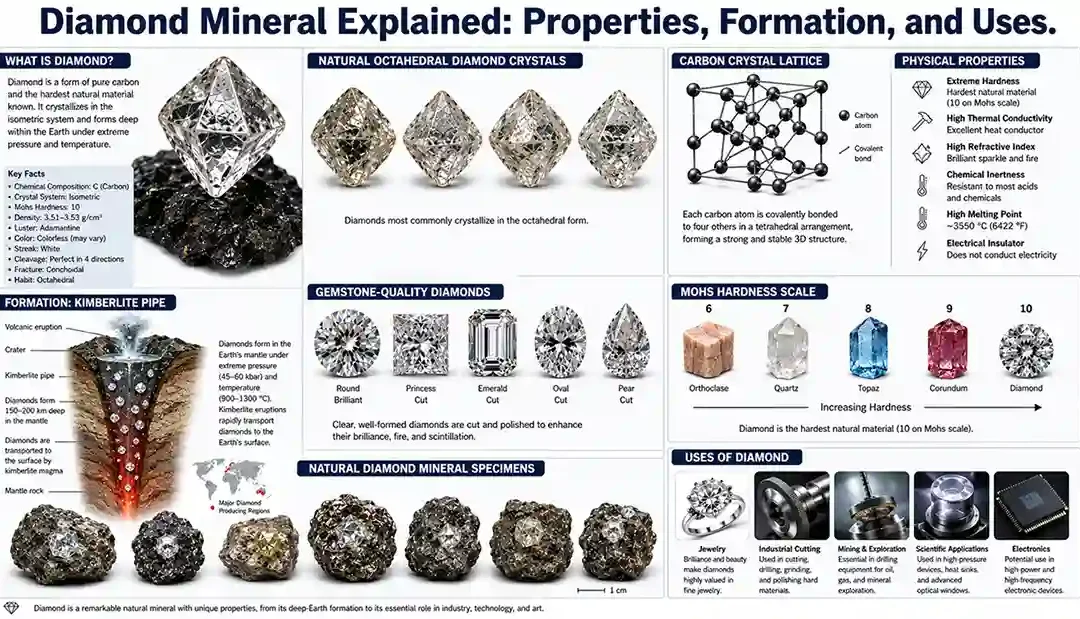
Diamond is one of the most famous minerals in the world and is renowned for being the hardest naturally occurring substance on Earth. Composed entirely of carbon, diamond is valued as both a precious gemstone and an important industrial material.
Diamonds form deep within Earth's mantle under extreme pressure and temperature conditions before being transported to the surface by volcanic eruptions.
Diamond is important because it:
- is the hardest known natural mineral
- has exceptional brilliance
- conducts heat efficiently
- is widely used in industry
- provides insights into Earth's deep interior
Learn more → what is a mineral
What Is Diamond?
Diamond is a native carbon mineral. Its chemical formula is . Like graphite, diamond consists entirely of carbon. However, its crystal structure is completely different, producing dramatically different physical properties. Diamond belongs to the native element mineral group
Basic Properties of Diamond
| Property | Value |
|---|---|
| Chemical Formula | C |
| Mineral Group | Native Element |
| Crystal System | Isometric |
| Hardness | 10 |
| Streak | Colorless |
| Luster | Adamantine |
Why Is Diamond So Hard?
Diamond's hardness comes from strong three-dimensional carbon bonding. Each carbon atom is bonded tightly to four neighboring carbon atoms.
This creates:
- exceptional hardness
- high durability
- strong resistance to scratching
Diamond sits at the top of the Mohs Hardness Scale.
Learn more → hardness of minerals
Diamond and the Mohs Hardness Scale
Diamond defines hardness 10 on the Mohs Scale
The hardness relationship is:
Diamond can scratch all other natural minerals. No naturally occurring mineral can scratch diamond under normal conditions.
Learn more → Mohs hardness scale
Crystal Structure of Diamond
Diamond contains:
- carbon atoms
- tetrahedral bonding
- strong atomic connections
Its crystal structure is responsible for:
- hardness
- brilliance
- thermal conductivity
- durability
This structure differs completely from graphite despite both minerals having the same chemical composition.
Learn more → crystal structure in minerals
Crystal System of Diamond
Diamond belongs to the Isometric (Cubic) Crystal System. Its crystallographic relationship is . Common crystal forms include:
- octahedrons
- cubes
- dodecahedrons
Learn more → isometric crystal system
Physical Properties of Diamond
| Property | Description |
|---|---|
| Color | Colorless to various colors |
| Streak | Colorless |
| Luster | Adamantine |
| Hardness | 10 |
| Cleavage | Perfect |
| Transparency | Transparent to opaque |
| Specific Gravity | ~3.5 |
How Diamonds Form
Diamonds form deep within Earth's mantle.
Extreme Pressure
High pressure stabilizes diamond formation.
High Temperature
Temperatures exceed 900°C in many diamond-forming environments.
Mantle Depths
Most diamonds form at depths greater than 140 kilometers.
Volcanic Transport
Kimberlite and lamproite eruptions bring diamonds to the surface.
Diamond vs Graphite
Although both minerals are made of carbon, their properties differ dramatically.
| Property | Diamond | Graphite |
|---|---|---|
| Formula | C | C |
| Hardness | 10 | 1–2 |
| Crystal System | Isometric | Hexagonal |
| Conductivity | Poor Electrical | Excellent Electrical |
| Appearance | Transparent | Gray-Black |
This demonstrates how crystal structure controls mineral properties.
Learn more → graphite mineral explained
Diamond Colors
Although colorless diamonds are most famous, diamonds can occur in many colors.
Colorless Diamonds
Most valued for jewelry.
Yellow Diamonds
Contain nitrogen impurities.
Blue Diamonds
Contain boron.
Pink Diamonds
Result from crystal deformation.
Green Diamonds
Caused by natural radiation exposure.
Common Diamond Colors
| Variety | Color |
|---|---|
| Classic Diamond | Colorless |
| Canary Diamond | Yellow |
| Blue Diamond | Blue |
| Pink Diamond | Pink |
| Green Diamond | Green |
Industrial Uses of Diamond
Jewelry
Most famous gemstone application.
Cutting Tools
Used to cut hard materials.
Drilling Equipment
Essential in mining and exploration.
Polishing Materials
Used for grinding and polishing.
Electronics
Used in specialized high-performance technologies.
Major Uses of Diamond
| Industry | Application |
|---|---|
| Jewelry | Gemstones |
| Mining | Drill bits |
| Manufacturing | Cutting tools |
| Polishing | Abrasives |
| Technology | Specialized electronics |
Diamond in Mineral Identification
Geologists identify diamond using:
- extreme hardness
- adamantine luster
- high brilliance
- octahedral crystals
- high thermal conductivity
Its hardness remains its most distinctive feature.
Learn more → mineral identification guide
Diamond Identification Summary
| Property | Diamond |
|---|---|
| Formula | C |
| Hardness | 10 |
| Crystal System | Isometric |
| Luster | Adamantine |
| Cleavage | Perfect |
| Mineral Group | Native Element |
Diamond is composed entirely of carbon atoms.
Its carbon atoms are bonded in a strong three-dimensional crystal lattice.
Diamond belongs to the isometric (cubic) crystal system.
Most diamonds form deep within Earth's mantle under extreme pressure and temperature.
Yes. Diamond is the hardest naturally occurring mineral and defines hardness level 10 on the Mohs Scale.
Final Thoughts
Diamond is one of the most extraordinary minerals on Earth. Its unmatched hardness, brilliant appearance, and deep-mantle origin make it important in both geology and industry. From precious gemstones to industrial cutting tools, diamond demonstrates how crystal structure can dramatically influence mineral properties.
Understanding diamond also provides valuable insights into Earth's mantle, volcanic processes, and the remarkable diversity of carbon minerals.