
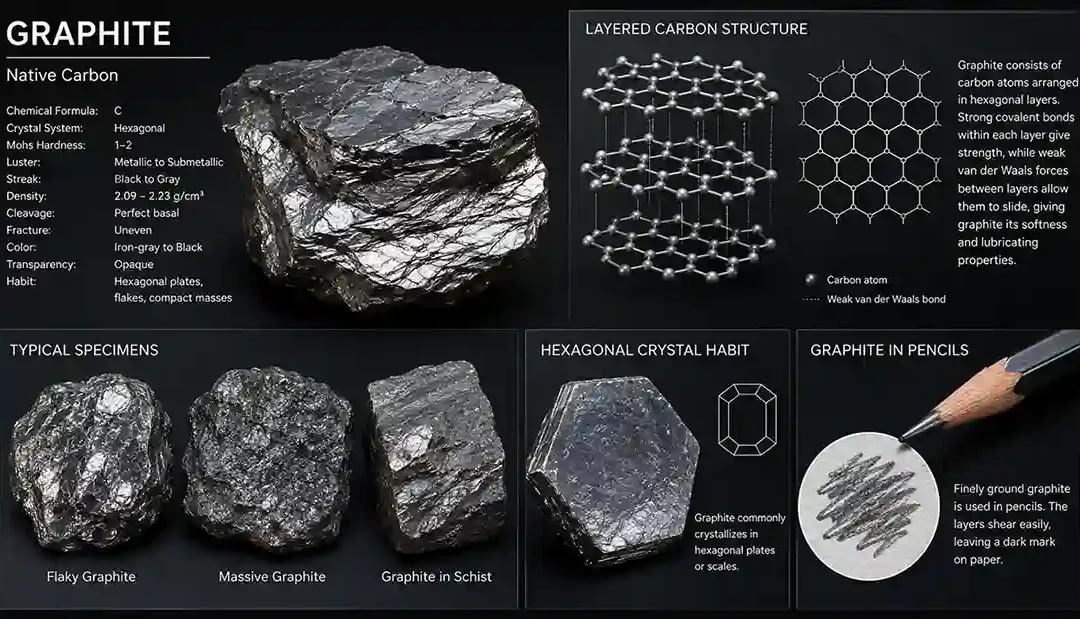
Graphite is a naturally occurring mineral composed entirely of carbon. It is one of the few minerals classified as a native element and is well known for its soft texture, metallic appearance, and excellent electrical conductivity.
Graphite is widely used in modern technology and industry, from pencils and lubricants to lithium-ion batteries and electric vehicles.
Because graphite and diamond are both made of carbon, they are considered polymorphs—minerals with the same chemical composition but different crystal structures.
Graphite is one of the most important industrial minerals in the modern world.
Learn more → what is a mineral
What Is Graphite?
Graphite is a native carbon mineral. Its chemical formula is C. Graphite consists entirely of carbon atoms arranged in layered sheets. It belongs to the native element mineral group alongside minerals such as sulfur, gold, silver, and copper.
Basic Properties of Graphite
| Property | Value |
|---|---|
| Chemical Formula | C |
| Mineral Group | Native Element |
| Crystal System | Hexagonal |
| Hardness | 1–2 |
| Streak | Black |
| Luster | Metallic to Earthy |
| Color | Gray to Black |
Why Is Graphite Soft?
Graphite's softness comes from layered carbon structure. Carbon atoms form strong bonds within each layer but weak bonds between layers.
As a result:
- layers slide easily
- graphite feels slippery
- graphite leaves marks on paper
This property explains why graphite is used in pencils and lubricants.
Crystal Structure of Graphite
Graphite consists of:
- hexagonal carbon rings
- layered atomic sheets
- strong internal bonds
Its unique structure produces:
- electrical conductivity
- softness
- thermal conductivity
- lubricating properties
Learn more → crystal structure in minerals
Crystal System of Graphite
Graphite belongs to the hexagonal crystal system. Its crystallographic relationship is .
Most graphite occurs as:
- flakes
- masses
- foliated aggregates
Well-formed crystals are relatively uncommon.
Learn more → hexagonal crystal system
Physical Properties of Graphite
| Property | Description |
|---|---|
| Color | Gray to black |
| Streak | Black |
| Luster | Metallic to dull |
| Hardness | 1–2 |
| Cleavage | Perfect basal |
| Conductivity | Excellent |
| Specific Gravity | ~2.2 |
Graphite vs Diamond
Both graphite and diamond consist entirely of carbon.
However, their crystal structures are very different.
| Property | Graphite | Diamond |
|---|---|---|
| Formula | C | C |
| Hardness | 1–2 | 10 |
| Crystal System | Hexagonal | Isometric |
| Conductivity | Excellent | Poor |
| Appearance | Gray-Black | Transparent |
This demonstrates how crystal structure controls mineral properties.
Learn more → crystal structure in minerals
How Graphite Forms
Graphite commonly forms through:
Metamorphism
Organic-rich sediments transform into graphite under heat and pressure.
Igneous Processes
Small amounts may crystallize from magma.
Hydrothermal Activity
Carbon-rich fluids can deposit graphite.
Most economic graphite deposits are metamorphic in origin.
Graphite in Metamorphic Rocks
Graphite is often found in:
- schist
- gneiss
- marble
- quartzite
It commonly forms from carbon-rich organic material that has undergone metamorphism.
Graphite and Electrical Conductivity
Graphite is unusual because it is an excellent electrical conductor. Electrons move easily through its layered structure.
This property makes graphite important in:
- batteries
- electrodes
- electronics
- industrial equipment
Graphite in Modern Batteries
Graphite is a key component in:
Lithium-Ion Batteries
Used in:
- smartphones
- laptops
- electric vehicles
- renewable energy storage systems
Modern battery demand has greatly increased the importance of graphite mining.
Major Uses of Graphite
| Industry | Application |
|---|---|
| Batteries | Lithium-ion batteries |
| Writing | Pencil cores |
| Metallurgy | Refractory materials |
| Electronics | Electrodes |
| Lubrication | Dry lubricants |
Graphite in Pencils
One of graphite's most familiar uses is in Pencil "Lead". Despite the common name, pencil lead contains Graphite, not lead metal. The soft graphite layers transfer easily onto paper during writing.
Graphite in Mineral Identification
Geologists identify graphite using:
- black streak
- soft hardness
- greasy feel
- metallic appearance
- ability to mark paper
These characteristics make graphite easy to recognize.
Learn more → mineral identification guide
Graphite Identification Summary
| Property | Graphite |
|---|---|
| Formula | C |
| Hardness | 1–2 |
| Crystal System | Hexagonal |
| Streak | Black |
| Conductivity | Excellent |
| Mineral Group | Native Element |
Graphite is composed entirely of carbon atoms.
No. Both are carbon minerals, but they have different crystal structures and properties.
Its layered structure allows tiny flakes to transfer easily onto paper.
Yes. Graphite is an excellent conductor of electricity.
Graphite belongs to the hexagonal crystal system.
Final Thoughts
Graphite is one of the most important native element minerals due to its unique carbon structure, electrical conductivity, and industrial value. From pencil writing and lubricants to advanced lithium-ion batteries, graphite plays a critical role in modern technology.
Its relationship with diamond also makes graphite one of the best examples of how crystal structure influences mineral properties. Understanding graphite provides valuable insights into mineralogy, materials science, and Earth's geological processes.