
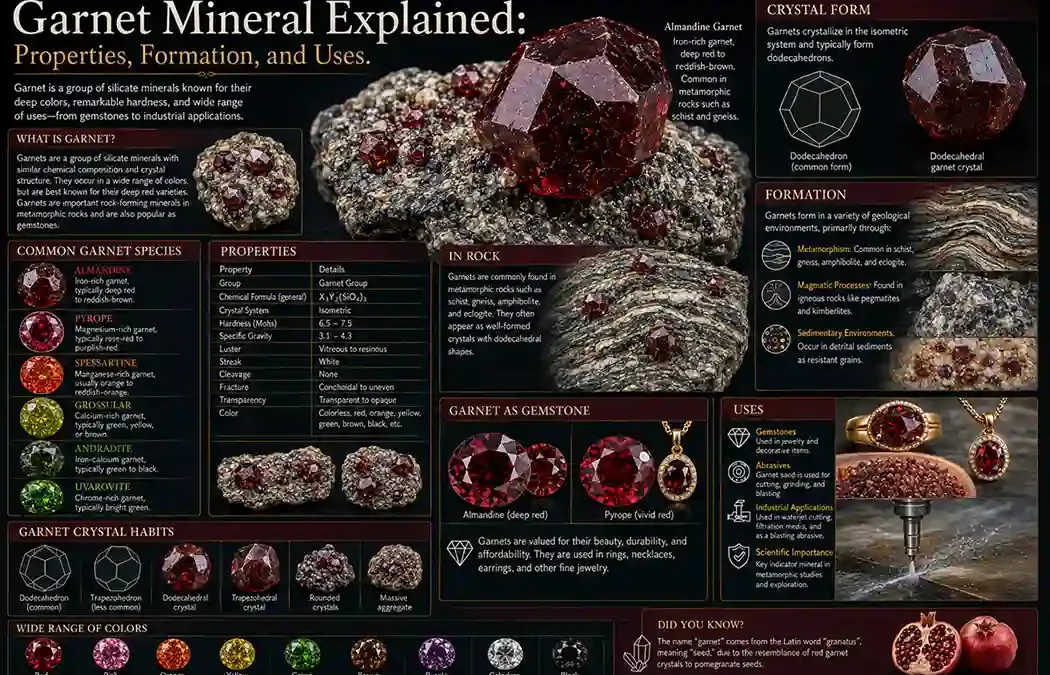
Garnet is a group of closely related silicate minerals famous for their beautiful crystal forms, rich colors, and widespread occurrence in metamorphic rocks. While most people recognize garnet as a red gemstone, the garnet group includes minerals of many different colors and compositions.
Garnets are important because they:
- form in metamorphic and igneous rocks
- help geologists determine pressure and temperature conditions
- serve as valuable gemstones
- are widely used as industrial abrasives
Their durability and distinctive crystal shapes make garnets among the most recognizable minerals.
Learn more → what is a mineral
What Is Garnet?
Garnet is a group of silicate minerals. Rather than a single mineral, garnet consists of several closely related species.
General garnet formula:
Where:
- X = Mg, Fe, Mn, or Ca
- Y = Al, Fe, or Cr
Different chemical compositions create different garnet varieties.
Basic Properties of Garnet
| Property | Value |
|---|---|
| Mineral Group | Silicate |
| Crystal System | Isometric |
| Hardness | 6.5–7.5 |
| Streak | White |
| Luster | Vitreous |
| Cleavage | None |
Common Garnet Varieties
Several garnet species occur naturally.
Almandine
Most common garnet, deep red to reddish-brown.
Pyrope
Dark red gemstone variety.
Spessartine
Orange to reddish-orange garnet.
Grossular
Green, yellow, or colorless varieties.
Andradite
Green, brown, or black garnets.
Major Garnet Species
| Species | Typical Color |
|---|---|
| Almandine | Red |
| Pyrope | Dark Red |
| Spessartine | Orange |
| Grossular | Green |
| Andradite | Green to Black |
Crystal Structure of Garnet
Garnet contains:
- isolated silicate tetrahedra
- metallic ions
- highly symmetrical atomic arrangements
Its structure contributes to:
- hardness
- durability
- crystal symmetry
Learn more → crystal structure in minerals
Crystal System of Garnet
Garnet belongs to the isometric (cubic) crystal system. Its crystallographic relationship is:
Common crystal forms include:
- dodecahedrons
- trapezohedrons
- rounded crystals
Learn more → isometric crystal system
Common Crystal Forms of Garnet
The most recognizable garnet crystal shape is dodecahedron
This crystal has:
- 12 diamond-shaped faces
- high symmetry
- excellent crystal development
Many garnet specimens display nearly perfect crystal forms.
Physical Properties of Garnet
| Property | Description |
|---|---|
| Color | Red, orange, green, yellow, brown |
| Streak | White |
| Luster | Vitreous |
| Hardness | 6.5–7.5 |
| Cleavage | None |
| Fracture | Conchoidal to uneven |
| Specific Gravity | 3.5–4.3 |
How Garnet Forms
Garnet commonly forms through:
Metamorphism
Heat and pressure create garnet crystals in metamorphic rocks.
Igneous Crystallization
Some garnets form from magma.
Hydrothermal Activity
Mineral-rich fluids may deposit garnet.
Metamorphic environments are the most common source of garnet.
Garnet in Metamorphic Rocks
Garnet commonly occurs in:
- schist
- gneiss
- amphibolite
- granulite
Because garnet forms under specific temperature and pressure conditions, geologists use it to study metamorphic history.
Learn more → mineral texture guide
Garnet as an Index Mineral
Garnet is considered an index mineral
Index minerals help determine:
- metamorphic grade
- temperature conditions
- pressure conditions
The presence of garnet often indicates moderate to high-grade metamorphism.
Garnet Gemstones
Many garnets are valuable gemstones.
Popular gemstone varieties include:
Almandine Garnet
Deep red gemstones.
Pyrope Garnet
Dark red jewelry stones.
Tsavorite Garnet
Bright green grossular variety.
Demantoid Garnet
Rare green andradite variety.
Industrial Uses of Garnet
Besides gemstones, garnet has important industrial applications.
Abrasives
Used in sandpaper and grinding materials.
Waterjet Cutting
Garnet is widely used in industrial cutting systems.
Filtration
Used in water filtration media.
Jewelry
One of the most popular gemstone groups.
Major Uses of Garnet
| Industry | Application |
|---|---|
| Jewelry | Gemstones |
| Manufacturing | Abrasives |
| Waterjet Cutting | Industrial cutting |
| Filtration | Water treatment |
Garnet in Mineral Identification
Geologists identify garnet using:
- dodecahedral crystals
- hardness of 6.5–7.5
- vitreous luster
- lack of cleavage
- characteristic red colors
Its crystal shape is often the most diagnostic feature.
Learn more → mineral identification guide
Garnet Identification Summary
| Property | Garnet |
|---|---|
| Hardness | 6.5–7.5 |
| Crystal System | Isometric |
| Cleavage | None |
| Luster | Vitreous |
| Common Color | Red |
| Mineral Group | Silicate |
No. Garnet is a group of closely related silicate minerals.
Most garnets are red, but they can also be green, orange, yellow, brown, and black.
Garnet belongs to the isometric (cubic) crystal system.
Garnet is an important metamorphic index mineral used to determine pressure and temperature conditions.
Garnet is used in jewelry, abrasives, waterjet cutting, and industrial filtration.
Final Thoughts
Garnet is one of the most important mineral groups in geology and gemology. Its beautiful crystal forms, wide range of colors, and significance as a metamorphic index mineral make it valuable for both scientific study and commercial applications.
From deep metamorphic rocks to fine jewelry and industrial cutting systems, garnet demonstrates the remarkable diversity and usefulness of Earth's minerals.
Continue learning with → isometric crystal system and mineral identification guide.