
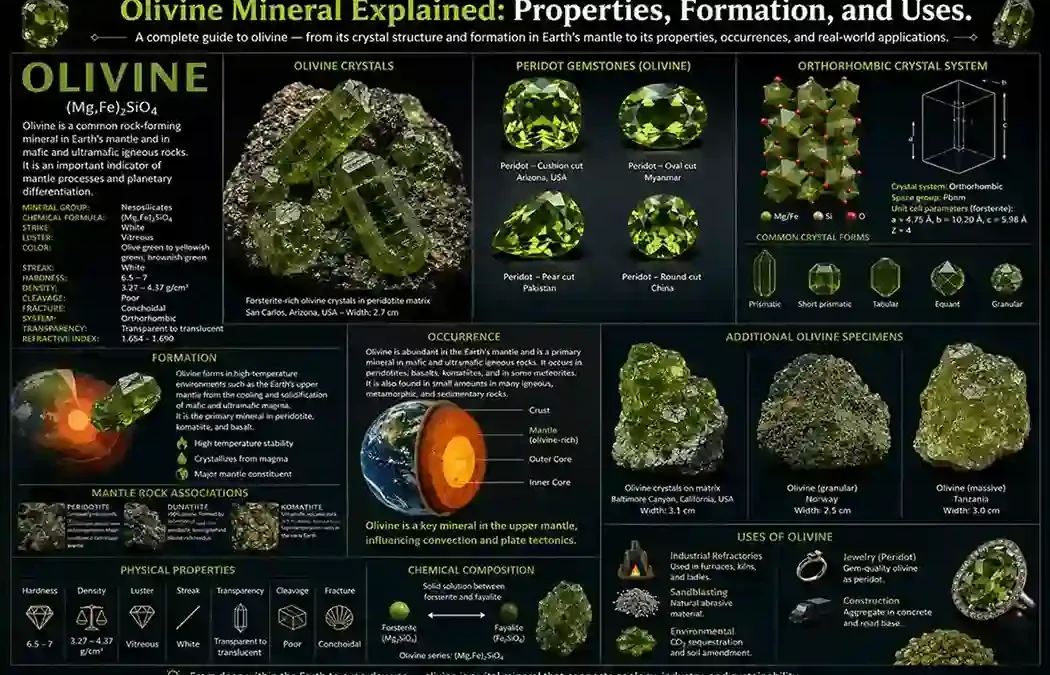
Olivine is one of the most important rock-forming minerals on Earth and a major component of the upper mantle. Known for its distinctive olive-green color, olivine occurs in igneous rocks, mantle-derived rocks, and some meteorites.
Olivine is especially significant because it provides valuable information about Earth's interior and geological processes such as volcanism and mantle convection. The gemstone variety of olivine is known as Peridot
Olivine is widely studied by geologists because it helps reveal how magma forms and evolves beneath Earth's surface.
Learn more → what is a mineral
What Is Olivine?
Olivine is a magnesium-iron silicate mineral. Its composition varies between magnesium-rich and iron-rich end members. The olivine series is represented by:
Forsterite (Magnesium-rich)
Fayalite (Iron-rich)
Most natural olivine contains both magnesium and iron.
Basic Properties of Olivine
| Property | Value |
|---|---|
| Mineral Group | Silicate |
| Subgroup | Nesosilicate |
| Crystal System | Orthorhombic |
| Hardness | 6.5–7 |
| Streak | White |
| Luster | Vitreous |
Why Is Olivine Green?
The characteristic green color of olivine is caused primarily by: Iron Content. Unlike many minerals whose colors result from impurities, olivine's color is an inherent part of its chemical composition.
Color variations include:
- yellow-green
- olive-green
- dark green
- brownish green
Crystal Structure of Olivine
Olivine has an isolated silicate structure.
Its crystal framework consists of:
- silicon-oxygen tetrahedra
- magnesium ions
- iron ions
This structure contributes to:
- high melting temperature
- durability
- mantle stability
Learn more → crystal structure in minerals
Crystal System of Olivine
Olivine belongs to the orthorhombic crystal system. Its crystallographic relationship is . Well-formed crystals are relatively uncommon, but when present they often appear as short prisms or granular crystals.
Learn more → orthorhombic crystal system
Physical Properties of Olivine
| Property | Description |
|---|---|
| Color | Olive green |
| Streak | White |
| Luster | Vitreous |
| Hardness | 6.5–7 |
| Cleavage | Poor |
| Fracture | Conchoidal to uneven |
| Specific Gravity | 3.2–4.4 |
How Olivine Forms
Olivine forms primarily through:
Magmatic Crystallization
Olivine is one of the first minerals to crystallize from magma.
Mantle Processes
Large quantities occur in Earth's mantle.
Volcanic Activity
Basaltic lavas commonly contain olivine crystals.
Meteorite Formation
Many meteorites contain abundant olivine.
Olivine in Earth's Mantle
Olivine makes up a significant portion of Earth's upper mantle.
Scientists study olivine to understand:
- mantle composition
- plate tectonics
- magma generation
- volcanic eruptions
Much of what we know about Earth's interior comes from studying olivine-rich rocks.
Olivine in Igneous Rocks
Olivine commonly occurs in:
Basalt
Dark volcanic rock.
Gabbro
Coarse-grained intrusive rock.
Peridotite
Mantle rock composed largely of olivine.
Dunite
Rock containing mostly olivine.
Common Olivine-Bearing Rocks
| Rock | Olivine Content |
|---|---|
| Basalt | Moderate |
| Gabbro | Moderate |
| Peridotite | High |
| Dunite | Very High |
Peridot: The Gemstone Variety
Peridot is the transparent gemstone variety of olivine.
Characteristics:
- bright green color
- high clarity
- attractive luster
Peridot has been used in jewelry for thousands of years.
Olivine and Weathering
Unlike quartz, olivine weathers relatively quickly.
When exposed to water and oxygen:
- iron oxidizes
- alteration minerals form
- weathering progresses rapidly
This explains why olivine is uncommon in mature sedimentary rocks.
Learn more → quartz mineral explained
Olivine in Meteorites
Many stony meteorites contain abundant olivine.
These extraterrestrial olivines provide information about:
- early solar system formation
- planetary evolution
- asteroid composition
Some meteorite olivine crystals are billions of years old.
Industrial Uses of Olivine
Refractory Materials
Used in high-temperature furnaces.
Foundry Sand
Resistant to heat and thermal shock.
Metallurgy
Used in steel production.
Gemstones
Peridot is widely used in jewelry.
Major Uses of Olivine
| Industry | Application |
|---|---|
| Metallurgy | Furnace materials |
| Foundry | Molding sand |
| Jewelry | Peridot gemstones |
| Research | Mantle studies |
Olivine in Mineral Identification
Geologists identify olivine using:
- olive-green color
- hardness of 6.5–7
- vitreous luster
- granular habit
- lack of cleavage
These properties help distinguish olivine from pyroxene and amphibole.
Learn more → mineral identification guide
Olivine Identification Summary
| Property | Olivine |
|---|---|
| Hardness | 6.5–7 |
| Crystal System | Orthorhombic |
| Color | Olive Green |
| Cleavage | Poor |
| Luster | Vitreous |
| Mineral Group | Silicate |
Olivine is a magnesium-iron silicate mineral composed primarily of magnesium, iron, silicon, and oxygen.
Its green color is mainly caused by iron within its crystal structure.
Olivine belongs to the orthorhombic crystal system.
Peridot is the gemstone-quality variety of olivine.
Olivine is a major component of Earth's mantle and provides valuable information about mantle processes and volcanic activity.
Final Thoughts
Olivine is one of the most significant minerals in Earth science. Its role as a major mantle mineral, its presence in volcanic rocks and meteorites, and its gemstone variety peridot make it important in geology, planetary science, and gemology.
By studying olivine, geologists gain valuable insights into Earth's interior, magma formation, and the evolution of our planet and solar system.