
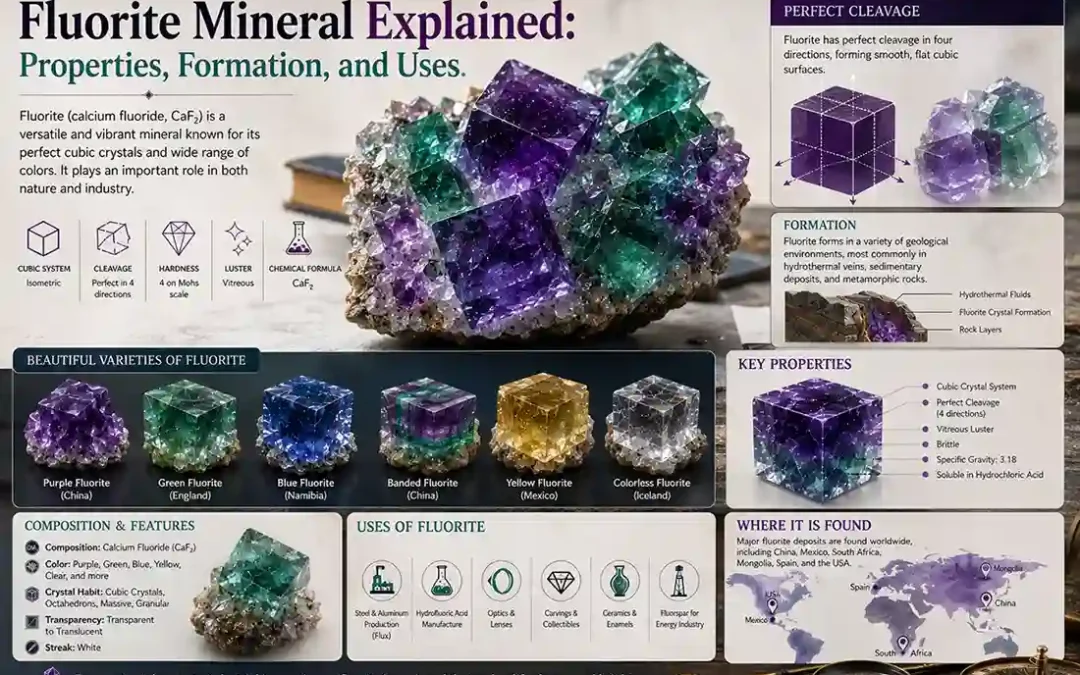
Fluorite is one of the most colorful and visually striking minerals found in nature. Known for its wide range of colors and its ability to fluoresce under ultraviolet light, fluorite is a favorite among mineral collectors and geologists.
Fluorite is an important industrial mineral and a major source of fluorine used in manufacturing and chemical industries.
The mineral is commonly found in:
- hydrothermal veins
- sedimentary rocks
- limestone deposits
- ore-bearing mineral systems
Its beautiful crystal forms and vibrant colors make fluorite one of the most recognizable minerals in mineralogy.
Learn more → what is a mineral
What Is Fluorite?
Fluorite is a calcium fluoride mineral. Its chemical formula is CaF2. Fluorite belongs to the halide mineral group. It is the most important natural source of fluorine.
Basic Properties of Fluorite
| Property | Value |
|---|---|
| Chemical Formula | CaF₂ |
| Mineral Group | Halide |
| Crystal System | Isometric (Cubic) |
| Hardness | 4 |
| Streak | White |
| Cleavage | Perfect |
How Fluorite Forms
Fluorite commonly forms through:
Hydrothermal Activity
Hot mineral-rich fluids deposit fluorite crystals in fractures and veins.
Sedimentary Processes
Fluorite may form in limestone and dolostone deposits.
Ore Deposits
Often occurs alongside metallic ore minerals.
Pegmatites
Some fluorite forms in igneous environments.
Crystal Structure of Fluorite
Fluorite has a highly symmetrical atomic arrangement.
Its crystal structure produces:
- cubic crystals
- octahedral cleavage
- excellent crystal symmetry
The mineral's internal structure strongly influences its physical appearance.
Learn more → crystal structure in minerals
Crystal System of Fluorite
Fluorite belongs to the isometric (Cubic) crystal system. Its crystallographic relationship is
This symmetry commonly produces:
- cubes
- octahedrons
- combinations of crystal forms
Learn more → isometric crystal system
Physical Properties of Fluorite
| Property | Description |
|---|---|
| Color | Purple, green, blue, yellow, colorless |
| Streak | White |
| Luster | Vitreous |
| Hardness | 4 |
| Cleavage | Perfect Octahedral |
| Transparency | Transparent to translucent |
| Specific Gravity | ~3.2 |
Why Is Fluorite So Colorful?
Pure fluorite is generally colorless.
Its colors are caused by:
- trace elements
- crystal defects
- radiation exposure
Common colors include:
Purple Fluorite
Most common variety.
Green Fluorite
Popular collector mineral.
Blue Fluorite
Less common.
Yellow Fluorite
Often associated with hydrothermal deposits.
Common Fluorite Colors
| Variety | Color |
|---|---|
| Purple Fluorite | Purple |
| Green Fluorite | Green |
| Blue Fluorite | Blue |
| Yellow Fluorite | Yellow |
| Colorless Fluorite | Clear |
Fluorescence in Fluorite
Fluorite is famous because of its fluorescence. Under ultraviolet (UV) light, some fluorite specimens glow brightly.
The term fluorescence was actually derived from the mineral fluorite.
Fluorescent colors may include:
- blue
- purple
- green
- white
Fluorite Cleavage
Fluorite exhibits perfect octahedral cleavage,
When broken, fluorite commonly forms:
- octahedral fragments
- smooth cleavage surfaces
- sharp geometric shapes
This property is one of the best identification features of fluorite.
Learn more → mineral cleavage vs fracture
Fluorite Hardness
Fluorite has a hardness of 4 on the Mohs Scale
The hardness relationship is
Fluorite can:
- scratch calcite
- be scratched by apatite
It serves as the reference mineral for hardness level 4.
Learn more → Mohs hardness scale
Major Fluorite Deposits
Important fluorite deposits occur in:
- China
- Mexico
- South Africa
- Mongolia
- Spain
- United States
Many deposits are associated with hydrothermal mineralization.
Industrial Uses of Fluorite
Fluorite is widely used in industry.
Metallurgy
Used as a flux in steel production.
Chemical Industry
Source of fluorine compounds.
Glass Manufacturing
Improves glass quality.
Optical Equipment
High-purity fluorite is used in specialized lenses.
Major Uses of Fluorite
| Industry | Application |
|---|---|
| Metallurgy | Flux |
| Chemical | Fluorine source |
| Glass | Manufacturing |
| Optics | Precision lenses |
Fluorite in Mineral Identification
Geologists identify fluorite using:
- hardness of 4
- cubic crystal habit
- octahedral cleavage
- colorful appearance
- fluorescence
These features make fluorite one of the easiest colorful minerals to recognize.
Learn more → mineral identification guide
Fluorite Identification Summary
| Property | Fluorite |
|---|---|
| Formula | CaF₂ |
| Hardness | 4 |
| Crystal System | Isometric |
| Cleavage | Perfect Octahedral |
| Streak | White |
| Fluorescence | Common |
Fluorite is composed of calcium fluoride (CaF₂).
The mineral gave its name to the phenomenon of fluorescence.
Fluorite has a hardness of 4 on the Mohs Hardness Scale.
Fluorite belongs to the isometric (cubic) crystal system.
Certain impurities and crystal defects cause fluorescence when exposed to ultraviolet light.
Final Thoughts
Fluorite is one of the most beautiful and scientifically important minerals in the world. Its colorful appearance, perfect cleavage, cubic crystal forms, and famous fluorescence make it a favorite among collectors, geologists, and mineral enthusiasts.
From hydrothermal ore deposits to high-tech optical equipment, fluorite demonstrates how mineral properties can influence both geology and modern industry.