
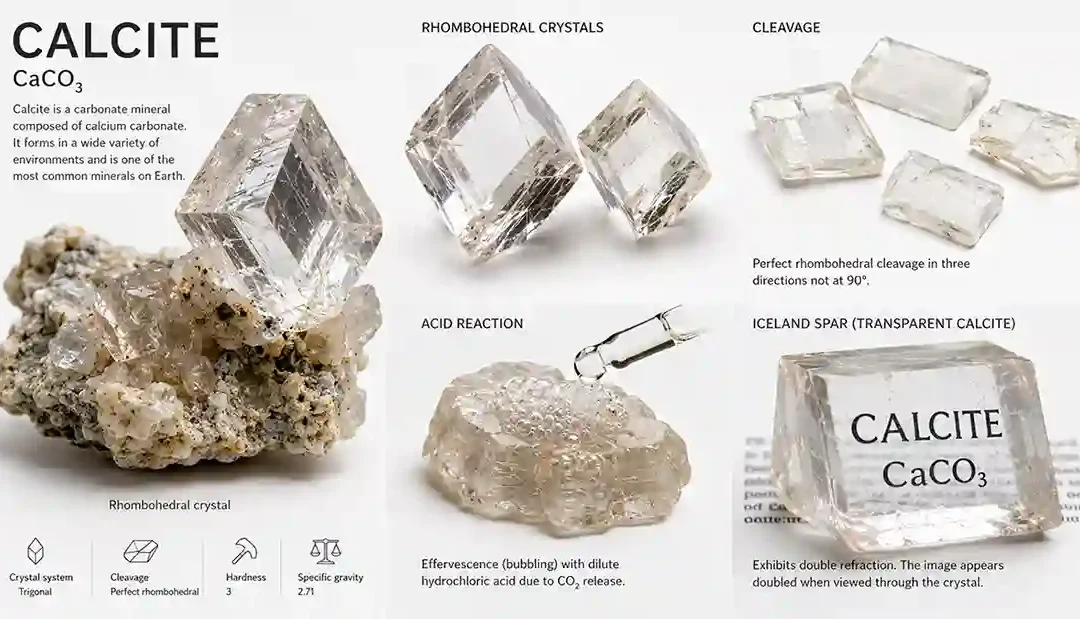
Calcite is one of the most common and important minerals on Earth. It is the primary mineral found in limestone and marble and plays a major role in sedimentary, metamorphic, and biological processes.
Composed of calcium carbonate, calcite is widely recognized for its distinctive crystal forms, reaction with acid, and importance in the global carbon cycle.
Calcite is found in:
- sedimentary rocks
- caves
- hydrothermal veins
- marine environments
- metamorphic rocks
Because of its abundance and unique properties, calcite is one of the most studied minerals in geology.
Learn more → what is a mineral
What Is Calcite?
Calcite is a calcium carbonate mineral. Its chemical formula is CaCO3 . Calcite belongs to the carbonate mineral group and is the most common natural form of calcium carbonate.
Basic Facts
| Property | Value |
|---|---|
| Chemical Formula | CaCO₃ |
| Mineral Group | Carbonate |
| Crystal System | Trigonal |
| Hardness | 3 |
| Cleavage | Perfect |
| Streak | White |
How Calcite Forms
Calcite forms through several geological processes.
Marine Sedimentation
Shells and skeletons of marine organisms accumulate and become limestone.
Chemical Precipitation
Calcium-rich water deposits calcite directly.
Cave Formation
Calcite forms stalactites and stalagmites.
Metamorphism
Limestone transforms into marble during metamorphism.
Crystal Structure of Calcite
Calcite has an ordered crystal lattice that produces:
- perfect cleavage
- trigonal symmetry
- rhombohedral crystal forms
Its atomic arrangement strongly influences its physical properties.
Learn more → crystal structure in minerals
Calcite Crystal System
Calcite belongs to the trigonal crystal system
Common crystal forms include:
- rhombohedrons
- scalenohedrons
- prisms
The crystal symmetry is characterized by rotation symmetry=120∘
Learn more → trigonal crystal system
Physical Properties of Calcite
| Property | Description |
|---|---|
| Color | Colorless, white, yellow, gray |
| Streak | White |
| Luster | Vitreous |
| Hardness | 3 |
| Cleavage | Perfect rhombohedral |
| Transparency | Transparent to translucent |
| Fracture | Uneven |
Calcite Hardness
Calcite has a hardness of 3 on the Mohs Scale
This means:
- a copper coin can scratch calcite
- calcite cannot scratch glass
Its relatively low hardness makes it easy to identify.
Calcite Cleavage
Calcite exhibits perfect rhombohedral cleavage
When broken, calcite forms:
- rhombohedral fragments
- angled surfaces
- smooth cleavage planes
This is one of calcite's most distinctive identification features.
Learn more → mineral cleavage vs fracture
Calcite and Acid Reaction
One of the most famous properties of calcite is its reaction with acid. When dilute hydrochloric acid is applied, calcite fizzes
The reaction can be represented as:
CaCO3+2HCl→CaCl2+CO2+H2O
This bubbling reaction releases carbon dioxide gas and is widely used in mineral identification.
Learn more → chemical properties of minerals
Double Refraction in Calcite
Clear calcite varieties can exhibit double refraction. Objects viewed through transparent calcite may appear doubled.This optical property is caused by light splitting into two rays inside the crystal.
Common Varieties of Calcite
| Variety | Description |
|---|---|
| Iceland Spar | Transparent optical calcite |
| Dogtooth Calcite | Scalenohedral crystals |
| Marble Calcite | Metamorphosed limestone |
| Limestone Calcite | Sedimentary calcite |
Calcite in Rocks
Calcite is a major component of:
Sedimentary Rocks
- Limestone
- Chalk
- Travertine
Metamorphic Rocks
- Marble
These rocks are widely used in construction and industry.
Calcite in Caves
Calcite is responsible for many cave formations.
Examples include:
Stalactites
Hang from cave ceilings.
Stalagmites
Grow upward from cave floors.
Flowstones
Form when mineral-rich water flows over cave surfaces.
Industrial Uses of Calcite
Calcite has many commercial applications.
Construction
- Cement
- Concrete
- Building stone
Agriculture
- Soil treatment
- Liming agent
Manufacturing
- Paint
- Plastics
- Glass
Environmental Uses
- Water treatment
- Pollution control
Major Uses of Calcite
| Industry | Use |
|---|---|
| Construction | Cement and concrete |
| Agriculture | Soil amendment |
| Manufacturing | Paint and plastics |
| Water Treatment | Neutralization |
Calcite in Mineral Identification
Geologists identify calcite using:
- hardness of 3
- acid reaction
- rhombohedral cleavage
- white streak
- trigonal crystal forms
These properties make calcite one of the easiest minerals to recognize.
Learn more → mineral identification guide
Calcite Identification Summary
| Property | Calcite |
|---|---|
| Formula | CaCO₃ |
| Hardness | 3 |
| Cleavage | Perfect |
| Crystal System | Trigonal |
| Streak | White |
| Acid Reaction | Strong |
Calcite is composed of calcium carbonate (CaCO₃).
Calcite belongs to the trigonal crystal system.
Calcite has a Mohs hardness of 3.
Calcite reacts with acids and releases carbon dioxide gas.
Limestone, chalk, travertine, and marble contain large amounts of calcite.
Final Thoughts
Calcite is one of Earth's most important minerals, forming the foundation of many sedimentary and metamorphic rocks. Its distinctive acid reaction, perfect cleavage, trigonal crystal structure, and widespread occurrence make it a key mineral in geology and mineral identification.
From cave formations and marine sediments to cement production and agriculture, calcite plays a vital role in both natural systems and human industries.
Continue learning with → trigonal crystal system and chemical properties of minerals.