
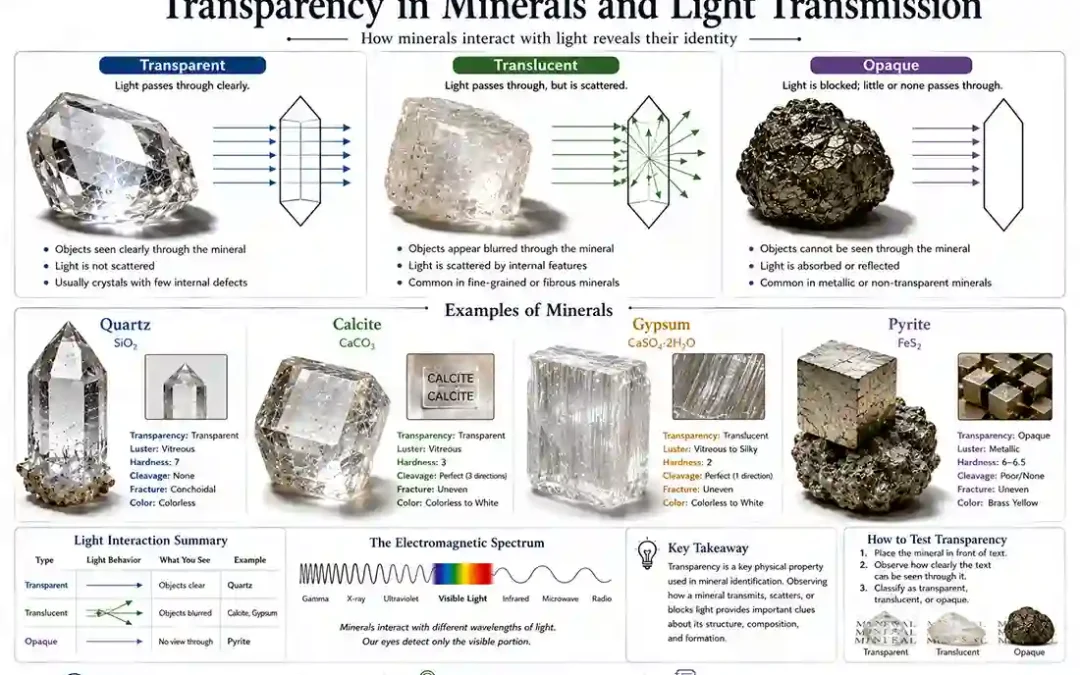
Transparency is an important optical property used in mineral identification. It describes how much light can pass through a mineral specimen.
Some minerals allow light to pass through completely, while others block light entirely. By observing transparency, geologists can gather useful clues about a mineral's composition, crystal structure, and purity.
Transparency is commonly used alongside:
- color
- luster
- hardness
- crystal habit
- cleavage
Together, these properties help scientists identify and classify minerals accurately.
Learn more → mineral identification guide
Main Transparency Categories
| Transparency Type | Light Transmission |
|---|---|
| Transparent | Most light passes through |
| Translucent | Some light passes through |
| Opaque | No light passes through |
What Is Transparency in Minerals?
Transparency refers to a mineral's ability to transmit light. It helps determine whether objects can be seen through a mineral.
Transparency depends on:
- crystal structure
- impurities
- thickness
- internal defects
- mineral composition
This property is one of the simplest visual tests used in geology.
Transparent Minerals
Transparent minerals allow nearly all light to pass through. Objects behind the mineral can be seen clearly.
Common Transparent Minerals
- Quartz
- Calcite
- Diamond
- Gypsum (clear varieties)
- Topaz
Transparent minerals often develop under conditions that produce:
- fewer impurities
- fewer crystal defects
Translucent Minerals
Translucent minerals allow partial light transmission. Light passes through, but objects cannot be seen clearly.
Common Examples
- Milky quartz
- Some feldspars
- Opal
- Certain gypsum varieties
These minerals often contain:
- microscopic inclusions
- internal fractures
- structural irregularities
Opaque Minerals
Opaque minerals do not transmit light. Even thin specimens block light completely.
Common Opaque Minerals
- Pyrite
- Magnetite
- Galena
- Hematite
Most metallic minerals are opaque because their atomic structure absorbs or reflects light.
Examples of Mineral Transparency
| Mineral | Transparency |
|---|---|
| Quartz | Transparent to translucent |
| Calcite | Transparent to translucent |
| Diamond | Transparent |
| Pyrite | Opaque |
| Galena | Opaque |
| Gypsum | Transparent to translucent |
Why Some Minerals Are Transparent
Transparency depends largely on:
- atomic arrangement
- crystal purity
- absence of impurities
When light passes through a crystal without significant scattering, the mineral appears transparent. Well-formed crystals with few defects often show greater transparency.
Learn more → crystal structure in minerals
How Impurities Affect Transparency
Impurities can reduce transparency by:
- scattering light
- absorbing light
- creating internal flaws
Example
Pure quartz may appear:
- nearly transparent
Quartz containing impurities may become:
- milky
- smoky
- cloudy
This is why transparency varies even within the same mineral species.
Factors Affecting Mineral Transparency
Transparency∝Impurities+DefectsCrystal Purity
Although simplified, this relationship shows that greater crystal purity generally results in better transparency.
Transparency and Mineral Identification
Transparency is often combined with:
- luster
- color
- streak
- cleavage
- hardness
Example
Quartz:
- transparent to translucent
- vitreous luster
- hardness of 7
These combined properties make identification easier.
Learn more → mineral luster explained
Transparency in Gemstones
Transparency is especially important in gemstones.
Gemologists evaluate:
- clarity
- transparency
- inclusions
- light transmission
Highly transparent gemstones often have greater commercial value.
Examples
- Diamond
- Sapphire
- Emerald
- Topaz
Transparency vs Luster
| Property | Transparency | Luster |
|---|---|---|
| Measures | Light transmission | Light reflection |
| Example | Transparent quartz | Vitreous quartz |
| Purpose | Optical clarity | Surface appearance |
Both properties are important for mineral identification.
Learn more → mineral luster explained
Transparency Categories in Geology
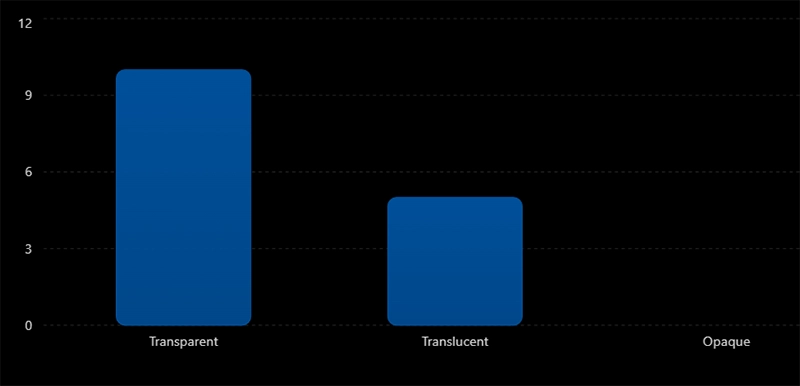
Transparency Categories in Minerals
Three major transparency classifications used in mineral identification.
Why Transparency Matters
Geologists study transparency to:
- identify minerals
- assess crystal quality
- understand mineral formation
- evaluate gemstones
Transparency can also reveal:
- internal defects
- weathering effects
- impurity content
It remains one of the most useful visual properties in mineralogy.
Transparency describes how much light can pass through a mineral.
Transparent minerals allow clear viewing through them, while translucent minerals allow light through but not clear images.
No. Most metallic minerals are opaque.
Impurities and microscopic inclusions scatter light and reduce transparency.
Final Thoughts
Transparency is an important optical property that helps geologists understand how minerals interact with light. Whether a mineral is transparent, translucent, or opaque can reveal valuable information about its composition, purity, and crystal structure.
When combined with luster, hardness, streak, and cleavage, transparency becomes a powerful tool for mineral identification and geological analysis.