
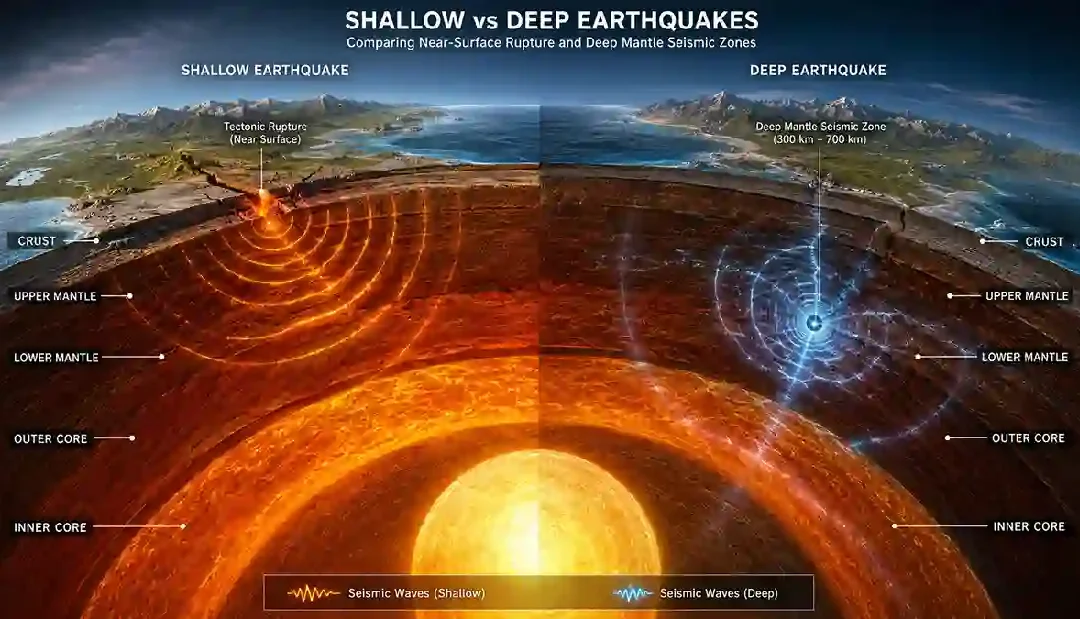
Not all earthquakes happen at the same depth underground. Some occur very close to Earth’s surface, while others happen hundreds of kilometers deep inside the planet.
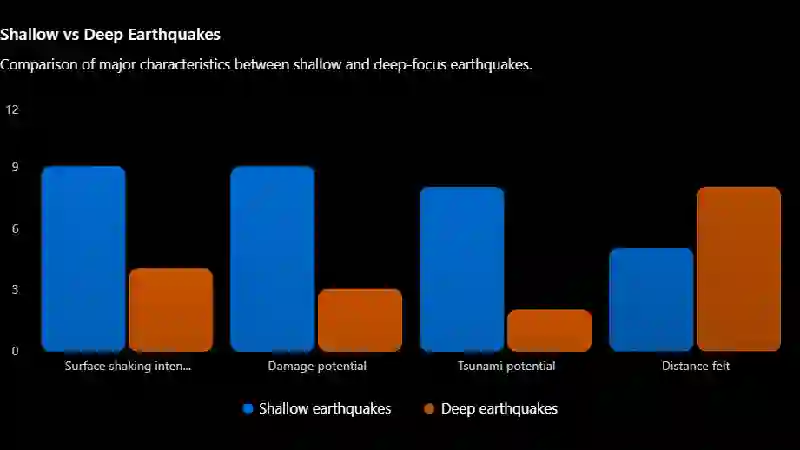
This difference strongly affects:
- shaking intensity
- damage potential
- how far the earthquake can be felt
- tsunami risk
In many cases, shallow earthquakes are far more dangerous than deeper ones.
If you’re new to earthquakes, begin here → what is an earthquake
Shallow vs Deep Earthquakes at a Glance
Shallow vs Deep Earthquakes
Comparison of major characteristics between shallow and deep-focus earthquakes.
What Is a Shallow Earthquake?
Shallow earthquakes occur between 0 and 70 km below Earth’s surface.
Because they happen close to the surface:
- seismic energy reaches buildings quickly
- shaking becomes more intense
- damage is often severe
Most destructive urban earthquakes are shallow earthquakes.
Characteristics of Shallow Earthquakes
Main Features
- Strong local shaking
- High structural damage risk
- Often linked to crustal faults
- Can generate tsunamis if offshore
Common Locations
- California
- Turkey
- Japan
- New Zealand
Learn more → earthquakes Southern California
What Is a Deep Earthquake?
Deep earthquakes occur between 300 and 700 km underground.
These earthquakes happen far beneath Earth’s crust, usually inside sinking tectonic plates.
Because they occur so deep:
- shaking weakens before reaching the surface
- local destruction is often reduced
- earthquakes may still be felt across huge regions
Characteristics of Deep Earthquakes
Main Features
- Occur mostly in subduction zones
- Felt across wide areas
- Usually less destructive locally
- Rarely generate tsunamis
Common Regions
- Japan
- Tonga
- Fiji
- Indonesia
- Chile
Learn more → earthquakes Indonesia
Why Shallow Earthquakes Are Usually More Dangerous
The main reason is energy loss.
When earthquakes happen deeper underground:
- seismic waves travel farther
- more energy dissipates
- surface shaking weakens
Shallow earthquakes have little time to lose energy before reaching cities and buildings.
This creates stronger ground motion.
How Subduction Zones Create Deep Earthquakes
Deep earthquakes mostly occur in subduction zones.
Here’s the process:
- Oceanic plate sinks into Earth’s mantle
- Cold dense slab moves downward
- Stress builds deep underground
- Earthquakes occur inside the descending plate
Some deep earthquakes happen nearly 700 km below Earth’s surface.
Shallow vs Deep Earthquakes and Tsunamis
Tsunamis usually require:
- shallow offshore earthquakes
- vertical seafloor movement
- strong tectonic displacement
Deep earthquakes almost never generate major tsunamis.
This is why giant tsunami earthquakes are typically shallow megathrust earthquakes.
Learn more → strongest earthquakes in history
Famous Shallow Earthquakes
| Earthquake | Type |
|---|---|
| 2010 Haiti | Shallow |
| 2023 Turkey–Syria | Shallow |
| 2011 Christchurch | Shallow |
| 1906 San Francisco | Shallow |
These earthquakes caused severe urban destruction because of shallow depth.
Famous Deep Earthquakes
| Earthquake Region | Type |
|---|---|
| Fiji deep earthquakes | Deep |
| Tonga trench earthquakes | Deep |
| Japan subduction earthquakes | Deep-focus |
| Indonesia deep seismic zones | Deep-focus |
Deep earthquakes are scientifically important because they occur under extreme pressure and temperature.
Earthquake Depth Categories
| Depth Type | Depth Range |
|---|---|
| Shallow | 0–70 km |
| Intermediate | 70–300 km |
| Deep | 300–700 km |
Most destructive earthquakes are shallow earthquakes.
Learn more → earthquake depth explained
Can Deep Earthquakes Be Very Powerful?
Yes.
Some deep earthquakes reach:
- magnitude 7
- magnitude 8
- or even larger
But despite their size:
- surface shaking is often weaker
- damage is usually less severe than shallow earthquakes of similar magnitude
Why Scientists Study Deep Earthquakes
Deep earthquakes help scientists understand:
- Earth’s mantle
- subduction processes
- tectonic plate behavior
- extreme rock physics
They remain one of the most unusual types of earthquakes on Earth.
Shallow earthquakes are usually more destructive.
Because seismic waves travel efficiently through Earth’s interior.
Rarely — most tsunamis come from shallow offshore earthquakes.
Inside subduction zones beneath sinking tectonic plates.
Final Thoughts
Shallow and deep earthquakes behave very differently because of where they originate underground. Shallow earthquakes usually produce stronger surface shaking and greater destruction, while deep earthquakes often spread weaker shaking across much larger regions.
Understanding earthquake depth helps explain why some earthquakes become catastrophic disasters while others are felt only as distant vibrations beneath Earth’s surface.