
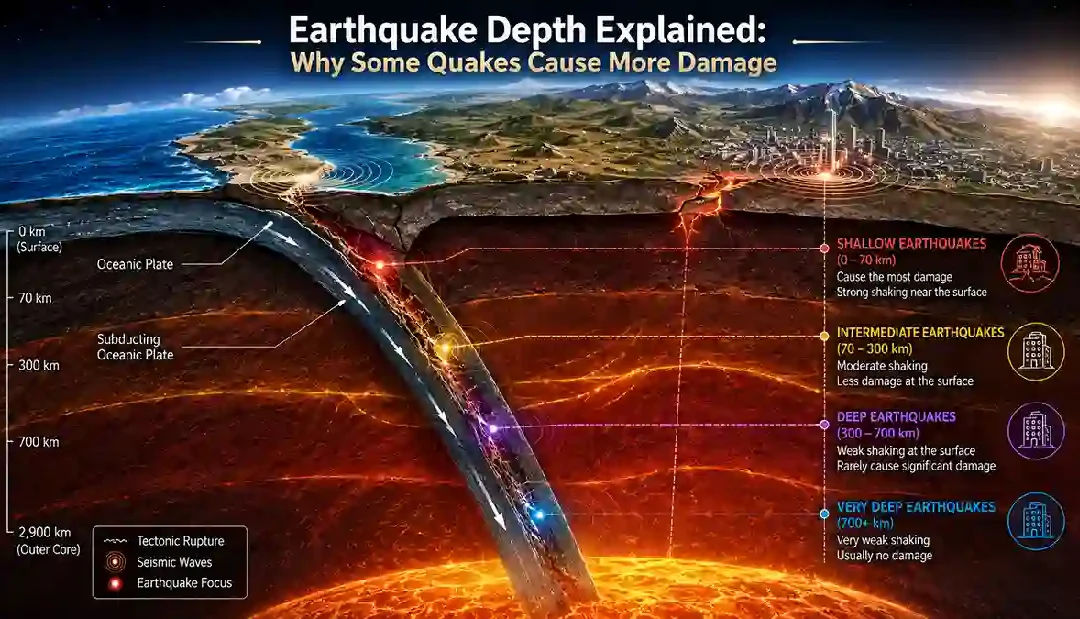
Not all earthquakes happen near Earth’s surface. Some occur only a few kilometers underground, while others happen hundreds of kilometers deep inside Earth. This underground location is called earthquake depth.
Depth plays a major role in:
- shaking intensity
- damage potential
- seismic wave behavior
- how far an earthquake can be felt
In many cases, a smaller shallow earthquake can feel stronger than a deeper, larger one.
If you’re new to earthquakes, begin here → what is an earthquake
What Is Earthquake Depth?
Earthquake depth refers to how far below Earth’s surface an earthquake begins. The exact underground starting point is called the hypocenter or focus. The point directly above it on Earth’s surface is the epicenter.
Learn more → epicenter vs focus
Main Earthquake Depth Categories
Earthquakes are usually grouped into three depth ranges.
| Earthquake Type | Depth Range |
|---|---|
| Shallow earthquakes | 0–70 km |
| Intermediate earthquakes | 70–300 km |
| Deep earthquakes | 300–700 km |
Most destructive earthquakes are shallow earthquakes.
1. Shallow Earthquakes (Most Dangerous)
Shallow earthquakes happen close to Earth’s surface.
Why They Matter
- Stronger shaking reaches the surface
- Buildings absorb more seismic energy
- Damage is usually more severe
Most major urban earthquake disasters involve shallow earthquakes.
Common Locations
- California
- Turkey
- Japan
- New Zealand
Learn more → earthquakes Southern California
2. Intermediate-Depth Earthquakes
Intermediate earthquakes occur deeper underground.
Main Features
- Often linked to subduction zones
- Felt across larger regions
- Usually less destructive than shallow earthquakes
These earthquakes commonly occur where oceanic plates sink into Earth’s mantle.
3. Deep Earthquakes (Mysterious Seismic Events)
Deep earthquakes can occur hundreds of kilometers underground.
Important Facts
- Can reach depths near 700 km
- Mostly occur in subduction zones
- Often felt over very large distances
Scientists still study how rocks behave under such extreme pressure and temperature.
Why Depth Changes Earthquake Shaking
The closer an earthquake is to the surface, the less energy is lost before seismic waves reach people and buildings.
| Depth | Surface Effect |
|---|---|
| Very shallow | Strong shaking |
| Intermediate | Wider but weaker shaking |
| Deep | Broad but softer shaking |
Shallow earthquakes usually cause the most destruction.
Learn more → seismic waves
Why Deep Earthquakes Happen Mostly in Subduction Zones
Deep earthquakes are strongly connected to subduction zones.
Here’s why:
- Oceanic plates sink into Earth’s mantle
- Cold dense slabs descend underground
- Stress continues building deep below Earth
This allows earthquakes to occur far beneath the surface.
Regions with deep earthquakes include:
- Japan
- Indonesia
- Tonga
- Chile
Earthquake Depth & Tsunami Risk
Depth also affects tsunami generation.
Tsunamis Usually Need:
- shallow offshore earthquakes
- strong seafloor movement
- vertical displacement
Deep earthquakes rarely produce major tsunamis.
Famous Deep vs Shallow Earthquakes
| Earthquake | Type |
|---|---|
| 2010 Haiti | Shallow |
| 2011 Japan Tohoku | Shallow offshore |
| Deep Fiji earthquakes | Deep-focus |
| Turkey 2023 | Shallow crustal |
Many of history’s deadliest earthquakes were shallow earthquakes.
Explore → deadliest earthquakes in history
Why Some Deep Earthquakes Are Felt Far Away
Deep earthquakes lose less energy near the surface and can travel through Earth more efficiently.
That means:
- weaker local shaking
- but wider regional reach
Some deep earthquakes are felt across multiple countries.
How Scientists Measure Earthquake Depth
Scientists calculate depth using:
- seismic wave arrival times
- global seismic networks
- computer models of Earth’s interior
Modern monitoring systems can estimate depth very quickly after an earthquake begins.
Learn more → earthquake monitoring technology
Can Depth Predict Earthquake Danger?
Depth alone does not determine danger.
Scientists also consider:
- magnitude
- population density
- building quality
- local geology
However, shallow earthquakes are generally the most dangerous.
The underground distance between Earth’s surface and where the earthquake begins.
Very shallow earthquakes usually cause the strongest damage.
Yes — some occur nearly 700 km underground.
Because sinking tectonic plates continue generating stress deep underground.
Final Thoughts
Earthquake depth is one of the most important factors controlling how an earthquake behaves at Earth’s surface. From destructive shallow earthquakes to mysterious deep-focus seismic events, depth influences shaking intensity, tsunami potential, and how seismic waves travel through the planet.
Understanding earthquake depth helps explain why some earthquakes become catastrophic while others are felt only as distant vibrations.