
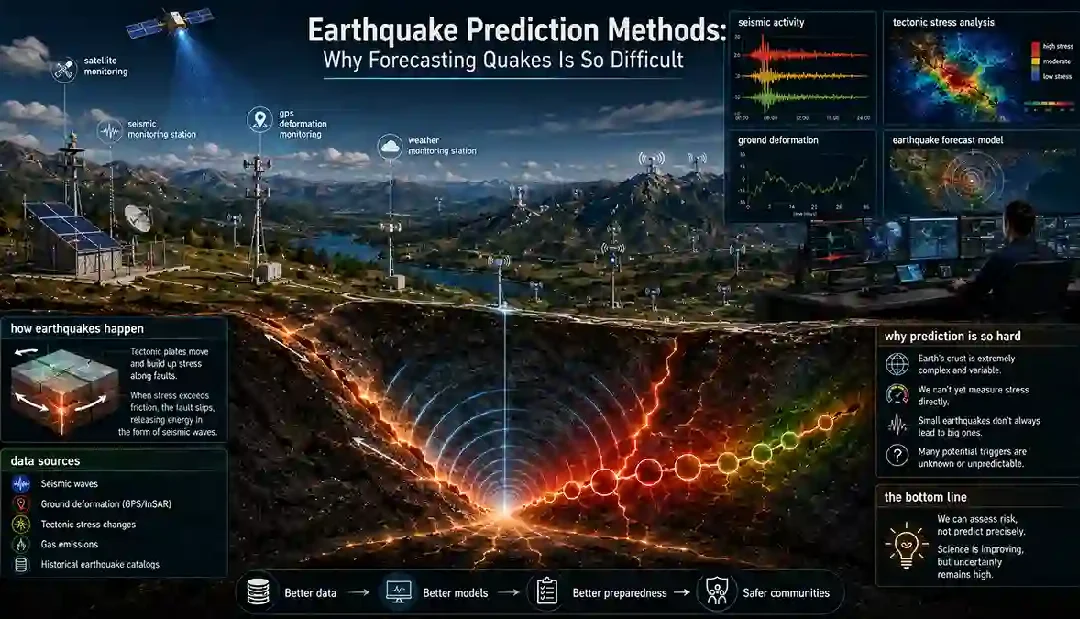
Humans have tried to predict earthquakes for centuries. Ancient civilizations watched:
- unusual animal behavior
- changes in water levels
- strange ground movements
Modern scientists now use satellites, seismic sensors, and advanced computer systems. Yet despite huge technological progress, earthquakes still cannot be predicted precisely.
Scientists can identify high-risk zones and estimate long-term probabilities, but the exact:
- time
- location
- magnitude
of a future earthquake remains unknown.
If you’re new to earthquakes, begin here → what is an earthquake
What Would True Earthquake Prediction Require?
A true prediction would need to answer:
| Question | Example |
|---|---|
| When? | Exact day and time |
| Where? | Precise fault location |
| How strong? | Estimated magnitude |
Modern science cannot currently do all three reliably. Instead, scientists focus mostly on:
- monitoring
- forecasting
- early warning systems
Learn more → earthquake early warning systems
Major Earthquake Prediction Methods Scientists Study
1. Seismic Monitoring Networks
The most important earthquake research tool is seismic monitoring. Scientists use thousands of sensors to detect:
- small earthquakes
- fault activity
- underground vibrations
Why It Matters
Tiny earthquakes sometimes reveal stress building along faults. Modern seismic networks continuously monitor active regions worldwide.
2. Fault Stress & Plate Movement Analysis
Scientists measure how tectonic plates move over time.
Tools include:
- GPS networks
- satellite measurements
- crustal deformation analysis
Main Goal
Track stress buildup along major faults and subduction zones.
Learn more → fault lines
3. Satellite-Based Ground Deformation Tracking
Modern satellites can detect tiny ground movements.
Scientists monitor:
- land uplift
- crustal stretching
- fault displacement
Important Technology
InSAR (Interferometric Synthetic Aperture Radar). This helps map tectonic stress over large regions.
4. Foreshock Detection
Some large earthquakes are preceded by smaller ones called foreshocks.
Problem
Not every small earthquake becomes a major earthquake.
Scientists often cannot tell if a quake is:
- a harmless small earthquake
- or the beginning of something larger
5. Groundwater & Gas Monitoring
Some researchers study:
- radon gas release
- groundwater changes
- underground chemical shifts
Why?
Stress in rocks may alter underground fluids before earthquakes.
Results remain inconsistent and controversial.
6. Artificial Intelligence & Earthquake Forecasting
AI is becoming an important research tool.
Scientists use machine learning to analyze:
- seismic patterns
- fault behavior
- historical earthquake data
Main Goal
Improve probability forecasting — not exact prediction.
Earthquake Forecasting vs Prediction
| Type | Meaning |
|---|---|
| Prediction | Exact time/place/magnitude |
| Forecasting | Probability over time |
| Early Warning | Alerts after earthquake begins |
Many people confuse these three concepts. Learn more → Can earthquakes be predicted?
Famous Failed Earthquake Predictions
Several earthquake prediction attempts have failed historically.
Examples include:
- animal behavior claims
- unusual cloud patterns
- unsupported “quake forecasting” systems
Most scientists require strong evidence before accepting prediction methods.
Why Earthquake Prediction Is So Difficult
Earth’s crust behaves in extremely complex ways.
Challenges include:
- hidden underground faults
- irregular stress release
- unpredictable rupture behavior
- limited underground observations
Even faults that appear quiet can suddenly produce major earthquakes.
What Scientists Can Predict Successfully
Although exact prediction is impossible, scientists can estimate:
- high-risk earthquake zones
- long-term seismic probability
- likely fault activity
- tsunami danger areas
Examples:
- Cascadia Subduction Zone
- Tokyo region
- Istanbul fault zone
- San Andreas Fault
Explore → earthquake risk zones worldwide
Countries Leading Earthquake Prediction Research
| Country | Main Focus |
|---|---|
| Japan | Early warning + seismic monitoring |
| United States | Fault movement + forecasting |
| China | Large seismic networks |
| Italy | Volcanic + tectonic monitoring |
| New Zealand | Plate boundary research |
Japan operates some of the world’s most advanced seismic monitoring systems.
Could Earthquakes Ever Be Predicted Perfectly?
Most scientists believe precise prediction remains extremely difficult.
Future improvements may come from:
- AI analysis
- denser sensor networks
- better satellite imaging
- improved fault models
But Earth’s tectonic system remains highly complex.
No — exact prediction is not currently possible.
Long-term forecasting and early warning systems.
Some unusual behavior has been reported, but scientific evidence remains weak.
AI may improve forecasting, but not exact prediction yet.
Final Thoughts
Earthquake prediction remains one of the biggest scientific challenges on Earth. While modern technology can monitor faults, track tectonic movement, and provide early warnings, accurately predicting the exact timing of earthquakes is still beyond current science.
Understanding earthquake prediction methods helps explain both the progress scientists have made — and the limits that still exist in forecasting one of nature’s most powerful forces.