
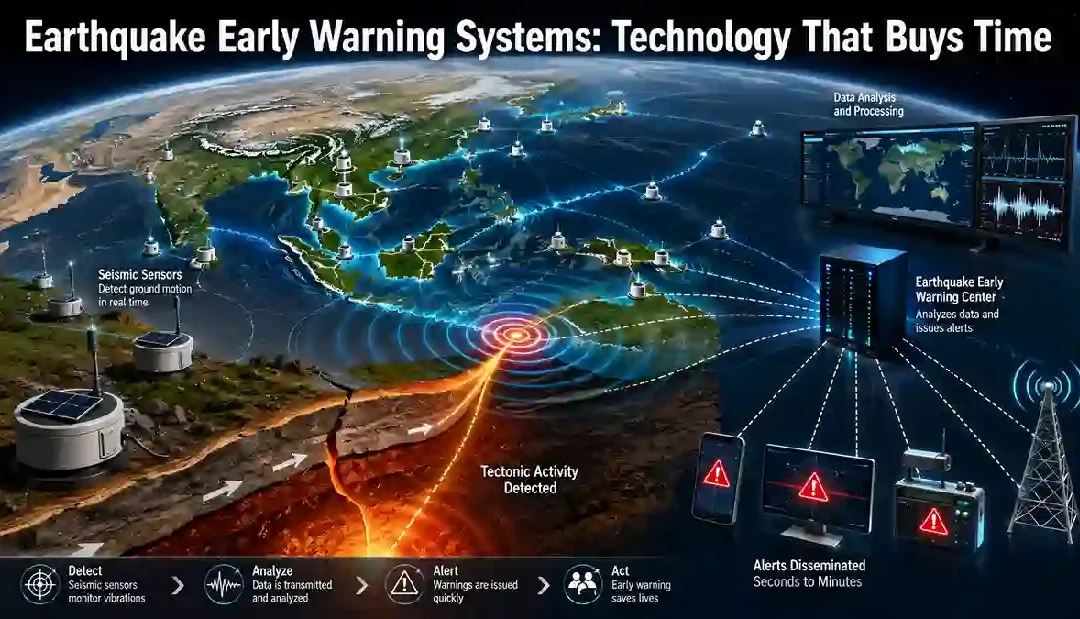
Earthquakes happen suddenly. But modern technology can sometimes detect an earthquake before the strongest shaking arrives. That’s the idea behind earthquake early warning systems.
These systems cannot predict earthquakes days or hours in advance. Instead, they detect earthquakes immediately after they begin and send alerts faster than damaging seismic waves can travel.
Even a warning of:
- 5 seconds
- 10 seconds
- 30 seconds
can save lives.
If you’re new to earthquakes, begin here → what is an earthquake
How Earthquake Early Warning Systems Work
Earthquake warnings rely on one important scientific fact: different seismic waves travel at different speeds.
The Basic Process
| Step | What Happens |
|---|---|
| 1 | Earthquake begins underground |
| 2 | Fast P waves travel outward |
| 3 | Sensors detect the P waves |
| 4 | Computers estimate earthquake size/location |
| 5 | Alerts are sent |
| 6 | Slower, stronger S waves arrive later |
The warning works because P waves travel faster than damaging shaking waves.
Understanding P Waves vs S Waves
The first waves from an earthquake are called P waves.
They usually cause:
- weak shaking
- small vibrations
- little damage
The more dangerous waves are S waves and surface waves.
They cause:
- strong shaking
- structural damage
- ground movement
Early warning systems use fast P-wave detection to provide advance notice.
Learn more → seismic waves
Main Parts of an Earthquake Early Warning System
1. Seismic Sensor Networks
Thousands of seismic sensors monitor Earth’s crust.
These sensors detect:
- ground motion
- P waves
- tectonic activity
Sensors are usually placed near active faults and subduction zones.
2. Real-Time Data Processing
After detection, computers rapidly analyze:
- earthquake location
- magnitude
- expected shaking intensity
Modern systems use advanced algorithms to process data within seconds.
3. Public Alert Systems
Warnings can reach people through:
- smartphones
- TV and radio
- sirens
- transportation systems
- internet alerts
Some systems automatically stop trains and industrial equipment.
4. Automated Emergency Actions
Advanced warning systems can automatically:
- stop high-speed trains
- shut down gas lines
- pause surgeries
- open fire station doors
Japan uses some of the world’s most advanced automated earthquake systems.
Countries With Advanced Earthquake Warning Systems
| Country | System Features |
|---|---|
| Japan | Nationwide alerts + train shutdowns |
| Mexico | Public seismic sirens |
| United States | ShakeAlert system |
| Taiwan | Smartphone earthquake alerts |
| China | Regional warning networks |
Many systems focus on high-risk seismic regions.
Japan’s Earthquake Warning System
Japan has one of the most advanced earthquake warning systems in the world.
Features
- Nationwide sensor networks
- TV + smartphone alerts
- High-speed train automation
- Real-time seismic analysis
Millions of alerts can be delivered within seconds.
Explore → earthquakes Tokyo region
The United States Shake Alert System
The western United States uses the ShakeAlert system.
It monitors regions including:
- California
- Oregon
- Washington
Main Goal
Provide warnings before strong shaking arrives from major earthquakes.
Learn more → earthquakes Southern California
Can Early Warning Systems Predict Earthquakes?
No.
This is one of the most misunderstood parts of earthquake science.
Early warning is NOT prediction.
Scientists still cannot predict:
- exact time
- exact location
- exact magnitude
Instead, early warning systems react immediately after an earthquake begins.
Learn more → can earthquakes be predicted
How Much Warning Time Is Possible?
Warning time depends on:
- distance from the epicenter
- earthquake depth
- wave travel speed
| Distance From Epicenter | Possible Warning |
|---|---|
| Very close | 0–3 seconds |
| Nearby city | 5–20 seconds |
| Distant region | 20–60+ seconds |
Sometimes, even 5 seconds can reduce injuries.
Why Early Warning Systems Matter
Even short warnings help people:
- move away from dangerous objects
- stop vehicles
- evacuate elevators
- protect industrial systems
They also help emergency services respond faster.
Future Earthquake Warning Technology
Scientists are improving systems using:
- AI-based seismic analysis
- satellite monitoring
- denser sensor networks
- faster mobile alerts
Future systems may become:
- faster
- more accurate
- more automated
But earthquakes still cannot be predicted far in advance.
No — they only detect earthquakes after they begin.
Because P waves travel faster than damaging S waves.
Japan is considered one of the global leaders.
No — they only reduce damage and improve safety.
Final Thoughts
Earthquake early warning systems are among the most important modern tools for reducing seismic disaster risks. By detecting earthquakes within seconds and sending rapid alerts before strong shaking arrives, these systems help protect millions of people in earthquake-prone regions.
Understanding how they work reveals how science and technology can provide valuable time during one of nature’s fastest disasters.