
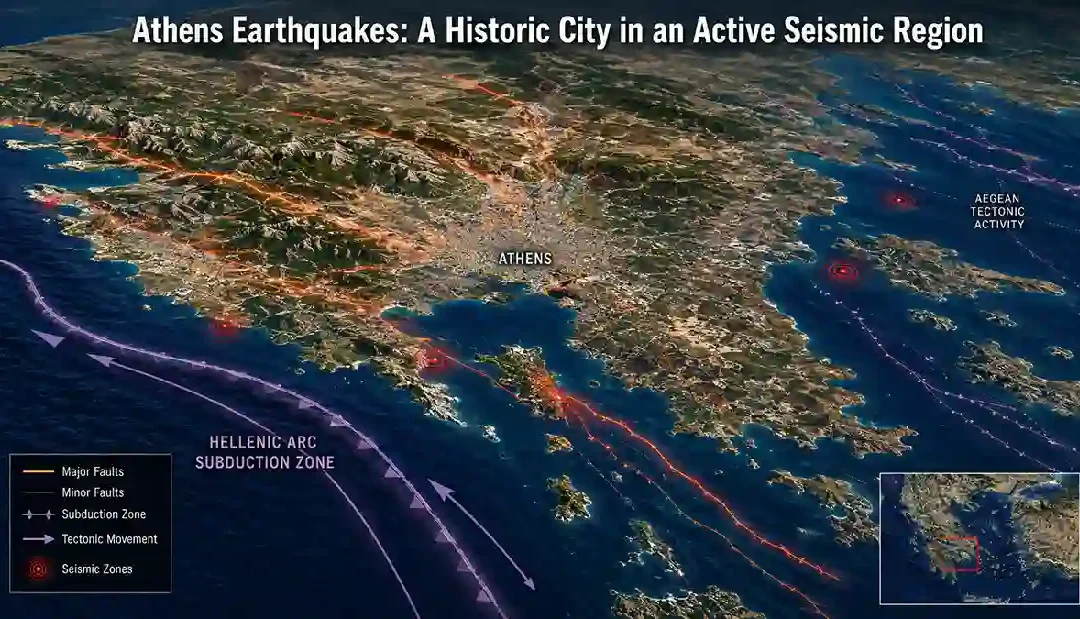
Athens is one of Europe’s most earthquake-prone capitals. While it doesn’t sit directly on a major plate boundary like Tokyo, it is located within a highly active tectonic region influenced by the collision between the African Plate and the Eurasian Plate
This interaction creates ongoing seismic activity across Greece, including the Athens region.
If you’re new to earthquakes, begin here → what is an earthquake
Athens Seismic Zones
| Zone | Risk Level | Main Cause |
|---|---|---|
| Local Athens Faults | High | Crustal fault movement |
| Corinth Rift Zone | Very High | Crust stretching |
| Hellenic Arc (Offshore) | Extremely High | Subduction zone |
| Central Greece | High | Regional tectonic stress |
| Aegean Sea Region | Very High | Plate interaction |
Athens is influenced by both inland faults and nearby subduction zones. To understand how faults work → fault lines
Why Do Earthquakes Happen in Athens?
Athens sits within the complex tectonic environment of the Aegean region.
Here’s the simple explanation:
- The African Plate moves northward
- It pushes beneath the Eurasian Plate
- The crust stretches and fractures in Greece
- Fault systems accumulate stress
- Earthquakes occur when these faults slip
This combination of compression and extension creates frequent earthquakes.
Learn more → causes of earthquakes
Four Major Earthquake Systems Affecting Athens
Local Athens Fault Systems
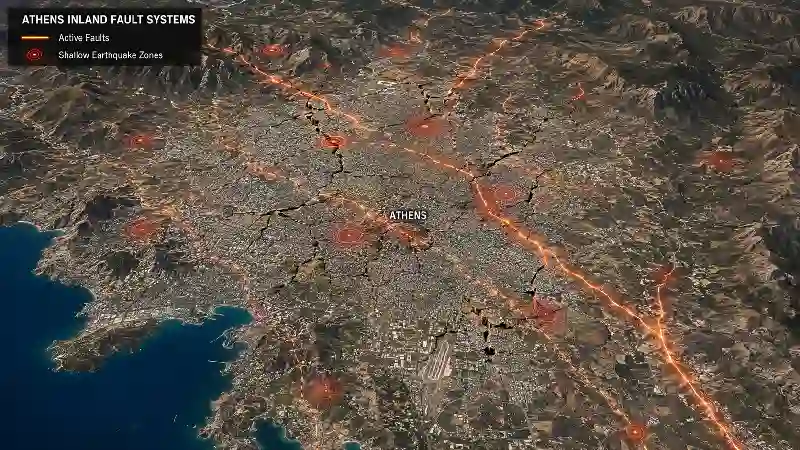
Several faults run beneath and around Athens.
- Shallow earthquakes
- Strong local shaking
- High urban risk
Explore earthquake types
Corinth Rift (Nearby Active Zone)
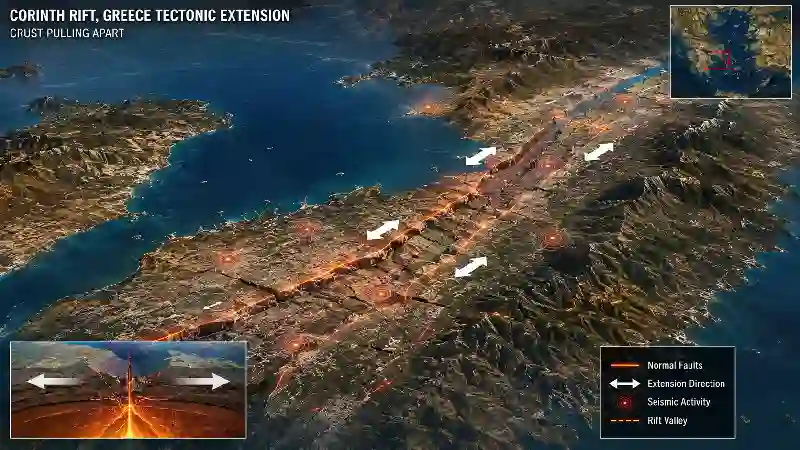
The Corinth Rift is one of the most active seismic zones near Athens.
- Crustal stretching
- Frequent earthquakes
- Strong seismic activity
Hellenic Arc Subduction Zone
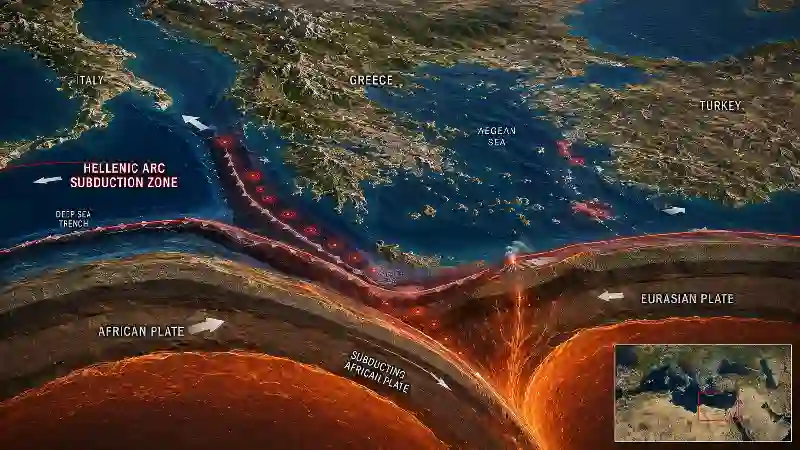
The Hellenic Arc lies south of Greece.
- Major subduction zone
- Capable of strong earthquakes
- Influences seismic activity across the region
Aegean Plate Tectonic Activity
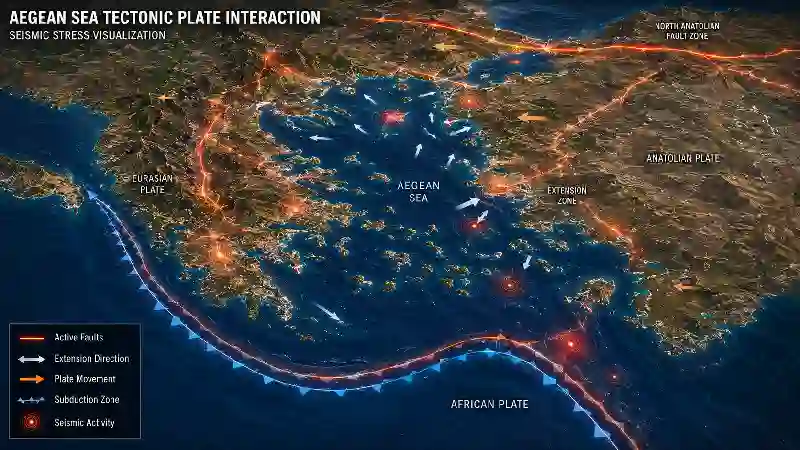
The Aegean region is highly tectonically active.
- Multiple small plates interact
- Complex fault systems
- Frequent earthquakes
Recent Earthquake Activity in Athens
Athens experiences occasional earthquakes.
Recent patterns show:
- Small to moderate earthquakes
- Activity linked to nearby fault systems
- Regional tectonic stress
Most earthquakes are moderate but can be strongly felt due to shallow depth.
Notable Earthquakes in Athens
Athens has experienced several significant earthquakes.
- 1999 Athens Earthquake (M6.0)
A strong earthquake causing damage in the city. - Historical Greek Earthquakes
Frequent seismic events across the region. - Corinth Rift Activity
Ongoing earthquake sequences near Athens.
Understand magnitude vs impact
Athens vs Other Earthquake Regions
Athens has a unique seismic profile.
- Athens → inland faults + nearby subduction
- Istanbul → transform fault system
- Tokyo → multiple subduction zones
- California → transform faults
Athens combines both compression and extension tectonics.
Can Earthquakes in Athens Be Predicted?
No — earthquakes cannot be predicted precisely.
Scientists can:
- monitor seismic activity
- study fault systems
- track tectonic movement
But exact timing remains uncertain.
Learn more → Can earthquakes be predicted
Because of tectonic interaction between the African and Eurasian Plates.
Strong shallow earthquakes from nearby fault systems.
Moderately — earthquakes occur occasionally.
Yes — damaging earthquakes are possible.
Final Thoughts
Athens sits in one of Europe’s most active seismic regions. With inland faults, nearby rift zones, and a major subduction system influencing the area, earthquakes are an ongoing natural process here.
Understanding Athens earthquakes helps explain how complex tectonic interactions shape seismic activity across the Mediterranean.