
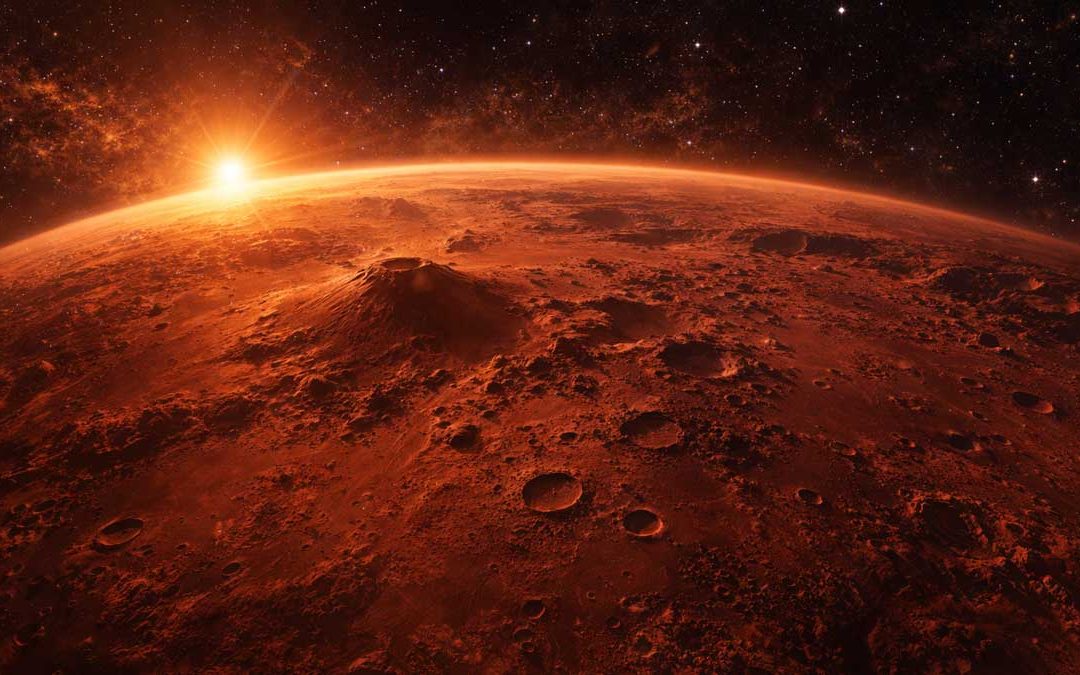
Mars is the fourth planet from the Sun and is commonly known as the Red Planet because of its reddish surface. The planet gets this color from iron oxide (rust) that covers much of its soil and rocks.
Mars has long fascinated scientists and astronomers because it is one of the most Earth-like planets in the solar system. Evidence suggests that billions of years ago Mars may have had rivers, lakes, and possibly oceans, raising questions about whether life might once have existed there.
Today, Mars is a cold desert world with a thin atmosphere, but it continues to be one of the most studied planets by space missions.
Mars Planet Quick Facts (4th Planet)
| Feature | Information |
|---|---|
| Planet Type | Rocky (Terrestrial) |
| Distance from Sun | 228 million km |
| Diameter | 6,779 km |
| Length of Day | 24.6 hours |
| Length of Year | 687 Earth days |
| Moons | 2 (Phobos & Deimos) |
| Average Temperature | −60°C |
| Surface Gravity | 38% of Earth |
Size of Mars
Mars has a diameter of about 6,779 kilometers (4,212 miles).
Although much smaller than Earth, Mars is still larger than Mercury.
| Planet | Diameter |
|---|---|
| Mercury | 4,879 km |
| Venus | 12,104 km |
| Earth | 12,742 km |
| Mars | 6,779 km |
Mars has only about 38% of Earth’s gravity, meaning objects weigh much less there. See the full guide to planet size comparison.
Why Mars Is Called the Red Planet
The surface of Mars is covered with iron-rich dust and rocks.
When iron reacts with oxygen, it forms iron oxide, which has a reddish color similar to rust on Earth.
This reddish surface gives Mars its famous nickname: the Red Planet.
Surface of Mars
Mars has some of the most impressive geological features in the solar system.
Olympus Mons
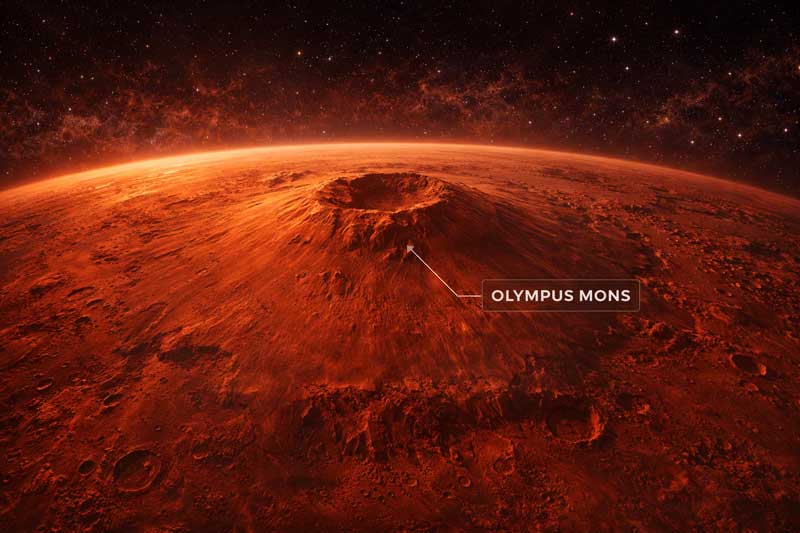
Mars is home to Olympus Mons, the largest volcano in the solar system.
It is about 22 kilometers tall, nearly three times the height of Mount Everest.
Valles Marineris
Mars also contains Valles Marineris, a massive canyon system stretching over 4,000 kilometers.
These features indicate that Mars once had strong geological activity.
Mars Atmosphere
Mars has a very thin atmosphere.
It is made mostly of:
- Carbon dioxide (95%)
- Nitrogen
- Argon
Because the atmosphere is so thin, Mars cannot trap heat effectively. As a result, the planet experiences cold temperatures and frequent dust storms.
Temperature on Mars
Mars is much colder than Earth.
| Time | Temperature |
|---|---|
| Average Temperature | −60°C |
| Winter Poles | −125°C |
| Summer Equator | 20°C |
Despite the cold climate, the planet occasionally experiences warmer temperatures near the equator.
Moons of Mars
Mars has two small moons:
Phobos
Phobos is the larger moon and orbits very close to Mars.
Deimos
Deimos is smaller and orbits farther away.
Scientists believe these moons may have formed from asteroid material captured by Mars’ gravity.
Exploration of Mars
Mars has been explored by numerous spacecraft.
Viking Missions
NASA’s Viking 1 and Viking 2 missions in the 1970s were the first to successfully land on Mars.
Mars Rovers
Several robotic rovers have explored the planet, including:
- Spirit
- Opportunity
- Curiosity
- Perseverance
These missions study the planet’s geology and search for signs of past microbial life.
Could Life Exist on Mars?
Scientists believe Mars once had liquid water on its surface billions of years ago.
Recent discoveries show evidence of:
- ancient river channels
- lakebeds
- underground ice
These findings suggest Mars may once have had conditions suitable for microbial life.
Future missions aim to collect samples that could provide more answers.
Interesting Facts About Mars
- Mars has the largest volcano in the solar system.
- A day on Mars is almost the same length as a day on Earth.
- Mars has massive dust storms that can cover the entire planet.
- The gravity on Mars is much weaker than Earth’s.
- Scientists are studying Mars as a possible future destination for human exploration.
Other Planets in the Solar System
Mars is just one of the eight planets orbiting the Sun.
Explore the others:
- Mercury – the smallest planet
- Venus – the hottest planet
- Earth – the only known planet with life
- Jupiter – the largest planet
- Saturn – famous for its rings
- Uranus – the tilted ice giant
- Neptune – the farthest planet
Also read the full guide: Solar System Planets
FAQ About Mars
Mars appears red because its surface contains iron oxide, which gives it a rusty color.
Mars currently has ice at its poles and underground, and scientists believe liquid water existed there billions of years ago.
Mars has two moons: Phobos and Deimos.
Mars is currently inhospitable to humans due to its thin atmosphere and cold temperatures, but future exploration may make human missions possible.