
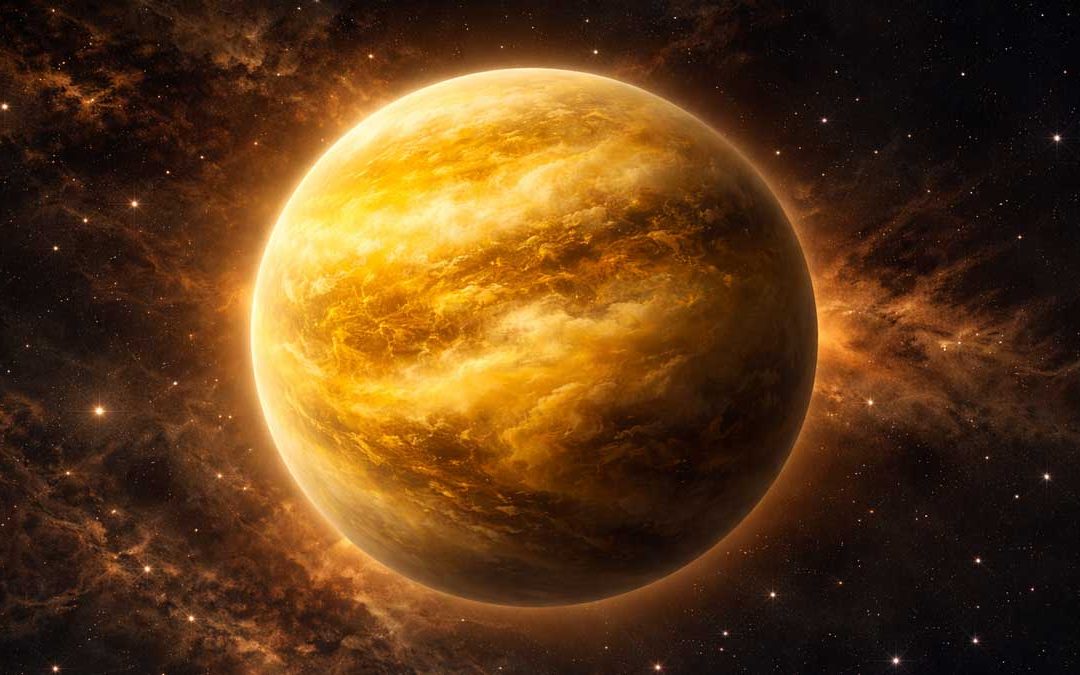
Venus is the second planet from the Sun and the hottest planet in the solar system. Although Mercury is closer to the Sun, Venus becomes much hotter because of its extremely thick atmosphere, which traps heat through a powerful greenhouse effect.
Often called Earth’s twin, Venus is similar in size and structure to Earth. However, the surface conditions on Venus are incredibly harsh, with crushing atmospheric pressure and extremely high temperatures.
Venus has fascinated astronomers for thousands of years and is one of the brightest objects visible in Earth’s night sky.
Venus Planet Quick Facts (2nd Planet)
| Feature | Information |
|---|---|
| Planet Type | Rocky (Terrestrial) |
| Distance from Sun | 108 million km |
| Diameter | 12,104 km |
| Length of Day | 243 Earth days |
| Length of Year | 225 Earth days |
| Moons | 0 |
| Average Temperature | 471°C (880°F) |
| Surface Pressure | 92× Earth |
Why Venus Is the Hottest Planet
Venus has an extremely thick atmosphere made mostly of carbon dioxide.
This atmosphere traps heat through a runaway greenhouse effect, making Venus hotter than Mercury.
| Planet | Average Temperature |
|---|---|
| Mercury | 167°C |
| Venus | 471°C |
Even though Mercury is closer to the Sun, Venus retains heat much more effectively.
The thick clouds surrounding the planet also reflect sunlight, which is why Venus appears very bright when seen from Earth.
Size of Venus
Venus is very similar in size to Earth.
| Planet | Diameter |
|---|---|
| Earth | 12,742 km |
| Venus | 12,104 km |
Because of this similarity, scientists often refer to Venus as Earth’s twin planet.
However, despite their similar sizes, the environments of the two planets are completely different. Check planet size comparison.
Surface of Venus
The surface of Venus is extremely hostile.
It is covered with:
- volcanic plains
- mountains
- lava flows
- large impact craters
Scientists believe Venus has experienced massive volcanic activity in the past.
Some evidence even suggests that volcanoes on Venus may still be active today.
The surface pressure on Venus is about 92 times stronger than Earth's, similar to the pressure found deep in Earth's oceans.
Venus Rotation and Orbit
Venus has one of the most unusual rotations in the solar system.
- One year on Venus = 225 Earth days
- One day on Venus = 243 Earth days
This means a day on Venus is longer than its year.
Venus also rotates backwards, a motion called retrograde rotation.
Because of this, the Sun would appear to rise in the west and set in the east if someone could stand on Venus.
Does Venus Have Moons?
Venus has no natural moons.
Only two planets in the solar system have no moons:
- Mercury
- Venus
Scientists believe Venus may have lost any moons it once had due to gravitational interactions or collisions early in its history.
Venus Atmosphere
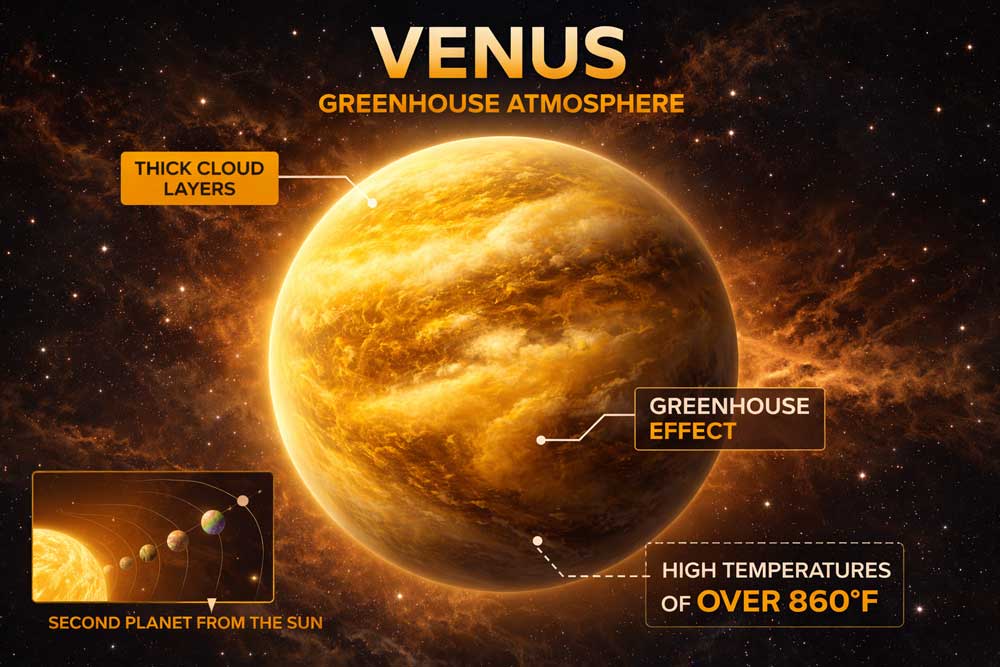
The atmosphere of Venus is extremely dense.
It consists mostly of:
- Carbon dioxide (96%)
- Nitrogen
- Clouds of sulfuric acid
These thick clouds completely hide the planet’s surface from normal telescopes.
Because of this, scientists use radar imaging from spacecraft to map the surface of Venus.
Exploration of Venus
Several missions have explored Venus.
Venera Program
The Soviet Union launched several Venera spacecraft in the 1970s and 1980s that successfully landed on Venus.
These missions captured the first images of the planet’s surface.
Magellan Mission
NASA’s Magellan spacecraft mapped about 98% of Venus’s surface using radar between 1990 and 1994.
Future Missions
New missions planned by NASA and ESA aim to better understand Venus’s atmosphere and geology.
Interesting Facts About Venus
- Venus is the brightest planet visible from Earth.
- A day on Venus is longer than its year.
- Venus rotates backwards compared to most planets.
- Surface pressure is 92 times stronger than Earth’s.
- Venus may once have had oceans billions of years ago.
Why Scientists Study Venus
Studying Venus helps scientists understand how planetary climates evolve.
Venus may once have been similar to Earth but later developed an extreme greenhouse effect.
By studying Venus, scientists learn important lessons about climate change, planetary atmospheres, and the evolution of rocky planets.
Other Planets in the Solar System
Venus is only one of the eight planets in our solar system.
Explore the others:
- Mercury – the smallest planet
- Earth – the only known planet with life
- Mars – the red planet
- Jupiter – the largest planet
- Saturn – famous for its rings
- Uranus – the tilted ice giant
- Neptune – the farthest planet
Also read the full guide: Solar System Planets
FAQ About Venus
Venus has a thick carbon dioxide atmosphere that traps heat through a strong greenhouse effect.
No. Extreme temperatures and crushing pressure make Venus uninhabitable.
Venus currently has almost no liquid water due to its extreme heat.
Its thick clouds reflect a large amount of sunlight, making it very bright when seen from Earth.