
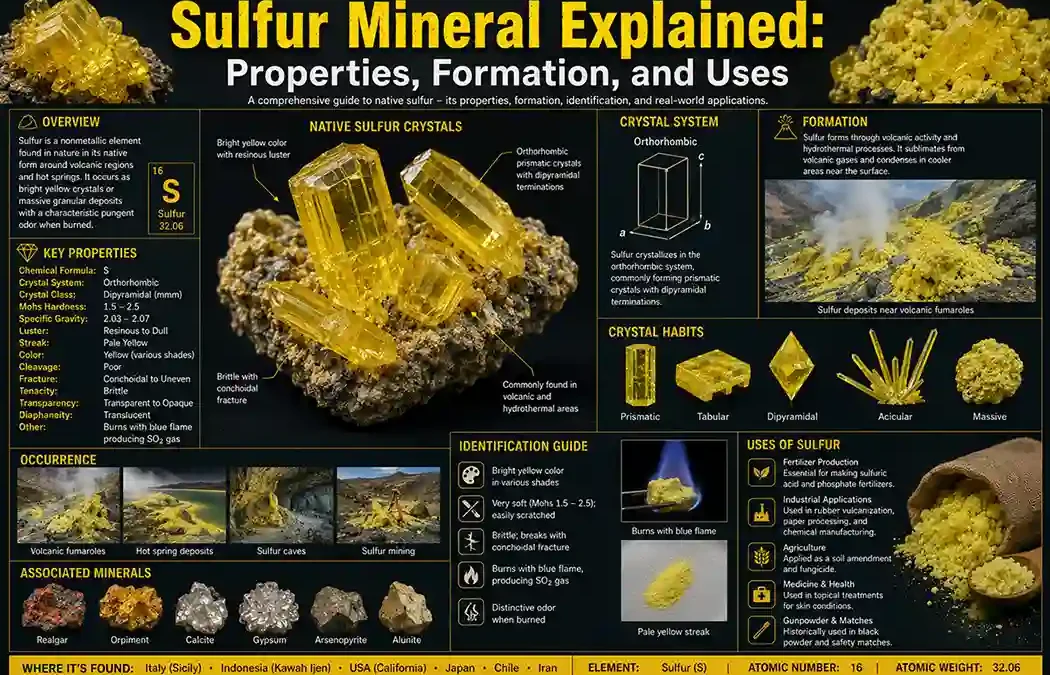
Sulfur is one of the few minerals that occur naturally as a pure chemical element. Its bright yellow color, low density, and association with volcanic activity make it one of the most recognizable minerals in geology.
Sulfur has been used by humans for thousands of years and remains one of the world's most important industrial minerals. It is essential for producing fertilizers, chemicals, pharmaceuticals, and many industrial products.
Sulfur commonly forms in:
- volcanic regions
- hot springs
- evaporite deposits
- sedimentary environments
Its distinctive appearance makes sulfur easy to identify in the field.
Learn more → what is a mineral
What Is Sulfur?
Sulfur is a native element mineral. Its chemical formula is: S. Unlike most minerals, sulfur consists entirely of a single element. It belongs to the native element mineral group alongside minerals such as gold, silver, and copper.
Basic Properties of Sulfur
| Property | Value |
|---|---|
| Chemical Formula | S |
| Mineral Group | Native Element |
| Crystal System | Orthorhombic |
| Hardness | 1.5–2.5 |
| Streak | Yellow |
| Luster | Resinous |
| Color | Bright Yellow |
Why Is Sulfur Yellow?
Sulfur's famous color comes from its atomic structure. Unlike many minerals that obtain color from impurities, sulfur's yellow appearance is an intrinsic property of the element itself.
Colors may vary from:
- pale yellow
- bright yellow
- greenish yellow
- amber yellow
depending on impurities and crystal conditions.
Crystal Structure of Sulfur
Sulfur crystals consist of sulfur atoms arranged in a repeating lattice.
This structure produces:
- bright color
- low hardness
- brittle behavior
- distinctive crystal forms
Sulfur's crystal structure differs significantly from metallic native elements.
Learn more → crystal structure in minerals
Crystal System of Sulfur
Sulfur belongs to the orthorhombic crystal system. Its crystallographic relationship is: .
Common crystal forms include:
- dipyramidal crystals
- tabular crystals
- massive aggregates
Learn more → orthorhombic crystal system
Physical Properties of Sulfur
| Property | Description |
|---|---|
| Color | Bright yellow |
| Streak | Yellow |
| Luster | Resinous |
| Hardness | 1.5–2.5 |
| Cleavage | Poor |
| Fracture | Conchoidal to uneven |
| Specific Gravity | ~2.0 |
How Sulfur Forms
Sulfur forms through several geological processes.
Volcanic Activity
Volcanic gases cool and deposit sulfur around vents and fumaroles.
Hot Springs
Sulfur-rich fluids precipitate native sulfur.
Biological Activity
Certain bacteria help form sulfur deposits.
Sedimentary Processes
Sulfur may develop in evaporite and hydrocarbon-rich environments.
Sulfur and Volcanoes
A Classic Volcanic Mineral Sulfur is strongly associated with:
- active volcanoes
- fumaroles
- geothermal fields
- volcanic gas emissions
As volcanic gases cool, sulfur crystals may form around vents, creating spectacular yellow deposits.
Major Sulfur Deposits
Important sulfur-producing regions occur in:
- Indonesia
- Italy
- United States
- Mexico
- Poland
- Russia
Many deposits are linked to volcanic or evaporite environments.
Sulfur in Biological Systems
Sulfur is essential for life.
It is found in:
- proteins
- amino acids
- enzymes
The sulfur cycle plays a major role in Earth's environmental systems.
Industrial Uses of Sulfur
Sulfur is one of the most important industrial minerals.
Fertilizer Production
Used to manufacture sulfuric acid and fertilizers.
Chemical Industry
Essential for producing many industrial chemicals.
Petroleum Refining
Used during fuel processing.
Pharmaceuticals
Important in medicines and healthcare products.
Rubber Manufacturing
Used in vulcanization processes.
Major Uses of Sulfur
| Industry | Application |
|---|---|
| Agriculture | Fertilizers |
| Chemical | Sulfuric acid |
| Petroleum | Refining |
| Pharmaceuticals | Medicines |
| Manufacturing | Rubber production |
Sulfur and Sulfuric Acid
One of sulfur's most important applications is the production of sulfuric acid
Simplified reaction:
Sulfuric acid is one of the most widely produced industrial chemicals in the world.
Sulfur in Mineral Identification
Geologists identify sulfur using:
- bright yellow color
- yellow streak
- low hardness
- resinous luster
- association with volcanic areas
Its vivid color makes sulfur one of the easiest minerals to recognize.
Learn more → mineral identification guide
Sulfur Identification Summary
| Property | Sulfur |
|---|---|
| Formula | S |
| Hardness | 1.5–2.5 |
| Crystal System | Orthorhombic |
| Streak | Yellow |
| Color | Bright Yellow |
| Mineral Group | Native Element |
Yes. Native sulfur is a naturally occurring mineral composed of elemental sulfur.
Its atomic structure naturally produces a bright yellow color.
Sulfur belongs to the orthorhombic crystal system.
Sulfur commonly occurs near volcanoes, hot springs, evaporite deposits, and sedimentary environments.
Sulfur is primarily used in fertilizer production, sulfuric acid manufacturing, petroleum refining, and chemical industries.
Final Thoughts
Sulfur is one of the most distinctive minerals in geology thanks to its brilliant yellow color, volcanic associations, and importance as a native element. Beyond its geological significance, sulfur is essential to agriculture, manufacturing, and modern industry.
From volcanic fumaroles to fertilizer production, sulfur demonstrates how naturally occurring minerals can have enormous scientific and economic importance.