
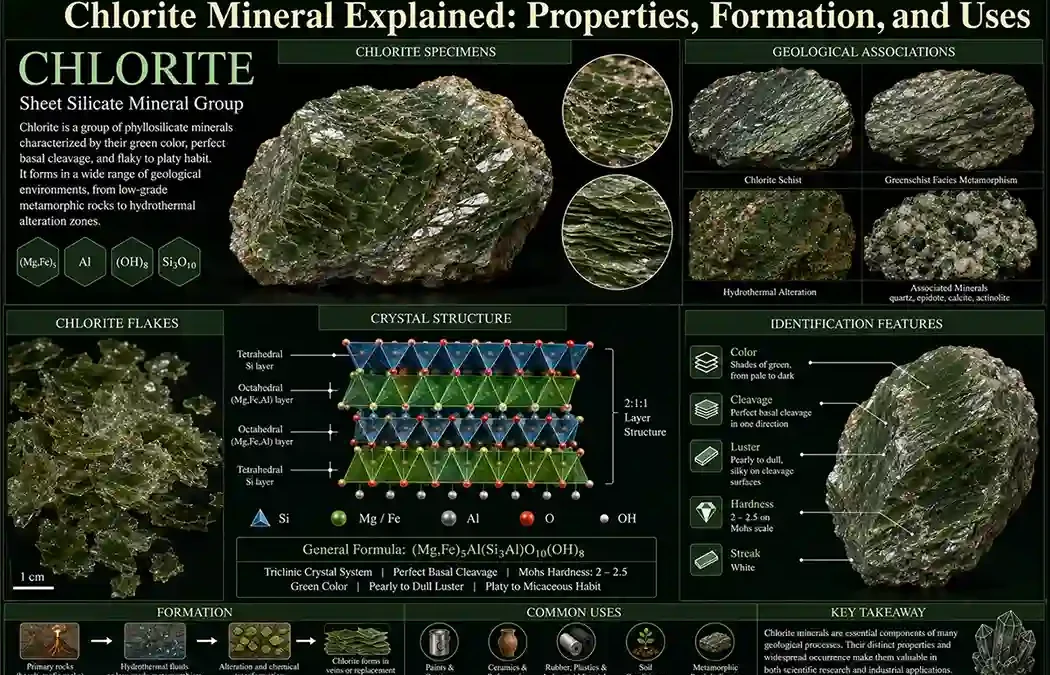
Chlorite is a common green mineral group belonging to the phyllosilicate (sheet silicate) family. It is especially abundant in metamorphic rocks and forms during the alteration of other ferromagnesian minerals such as biotite, pyroxene, amphibole, and garnet.
Chlorite is important because it:
- indicates low- to medium-grade metamorphism
- helps geologists interpret metamorphic conditions
- commonly occurs in schist and greenstone
- forms through mineral alteration processes
Its characteristic green color makes chlorite one of the most recognizable metamorphic minerals.
Learn more → what is a mineral
What Is Chlorite?
Chlorite is a group of hydrated magnesium-iron-aluminum silicate minerals. A generalized chlorite formula is:
Chlorite contains varying amounts of:
- magnesium
- iron
- aluminum
- silicon
- oxygen
- hydroxyl
It belongs to the chlorite group within the phyllosilicate minerals.
Basic Properties of Chlorite
| Property | Value |
|---|---|
| Mineral Group | Chlorite |
| Chemical Class | Phyllosilicate |
| Crystal System | Monoclinic |
| Hardness | 2–2.5 |
| Streak | White to Pale Green |
| Luster | Pearly to Vitreous |
Why Is Chlorite Green?
The characteristic green color of chlorite comes from iron and magnesium content.
These elements produce shades ranging from:
- pale green
- olive green
- dark green
- grayish green
The name chlorite comes from the Greek word chloros, meaning green.
Crystal Structure of Chlorite
Chlorite has a layered sheet silicate structure
Its structure contains:
- silica tetrahedral sheets
- octahedral magnesium and iron layers
- hydroxyl-rich layers
This structure produces:
- flaky crystals
- perfect cleavage
- low hardness
Learn more → crystal-structure-in-minerals
Crystal System of Chlorite
Most chlorite minerals belong to the monoclinic crystal system. Its crystallographic relationship is: However, visible crystals are uncommon because chlorite usually occurs as flakes or masses.
Learn more → monoclinic crystal system
Physical Properties of Chlorite
| Property | Description |
|---|---|
| Color | Green to dark green |
| Streak | White to pale green |
| Luster | Pearly to vitreous |
| Hardness | 2–2.5 |
| Cleavage | Perfect basal |
| Transparency | Transparent in thin flakes |
| Specific Gravity | 2.6–3.3 |
How Chlorite Forms
Chlorite commonly forms through:
Metamorphism
Develops under low- to medium-grade metamorphic conditions.
Hydrothermal Alteration
Hot fluids alter existing minerals.
Weathering
May form from decomposition of ferromagnesian minerals.
Regional Metamorphism
Common during mountain-building events.
Chlorite in Metamorphic Rocks
Important metamorphic mineral chlorite commonly occurs in:
- schist
- phyllite
- slate
- greenstone
- chlorite schist
Its abundance often indicates low-grade metamorphism. Geologists use chlorite as an indicator mineral when interpreting metamorphic history.
Chlorite and Metamorphic Grade
Chlorite is associated with chlorite zone metamorphism. This zone represents relatively low temperatures and pressures.
As metamorphism increases, chlorite may transform into:
- biotite
- garnet
- staurolite
These mineral changes help geologists estimate metamorphic conditions.
Learn more → garnet mineral explained
Chlorite vs Biotite
| Property | Chlorite | Biotite |
|---|---|---|
| Color | Green | Black-Brown |
| Hardness | 2–2.5 | 2.5–3 |
| Metamorphic Grade | Lower | Higher |
| Iron Content | Moderate | Higher |
Both minerals have sheet structures, but chlorite is generally greener and softer.
Learn more → biotite mineral explained
Geological Importance of Chlorite
Chlorite helps geologists determine:
- metamorphic grade
- alteration processes
- hydrothermal activity
- tectonic history
Its presence provides important clues about rock evolution.
Industrial and Scientific Uses
Although chlorite has limited commercial value, it is important in:
Geological Research
Understanding metamorphism and alteration.
Mineral Collections
Common educational mineral.
Petrology
Studying metamorphic rocks.
Environmental Studies
Investigating rock weathering processes.
Major Uses of Chlorite
| Field | Application |
|---|---|
| Geology | Metamorphic studies |
| Education | Mineral collections |
| Research | Petrology |
| Environmental Science | Weathering studies |
Chlorite in Mineral Identification
Geologists identify chlorite using:
- green color
- flaky habit
- perfect cleavage
- low hardness
- occurrence in metamorphic rocks
Its green color and sheet-like appearance are the most obvious features.
Learn more → mineral-identification-guide
Chlorite Identification Summary
| Property | Chlorite |
|---|---|
| Hardness | 2–2.5 |
| Crystal System | Monoclinic |
| Cleavage | Perfect Basal |
| Color | Green |
| Structure | Sheet Silicate |
| Mineral Group | Chlorite |
Chlorite is a group of green phyllosilicate minerals commonly found in metamorphic rocks.
Its green color is caused primarily by iron and magnesium within its crystal structure.
Most chlorite minerals belong to the monoclinic crystal system.
Chlorite occurs in schist, phyllite, slate, greenstone, and hydrothermally altered rocks.
Chlorite is an important indicator of low-grade metamorphism and hydrothermal alteration.
Final Thoughts
Chlorite is one of the most important metamorphic minerals for understanding low-grade metamorphism and rock alteration. Its distinctive green color, sheet silicate structure, and widespread occurrence make it a valuable tool for geologists studying Earth's crust.
From mountain belts and metamorphic terrains to hydrothermal systems, chlorite provides important evidence of the geological processes that shape rocks over time.