
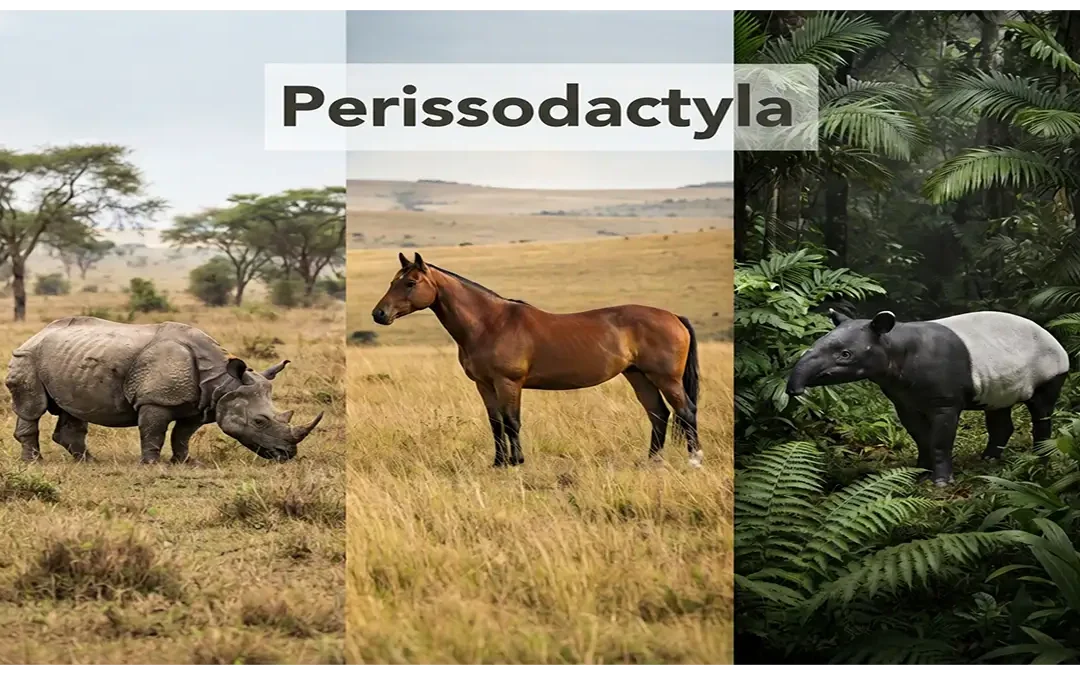
Perissodactyla is an order of hoofed mammals that includes horses, zebras, rhinoceroses, and tapirs. Commonly known as odd-toed ungulates, these animals share a distinctive foot structure in which the third toe forms the central weight-bearing axis. They inhabit diverse environments, including grasslands, savannas, and tropical forests, where they feed mainly on plant material. The fossil record reveals many extinct relatives, some of which had unusual body shapes and enormous sizes. Studying Perissodactyla helps scientists understand mammalian evolution, ancient ecosystems, biodiversity, and the conservation challenges facing several living species today.
What Is Perissodactyla?
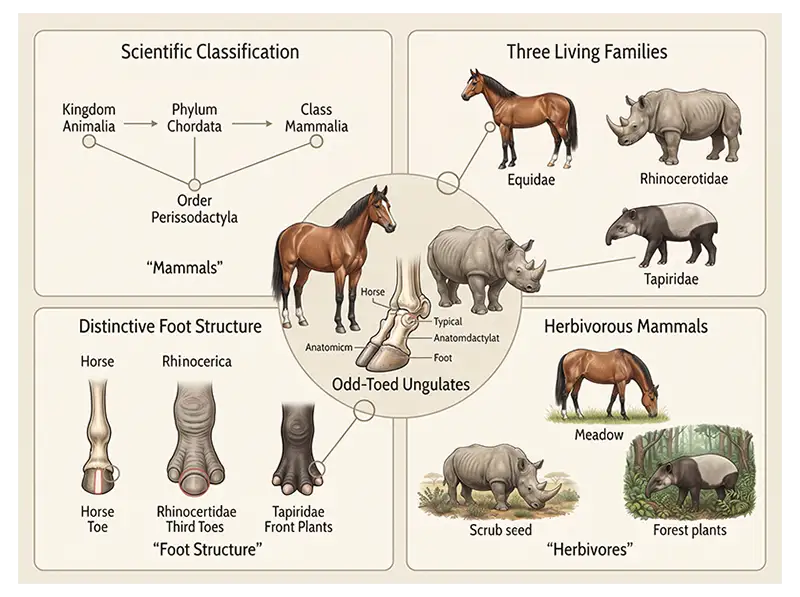
Perissodactyla is a taxonomic order of hoofed mammals belonging to the class Mammalia. Its living members include horses, zebras, asses, rhinoceroses, and tapirs. The name comes from Greek roots commonly interpreted as referring to an odd number of toes, reflecting the characteristic structure of their feet.
These mammals are part of a broader group of hoofed animals known as ungulates. Unlike even-toed ungulates, such as deer, cattle, and pigs, the main weight-bearing axis of a typical perissodactyl foot passes through the third digit. In horses, this arrangement is especially specialized: the third toe supports almost the entire body weight.
The order includes three living families:
- Equidae: Horses, zebras, and asses.
- Rhinocerotidae: Rhinoceroses.
- Tapiridae: Tapirs.
Many additional families are known from fossils. They occupied environments and ecological roles that are no longer represented among living species.
Perissodactyls are primarily herbivorous, meaning they obtain most of their food from plants. Their diets range from grasses to leaves, shoots, fruits, and other vegetation. Differences in teeth, digestive systems, body proportions, and feeding structures reflect the variety of plant resources they use.
The group became especially diverse during the Cenozoic Era, which began about 66 million years ago. Although many ancient lineages eventually disappeared, horses, rhinoceroses, and tapirs remain living representatives of this important mammalian order.
What Are the Main Characteristics of Perissodactyla?
Perissodactyls share several anatomical and biological traits, but the degree to which each feature is developed varies among families. Their most important common characteristics relate to their feet, teeth, digestive systems, and adaptation to plant-based diets.
Odd-toed foot structure
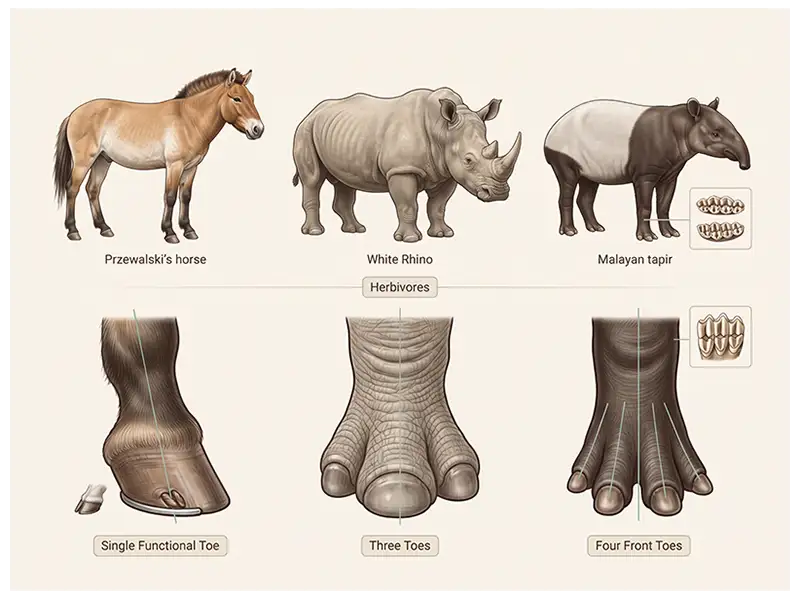
The defining feature is the arrangement of the toes. The third digit forms the central axis of the foot and is particularly important for supporting weight. Horses have a single functional toe on each foot, while rhinoceroses typically have three toes and tapirs have four toes on the front feet and three on the hind feet.
Hooves
The digits of living perissodactyls terminate in hoof structures. These tough coverings protect the ends of the toes and help distribute forces during movement. Hoof shape differs among families according to body weight, speed, and habitat.
Herbivorous diet
Living members of the order primarily eat plant material. Horses and zebras often graze on grasses, while tapirs commonly browse on leaves, shoots, and fruits. Rhinoceroses may graze or browse depending on the species.
Specialized teeth
Their teeth are adapted for processing vegetation. Many perissodactyls have broad premolars and molars with surfaces suited to crushing or grinding plant material. Horse teeth are particularly adapted to wear caused by abrasive grasses and the dust or grit associated with grazing.
Large range of body sizes
The order includes animals with very different body proportions. Tapirs are relatively compact, horses have elongated limbs, and rhinoceroses can weigh several tonnes. Fossil members included some of the largest land mammals known.
Well-developed senses
Perissodactyls rely on combinations of vision, hearing, smell, and other sensory abilities to locate food and respond to danger. The importance of each sense varies with lifestyle. For example, many horses and zebras depend on alertness and rapid movement in open habitats, while tapirs use their flexible snouts and keen sense of smell when foraging.
These characteristics provide a shared foundation for the order, while differences among its families show how related mammals can adapt to distinct ecological conditions.
How Are Perissodactyls Classified?
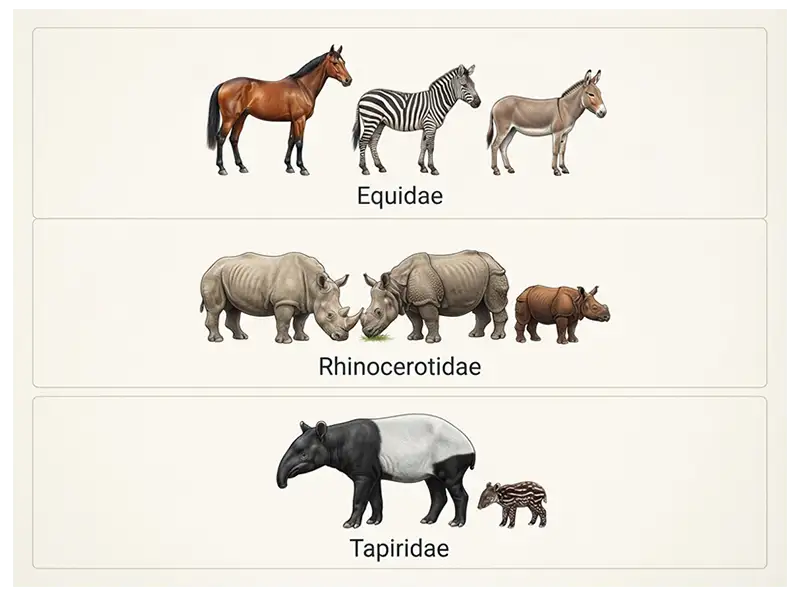
Scientists classify perissodactyls by examining anatomical characteristics, fossil evidence, and evolutionary relationships. Modern classification recognizes three living families, each containing animals with distinctive body structures and ecological adaptations.
Family Equidae
Equidae includes horses, zebras, and asses. Members of this family are characterized by elongated limbs, a single functional toe on each foot, and teeth adapted to grinding vegetation.
Many equids are well suited to running. Their long legs help them travel efficiently across open landscapes, and several species live in grasslands or savannas. Horses and zebras are social animals, although group structures and behavior vary by species.
Family Rhinocerotidae
Rhinocerotidae includes the living rhinoceros species. These mammals have heavy bodies, thick skin, three functional toes on each foot, and large skulls. Most living rhinoceroses possess one or two horns made primarily of keratin, the same structural protein found in human hair and nails.
Rhinoceroses differ in their feeding habits. White rhinoceroses are mainly grazers, while black rhinoceroses generally browse on woody plants and shrubs. Asian species also have different combinations of browsing and grazing behaviors.
Family Tapiridae
Tapiridae includes the living tapirs of Central and South America and Southeast Asia. Tapirs have compact bodies, short legs, and a flexible snout formed by the nose and upper lip. Their front feet have four toes, while their hind feet have three.
They are commonly associated with forests and other habitats with access to water and dense vegetation. Their flexible snouts help them select leaves, shoots, and fruits.
Extinct families and fossil lineages
The fossil record contains many additional perissodactyl families. Brontotheres were large herbivores, some with prominent paired projections on their snouts. Chalicotheres developed unusual forelimbs and long curved claws. Ancient rhinoceros relatives included species with body shapes and sizes unlike those of living rhinoceroses.
These fossil groups demonstrate that the order was once more diverse in body form and ecological role. Their classification depends on anatomical and evolutionary evidence, and researchers continue to revise relationships as new fossils and analyses become available.
How Is the Body of a Perissodactyl Adapted for Movement?
Perissodactyls use different combinations of limb structure, muscle strength, and foot anatomy to support their body weight and move through their habitats. Their shared central toe pattern does not mean every member moves in the same way.
Horses and zebras: efficient running
Equids have long limbs and a highly specialized single functional toe. The third digit is enclosed by a hoof, while other digits are reduced to small internal or vestigial structures. This arrangement helps support the body during fast movement.
Their limb joints and tendons contribute to efficient locomotion. Horses and zebras can cover considerable distances, and many rely on speed to escape predators. Their bodies are particularly suited to travel across open terrain.
Rhinoceroses: support for heavy bodies
Rhinoceroses have three weight-bearing toes on each foot. Their broad feet help support their substantial body mass and provide stability as they walk or run. Strong limbs and robust joints allow them to move through grasslands, scrub, and forest habitats.
Despite their size, rhinoceroses can move quickly over short distances. Their locomotion is not built around the same extreme limb specialization found in horses, but their feet and legs provide the support needed for heavy bodies.
Tapirs: movement through forests
Tapirs have shorter limbs and multiple toes that help them move through forest vegetation and across soft ground. Their feet support movement on uneven surfaces, while their compact body shape helps them navigate dense habitats.
Some tapirs are strong swimmers and may enter water to cool themselves, forage, or escape danger. Their movement patterns reflect their forest-associated lifestyle rather than the high-speed running specialization of many equids.
How hooves and toes function
Hooves protect the ends of the digits and transmit forces between the body and the ground. The number of functional toes, foot shape, limb proportions, and body mass all affect how a perissodactyl moves.
These differences illustrate a major evolutionary principle: related animals can retain a shared anatomical pattern while adapting it to very different forms of locomotion.
Where Do Perissodactyls Live?
Living perissodactyls occupy a range of habitats, including grasslands, savannas, shrublands, forests, and wetlands. Their distributions reflect evolutionary history, food availability, climate, and the influence of human activity.
Grasslands and open plains
Horses and several zebra species are associated with open grasslands and savannas. These environments provide abundant grasses and enough space for animals to travel, forage, and detect potential threats. Different equids tolerate different environmental conditions. Some inhabit relatively dry regions, while others depend on grasslands with more reliable water and plant growth.
Forests and dense vegetation
Tapirs are strongly associated with forested habitats. Depending on the species, they live in tropical rainforests, mountain forests, or other landscapes with dense vegetation and suitable water sources. Forest cover provides food and shelter. Tapirs often use established paths through vegetation and may visit rivers or pools as part of their daily activity.
Shrublands and mixed habitats
Several rhinoceros species occupy habitats that include grassland, scrub, woodland, and forest. The black rhinoceros often browses in areas with shrubs and woody plants, while the white rhinoceros commonly favors more open grasslands. Asian rhinoceroses use a range of habitats, including tropical forests, grasslands, and wetlands, depending on the species and location.
Geographic distribution
Historically, perissodactyls occupied much larger portions of the world than they do today. Fossil evidence shows that ancient members lived across parts of North America, Europe, Asia, and other regions. Their modern distribution is more restricted, particularly for rhinoceroses and tapirs.
Today, wild equids occur in parts of Africa and Asia, rhinoceroses survive in selected areas of Africa and Asia, and tapirs live in Central and South America and Southeast Asia.
Habitat requirements differ even within a single family. Protecting these mammals therefore requires attention to the specific landscapes, food sources, and movement routes that each species needs.
What Do Perissodactyls Eat?
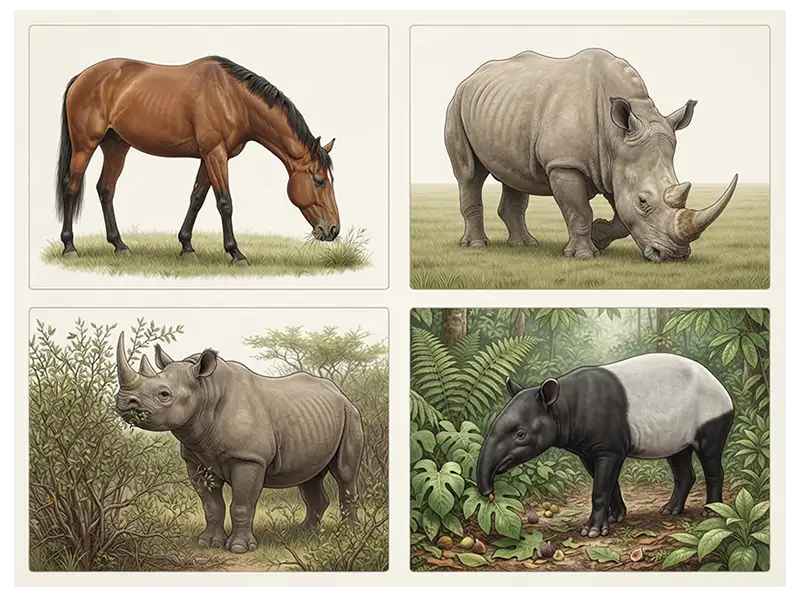
Living perissodactyls are primarily herbivores, but their diets vary according to tooth structure, habitat, and food availability. Some species mainly consume grasses, while others select leaves, shoots, fruits, and other plant parts.
Grazing in equids
Horses, zebras, and asses commonly feed on grasses and other low-growing vegetation. Their broad grinding teeth help break down plant material, and their dental structures are adapted to the wear caused by abrasive foods.
Grasses can contain silica and may be contaminated with grit, especially in dry or dusty habitats. The combination of these materials contributes to tooth wear, which is one reason equids have specialized, high-crowned teeth.
Browsing in tapirs
Tapirs generally consume leaves, shoots, fruits, and other vegetation. Their flexible snouts help them grasp and select food from plants. They may feed on fallen fruit as well as vegetation growing at different heights.
By consuming fruit and passing viable seeds through their digestive systems, tapirs can contribute to seed dispersal. The importance of this role depends on the plant species, local ecosystem, and movement patterns of the animals.
Different feeding strategies among rhinoceroses
Rhinoceros diets differ considerably. White rhinoceroses are primarily grazers and have broad, relatively wide mouths suited to cropping grass. Black rhinoceroses mainly browse on shrubs and woody plants, using a more pointed, grasping upper lip.
Other rhinoceros species consume combinations of leaves, grasses, shoots, and aquatic or wetland vegetation. Their feeding preferences reflect both anatomical differences and the resources available in their habitats.
Digestion and nutrient extraction
Perissodactyls are hindgut fermenters. Microorganisms in the cecum and colon help break down plant material that the animal's own digestive enzymes cannot fully digest. This process allows them to obtain nutrients from fibrous vegetation. Compared with ruminants such as cattle.
which ferment food in a foregut chamber before it reaches the small intestine, perissodactyls carry out much of their microbial fermentation farther along the digestive tract. Their feeding adaptations allow them to use a variety of plant resources and occupy different ecological niches.
How Did Perissodactyla Evolve?
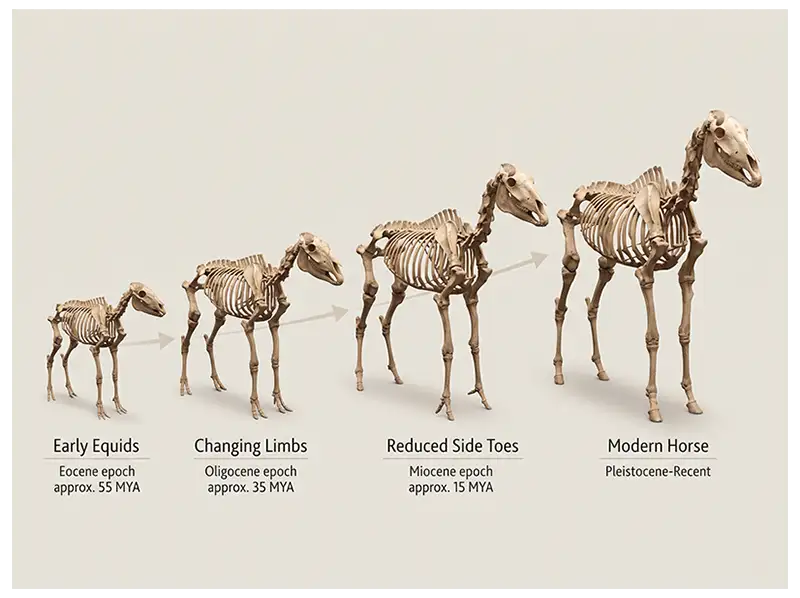
Perissodactyla emerged during the early Cenozoic Era, after the end-Cretaceous mass extinction approximately 66 million years ago. Early members were generally smaller than many later forms, and the group subsequently diversified into a wide variety of body sizes and ecological roles.
Early evolution during the Paleogene
Some of the earliest recognized perissodactyls appeared during the Eocene, although the precise relationships and timing of the earliest branches remain subjects of research. Early members included relatively small mammals with more toes than their modern descendants.
Fossil teeth, skulls, and limb bones provide evidence of their anatomy and lifestyles. These remains help scientists reconstruct how the order diversified as mammalian ecosystems developed after the extinction of non-avian dinosaurs.
Changes in feet and limbs
One important evolutionary trend occurred in the equid lineage. Early horses had multiple toes, while later forms developed increasingly specialized limbs. In many later equids, the central third toe became dominant and the side toes became reduced.
This transformation helped produce the single-hoofed foot of modern horses. It was not a simple process in which every species followed one straight path; different horse lineages displayed different combinations of toe structure and body form.
Changes in teeth and diet
Dental evolution also played an important role. As some lineages adapted to consuming more abrasive grasses, their teeth developed features that improved resistance to wear. In horses, high-crowned teeth became particularly important in grazing environments.
Not all perissodactyls followed this trend. Many species remained browsers, and their teeth reflected diets dominated by leaves or other softer plant material.
Diversification and extinction
Perissodactyls became highly diverse during parts of the Paleogene and Neogene. North America and Eurasia supported many extinct forms, including brontotheres, tapir relatives, and numerous ancient equids and rhinoceroses.
Over time, changes in climate, vegetation, competition, and geographic distribution contributed to the decline or extinction of several lineages. The reasons varied among groups, and no single environmental change explains every extinction.
The survival of three living families
Today, only Equidae, Rhinocerotidae, and Tapiridae remain among the living perissodactyls. Their survival reflects different evolutionary histories and ecological specializations. Modern horses and zebras represent highly specialized equids; rhinoceroses preserve a different combination of heavy body structure and three-toed feet; and tapirs retain a distinctive body form suited to browsing in forest environments.
The evolutionary history of Perissodactyla demonstrates how mammalian groups diversify, adapt, and sometimes decline as environments and ecosystems change.
What Were the Major Extinct Perissodactyls?
The fossil record includes many perissodactyls that looked very different from modern horses, rhinoceroses, and tapirs. Some were large browsers, others developed unusual limbs, and several lineages occupied ecological roles that no longer exist among living members of the order.
Brontotheres
Brontotheres were large herbivorous mammals that lived mainly during the Eocene and early Oligocene. Some species, including Megacerops, had massive bodies and paired bony projections on the front of the skull. These projections were not the same as the keratin horns of living rhinoceroses.
Their exact functions remain a subject of research, although display and competition are among the proposed explanations. Brontotheres disappeared around the Eocene–Oligocene transition, a time of significant climatic and environmental change. Their extinction illustrates how even large, successful mammal groups could be vulnerable to changing conditions.
Chalicotheres
Chalicotheres were unusual perissodactyls with long forelimbs and curved claws instead of the typical hoof-like appearance associated with living members. Some had shorter hind limbs and body proportions that differed sharply from those of horses and rhinoceroses.
Their anatomy suggests that at least some chalicotheres could reach vegetation using their forelimbs and claws. Their exact feeding behavior varied among species and is reconstructed from fossil anatomy rather than direct observation.
Chalicotheres survived into the later Cenozoic, with some forms persisting into the Pleistocene in parts of Eurasia and Africa. They demonstrate how widely perissodactyl body plans could vary.
Giant rhinoceros relatives
Among the largest known land mammals were giant hornless rhinoceros relatives, especially Paraceratherium. These animals lived during the Oligocene and had long limbs and necks that allowed them to browse on vegetation above the reach of many other herbivores.
Their size made them striking members of ancient terrestrial ecosystems. Fossil bones and teeth help researchers estimate their proportions and infer aspects of their diet, although exact body mass estimates remain uncertain.
Ancient horses
Early equids differed greatly from modern horses. Many had shorter legs, smaller bodies, and multiple functional toes. Over millions of years, different horse lineages developed varied combinations of body size, tooth structure, and locomotory adaptations.
The fossil record of horses is particularly useful for studying evolutionary change because many species are represented by teeth and limb bones. However, horse evolution should not be portrayed as a single linear progression toward the modern horse: numerous branches coexisted, and many became extinct.
Why extinct forms matter
These animals reveal the breadth of perissodactyl evolution. Their fossils help scientists investigate changes in vegetation, climate, feeding strategies, and mammalian communities through geological time. Their unusual forms also show why modern representatives alone cannot convey the full evolutionary diversity of the order.
How Do Perissodactyls Reproduce and Raise Their Young?
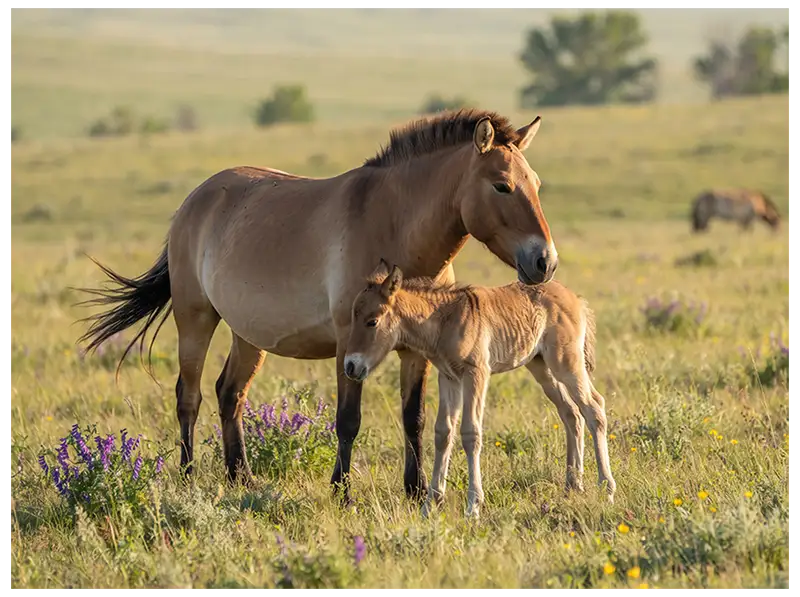
Perissodactyls reproduce sexually, with females giving birth to live young after a period of pregnancy. Reproductive timing, gestation length, social behavior, and parental care vary among horses, rhinoceroses, and tapirs.
Pregnancy and birth
Females carry developing young internally until birth. Gestation is relatively long in many species, particularly when compared with that of small mammals. Horses commonly have a gestation period of around 11 months, while rhinoceros and tapir pregnancies also last many months, with duration varying by species.
Most perissodactyl births result in a single offspring. Twins can occur in equids but are uncommon, and multiple births are unusual in many of the other living members.
Care of newborns
Young horses and zebras are precocial: they are relatively well developed at birth and can usually stand and begin moving soon afterward. This ability is important for species whose survival may depend on staying with a moving herd.
Rhinoceros calves remain dependent on their mothers for protection and nourishment over an extended period. Tapir calves are born with distinctive patterns of pale spots and stripes that provide camouflage in forest vegetation. These markings gradually fade as they mature.
Growth and maturity
Young perissodactyls grow through juvenile stages before reaching adult size and reproductive maturity. Growth rates differ with species, food supply, health, and environmental conditions.
The timing of maturity also varies. Smaller equids and larger rhinoceroses do not follow identical developmental schedules, and captive conditions may differ from those in the wild.
Reproductive challenges
Successful reproduction depends on suitable habitat, access to food and water, and the survival of young animals. In threatened species, poaching, habitat fragmentation, disturbance, and the loss of breeding individuals can reduce population growth.
Understanding reproductive biology helps conservationists estimate population trends, manage protected populations, and identify factors limiting recovery.
Why Are Perissodactyls Important to Their Ecosystems?
Perissodactyls influence the ecosystems they inhabit through feeding, movement, and interactions with other organisms. Their effects differ among species because a grazing horse does not use vegetation in the same way as a browsing tapir or rhinoceros.
Influence on vegetation
Grazing equids consume grasses and can affect vegetation height, plant composition, and the distribution of nutrients. The overall effect depends on population density, rainfall, soil conditions, and the presence of other herbivores.
Browsing rhinoceroses and tapirs remove leaves, shoots, and other plant material. This feeding can influence which plants grow successfully and how vegetation develops over time.
Seed dispersal
Tapirs eat fruits and may carry seeds away from the parent plant before depositing them in their dung. This process can help some plants spread through forest habitats.
The effectiveness of seed dispersal depends on the plant species, seed survival during digestion, and the distances travelled by the animals. Not every fruit consumed results in successful plant establishment.
Nutrient cycling
Plant material consumed by perissodactyls is converted into dung and other waste products that return nutrients to the environment. These materials can support decomposers and contribute to nutrient cycling in soil and vegetation.
Large herbivores can also move nutrients between areas as they travel, although the scale of this effect depends on their numbers and movement patterns.
Interactions with other wildlife
Perissodactyls share habitats with other herbivores, predators, and scavengers. Their feeding can alter the availability of vegetation, while carcasses provide resources for scavenging animals after death.
Their ecological roles should not be overstated: the effect of a species depends on its abundance, habitat, and interactions with other organisms. Nevertheless, large herbivores can be influential components of many terrestrial ecosystems.
What Threats Do Modern Perissodactyls Face?
Several living perissodactyl species face serious conservation challenges. The severity of each threat differs among species and regions, but habitat loss, illegal hunting, and conflict with human activities are major concerns.
Habitat loss and fragmentation
Agriculture, roads, settlements, mining, and other forms of development can reduce the amount of suitable habitat available to wildlife. Remaining habitat may become divided into isolated patches, making it harder for animals to find food, water, mates, and safe breeding areas.
Tapirs can be particularly affected by forest clearance and fragmentation. Rhinoceroses also need sufficiently large and connected areas to support viable populations, while wild equids may lose access to traditional grazing grounds and migration routes.
Poaching and illegal wildlife trade
Rhinoceroses are targeted by poachers because of demand for their horns. Illegal killing can have severe effects on small populations, especially when breeding adults are lost.
Conservation responses include anti-poaching patrols, intelligence-led enforcement, protected areas, monitoring technology, and efforts to reduce demand for illegal wildlife products.
Human–wildlife conflict
Perissodactyls sometimes encounter people in agricultural landscapes or near settlements. Horses and other equids may compete with livestock for resources in certain settings, while rhinoceroses can damage crops or pose risks to people when encounters occur at close range.
Conflict reduction can involve improved land-use planning, community-based conservation, wildlife corridors, and practical measures that protect both people and animals.
Climate and environmental change
Changes in temperature, rainfall, drought frequency, and vegetation can alter the availability of food and water. Species restricted to particular habitats may be especially vulnerable when suitable areas shrink or become disconnected.
Climate change can also interact with existing pressures, such as habitat fragmentation, making it harder for populations to move into more favorable environments.
Conservation and population recovery
Protected areas, habitat restoration, anti-poaching efforts, captive breeding where appropriate, and international cooperation all contribute to conservation. Some rhinoceros populations have benefited from sustained protection, although others remain critically threatened.
The International Union for Conservation of Nature (IUCN) assesses the conservation status of individual species. Status varies across Perissodactyla, so it is inaccurate to describe the entire order as equally endangered. Conservation planning must be tailored to each species, population, and region.
Conclusion
Perissodactyla is an important order of hoofed mammals whose living members include horses, zebras, rhinoceroses, and tapirs. Their characteristic foot structure, specialized teeth, and plant-based diets connect them through a shared evolutionary history, while differences in body shape and behavior reflect adaptations to distinct environments.
The fossil record reveals that the order was once far more diverse, including giant rhinoceros relatives, unusual clawed herbivores, and many extinct horse lineages. These remains help scientists reconstruct mammalian evolution and understand how environmental changes influenced the development and disappearance of species.
Modern perissodactyls also contribute to ecosystem processes through grazing, browsing, seed dispersal, and nutrient cycling. Protecting threatened species and their habitats is essential for preserving the remaining diversity of this ancient mammalian group.
Studying Perissodactyla therefore connects zoology, paleontology, ecology, and conservation, showing how evolutionary history continues to shape the animals living on Earth today.
Perissodactyla is the scientific name for an order of mammals commonly called odd-toed ungulates. The name refers to their characteristic foot structure, in which the third digit forms the central weight-bearing axis.
Living perissodactyls include horses, zebras, asses, rhinoceroses, and tapirs. Numerous extinct mammals, including brontotheres and chalicotheres, are also classified within the order.
Yes. Both belong to Perissodactyla and share an evolutionary ancestor. However, they belong to different families and have developed distinct anatomical features, diets, and lifestyles.
No. Perissodactyla is an order of mammals that evolved during the Cenozoic Era, after the extinction of non-avian dinosaurs about 66 million years ago. Dinosaurs and perissodactyls belong to different evolutionary groups.
No. Conservation status varies by species. Some rhinoceroses and tapirs face severe threats, while certain horse populations are more secure. The status of each species should be checked individually using current conservation assessments.