
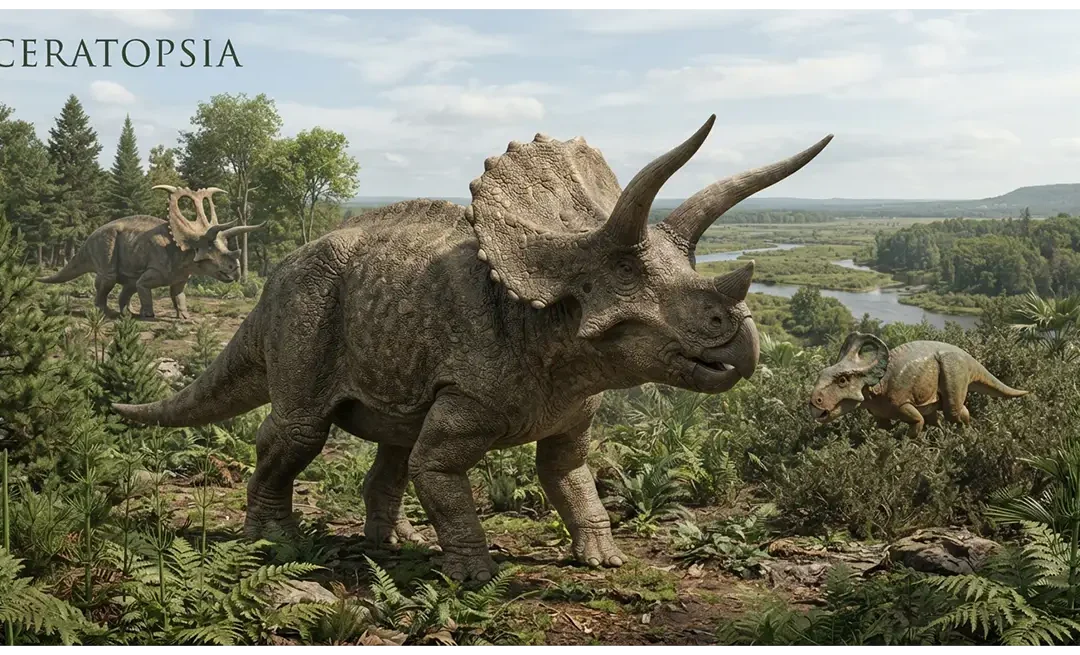
Ceratopsia was a diverse group of herbivorous dinosaurs known for their strong beaks, unusual skulls, and, in some members, large horns and bony frills. The group included small early forms such as Psittacosaurus as well as famous later dinosaurs such as Triceratops and Styracosaurus.
These dinosaurs lived mainly during the Jurassic and Cretaceous periods and became especially diverse during the Cretaceous. Their fossils provide important evidence about dinosaur evolution, feeding, growth, behavior, and the changing environments of ancient Asia and North America.
What Is Ceratopsia?
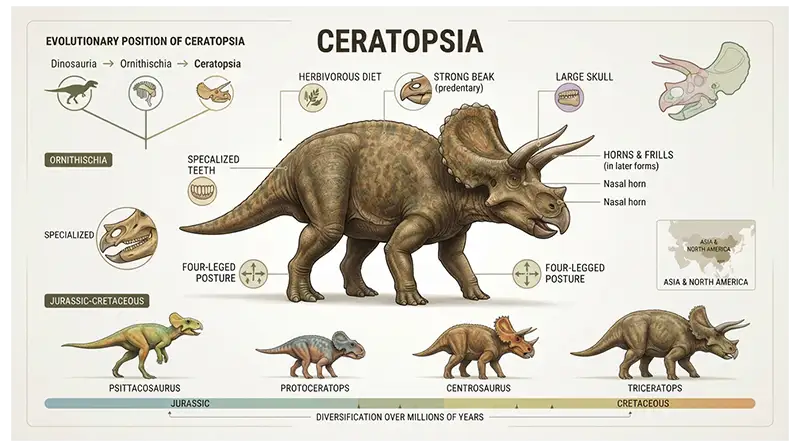
Ceratopsia is a major group within Ornithischia, one of the two principal dinosaur lineages. The name comes from Greek words meaning roughly “horned face,” referring to the distinctive skull structures developed by many members of the group.
Ceratopsians were herbivorous dinosaurs that generally walked on four limbs. Their evolutionary history began with relatively small animals and eventually produced some of the largest and most recognizable plant-eating dinosaurs of the Late Cretaceous.
Not every ceratopsian had prominent horns. Early members could have relatively simple skulls and lacked the enormous facial ornaments seen in later ceratopsids. Over time, different branches developed increasingly specialized beaks, jaws, horns, frills, and body sizes.
Ceratopsia includes several important evolutionary branches. Some forms remained small, while others became large-bodied animals with massive skulls. Their fossils have been discovered mainly in Asia and North America, although the broader history of the group extends across a much wider span of dinosaur evolution.
What Did Ceratopsians Look Like?
Ceratopsians generally had a compact, powerful body supported by four sturdy limbs. Their front limbs carried much of the body weight, while their hind limbs provided strong support and movement. One of their most noticeable features was the large head. In many later species, the skull became exceptionally large compared with the rest of the body.
A strong beak occupied the front of the jaws, giving the animals a somewhat parrot-like appearance. The shape of the skull varied considerably between species. Some early ceratopsians had short faces and relatively simple skulls, whereas later ceratopsids developed long nasal bones, brow horns, enormous frills, or other specialized structures.
Their bodies were generally low and broad compared with many other dinosaur groups. The tail helped balance the animal, while the limbs supported a substantial mass during walking and feeding. The famous appearance associated with ceratopsians therefore represents only part of their diversity. A small Psittacosaurus looked very different from a several-ton animal such as Triceratops.
What Are the Main Characteristics of Ceratopsia?
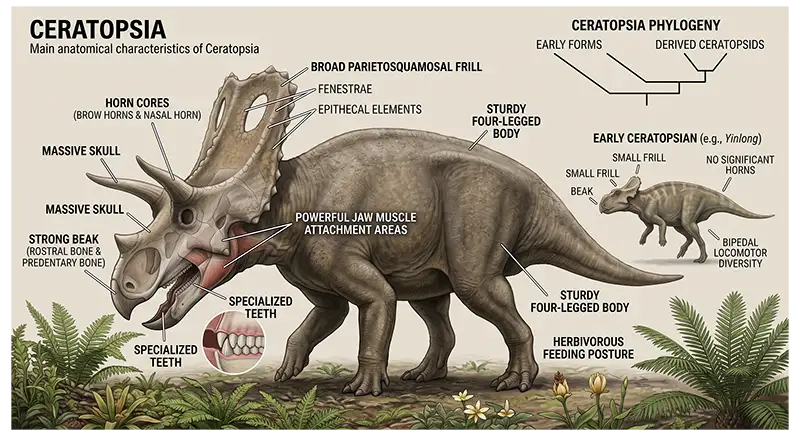
Ceratopsians developed several anatomical features that helped them feed, move, and interact with their surroundings. These characteristics changed considerably across the group, so they should not all be treated as identical in every species.
Parrot-Like Beak
The front of the jaws formed a strong beak that was useful for cropping vegetation. This structure was especially important because many ceratopsians fed close to the ground or among dense plant growth. The beak differed in shape between species, reflecting changes in feeding style and skull proportions.
Strong Jaws and Teeth
More advanced ceratopsians developed specialized teeth suited to processing tough plant material. In ceratopsids, teeth were arranged into dental batteries, with multiple teeth positioned closely together. As older teeth became worn, replacement teeth developed beneath them. This system allowed these animals to maintain an effective grinding surface while consuming vegetation.
Large Skull
A large skull became one of the defining features of many later ceratopsians. The expanded head provided space for powerful jaw muscles and supported elaborate structures such as horns and frills. Skull proportions also differed among species, showing that ceratopsian evolution involved considerable anatomical experimentation.
Horns and Frills
Some ceratopsians possessed horns above the nose or eyes, while others developed enlarged nasal bosses or different forms of facial ornamentation. The bony frill extended behind the skull in many later members. Its shape ranged from relatively short structures to broad shields with openings and long margins. These features probably had several functions, including communication, species recognition, display, social interactions, and possibly defense.
Four-Legged Body Plan
Ceratopsians were primarily quadrupedal. Their limbs were adapted to support substantial body weight, especially in large ceratopsids. The arrangement of the limbs and feet reflects a lifestyle based largely on steady terrestrial movement rather than fast running over long distances.
Herbivorous Adaptations
Their beaks, jaws, teeth, and skull muscles formed an effective feeding system for plant consumption. Different species probably exploited different types of vegetation depending on their size, habitat, and jaw structure. This combination of feeding adaptations helped ceratopsians occupy important herbivore roles in Cretaceous ecosystems.
What Are the Main Groups of Ceratopsians?
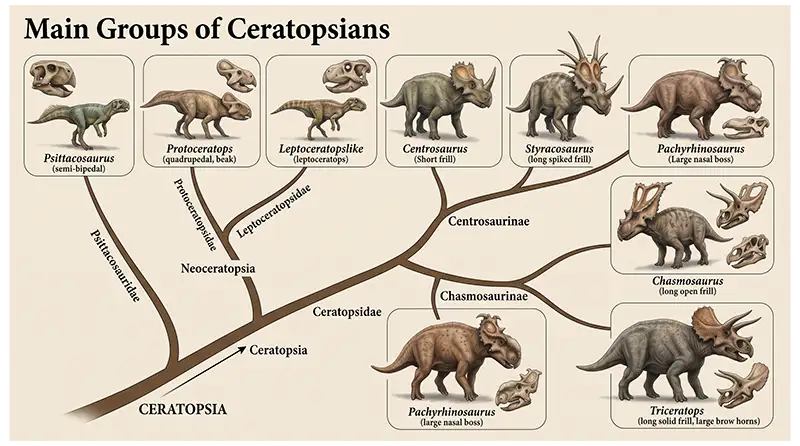
Ceratopsia contains several evolutionary branches, ranging from early small-bodied animals to large horned dinosaurs.
Psittacosauridae
Psittacosaurus represents one of the best-known early ceratopsian groups. These dinosaurs were relatively small and had compact skulls with strong beaks. They lived in Asia during the Early Cretaceous and are represented by numerous fossil specimens. Their remains have provided valuable information about growth, body coverings, feeding, and early ceratopsian evolution.
Protoceratopsidae
Protoceratopsids included small to medium-sized ceratopsians that lived mainly in Asia during the Late Cretaceous. Protoceratops is particularly famous because numerous fossils have been discovered in Mongolia. Unlike Triceratops, it lacked large facial horns but possessed a prominent frill and strong jaws.
Leptoceratopsidae
Leptoceratopsids were generally smaller-bodied ceratopsians. Their fossils are known primarily from North America, and some possessed relatively simple skulls compared with the enormous heads of ceratopsids. They demonstrate that ceratopsian evolution continued along multiple body plans rather than producing only large horned dinosaurs.
Ceratopsidae
Ceratopsidae includes the classic large horned dinosaurs of the Late Cretaceous. Important members include Triceratops, Centrosaurus, Styracosaurus, Chasmosaurus, and Pachyrhinosaurus.
These dinosaurs developed some of the most elaborate skulls known among terrestrial vertebrates. Horn arrangement, frill shape, and nasal structures varied greatly between genera.
How Did Ceratopsia Evolve?
The earliest ceratopsians appeared during the Jurassic Period, and the group later underwent major diversification during the Cretaceous. Early members were generally smaller and had less elaborate skulls. As different branches evolved, their jaws, teeth, skulls, and body proportions became increasingly specialized.
The evolutionary history of Ceratopsia was not a straight progression from a small dinosaur into Triceratops. Instead, it involved a branching pattern in which numerous lineages appeared, diversified, and eventually disappeared. During the Cretaceous, several ceratopsian groups occupied different environments across Asia and North America. Some remained relatively small, while others developed massive bodies and increasingly complex cranial structures.
The later evolution of ceratopsids produced striking differences in horn position and frill design. These changes show how natural selection could shape the same basic skull plan in multiple directions.
What Did Ceratopsians Eat?
Ceratopsians were herbivores, but their diets probably varied according to species, habitat, and available vegetation. Their strong beaks could crop leaves, stems, and other plant material. More advanced members possessed rows of closely packed teeth that helped break down food before swallowing.
Large ceratopsids probably consumed substantial quantities of vegetation because of their body size. Their low-set heads would have allowed them to feed efficiently on plants growing near the ground.
However, it would be too simple to describe every ceratopsian as eating exactly the same plants. Differences in skull shape and jaw mechanics suggest that various species could have exploited different food resources. Their feeding apparatus was therefore an important part of their ecological success and diversification.
Where Did Ceratopsians Live?
Ceratopsians inhabited terrestrial environments across parts of Asia and North America. Their fossils occur in deposits representing floodplains, river systems, woodland environments, and other Cretaceous landscapes. Early ceratopsians are particularly well represented in Asia. Later ceratopsids became especially prominent in western North America.
These regions were not identical. Climate, vegetation, water availability, and seasonal conditions varied across the Cretaceous world. Different ceratopsians therefore lived in different ecological settings. Their widespread distribution also indicates that the group was capable of adapting to a variety of terrestrial environments.
What Are the Most Famous Ceratopsians?
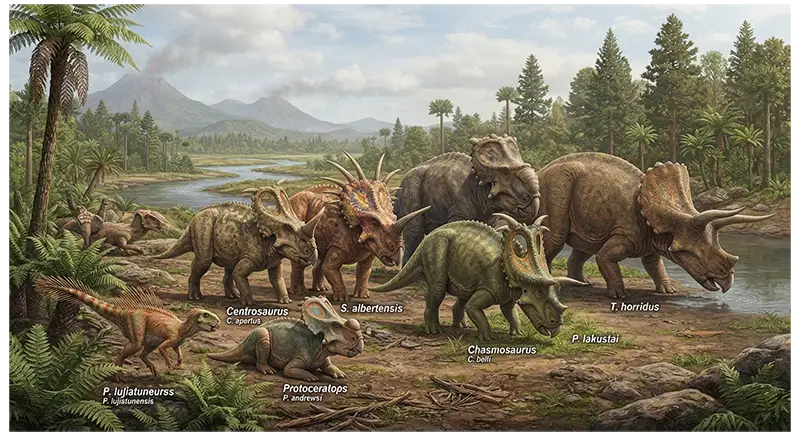
Ceratopsia included many different dinosaurs, but several genera are especially well known because of their unusual skulls, abundant fossils, or importance in paleontological research. These dinosaurs did not all look alike. Some were small and relatively lightly built, while others developed enormous skulls, horns, and frills.
Psittacosaurus
Psittacosaurus was a small early ceratopsian that lived in Asia during the Early Cretaceous. It had a short skull, a strong beak, and a relatively small body compared with later ceratopsids. Its fossils are important because they preserve several stages of growth and provide evidence about early ceratopsian anatomy. Some exceptionally preserved specimens have also revealed information about body coverings and coloration.
Protoceratops
Protoceratops was a small to medium-sized ceratopsian from Late Cretaceous Asia. It had a strong beak and a noticeable frill but did not possess the large facial horns seen in Triceratops. Numerous fossils from Mongolia have helped researchers study its growth, population variation, and possible reproductive behavior. Its remains are also important for understanding the diversity of Asian ceratopsians.
Centrosaurus
Centrosaurus was a large ceratopsid that lived in what is now western North America during the Late Cretaceous. It had a prominent nasal horn and a relatively shorter pair of brow horns. Its frill carried distinctive bony projections, making the skull useful for identifying the genus. Large fossil bonebeds containing Centrosaurus remains have also provided evidence about group behavior and mass mortality events.
Styracosaurus
Styracosaurus is recognized for its large nasal horn and striking frill, which carried several long spikes around its outer margin. It lived in western North America during the Late Cretaceous and was a substantial plant-eating dinosaur. Its skull demonstrates how ceratopsians could develop highly elaborate cranial structures.
Chasmosaurus
Chasmosaurus had a broad, relatively long frill and prominent horns above the eyes. It lived in Late Cretaceous North America alongside other large ceratopsids. The differences between Chasmosaurus and closely related genera show how rapidly skull shape and facial ornaments could vary among ceratopsians.
Pachyrhinosaurus
Pachyrhinosaurus had a very unusual skull. Instead of relying on a large pointed nasal horn, it developed a thickened bony structure called a nasal boss. Several species of Pachyrhinosaurus are known from northern North America. Their fossils are particularly useful for studying changes in skull form and population variation within ceratopsids.
Triceratops
Triceratops is perhaps the most famous member of Ceratopsia. It lived in western North America near the end of the Cretaceous and had two large brow horns, a smaller nasal horn, and a broad frill. It was a large, heavily built herbivore with a powerful beak and complex tooth batteries. Numerous fossils have allowed scientists to investigate its anatomy, growth, feeding, and possible behavior.
Ceratopsian Diversity
These genera demonstrate that ceratopsians followed many different evolutionary paths. Psittacosaurus and Protoceratops show the diversity of smaller early and intermediate forms, while Centrosaurus, Styracosaurus, Chasmosaurus, Pachyrhinosaurus, and Triceratops represent the remarkable variety of later ceratopsids.
Their differences in body size, horn arrangement, frill shape, skull proportions, and feeding anatomy make Ceratopsia an important example of evolutionary diversification among dinosaurs.
What Do Ceratopsian Fossils Reveal?
Ceratopsian fossils provide much more information than simply showing what these dinosaurs looked like.
Skulls and jaws reveal feeding anatomy, tooth replacement, muscle attachment, and changes in head shape. Horns and frills allow paleontologists to compare species and investigate how cranial ornaments changed through evolutionary time. Complete or partial skeletons provide evidence about body proportions, posture, locomotion, and growth.
Juvenile fossils are particularly useful because they show how individuals changed as they matured. Some ceratopsians underwent substantial changes in skull shape and ornamentation during growth.
Eggs, nests, and associated remains, where available, can provide information about reproduction and nesting behavior. Fossil discoveries have also helped scientists understand the geographic distribution of different ceratopsian lineages and how their populations changed through the Cretaceous.
Why Did Ceratopsians Have Horns and Frills?
The exact function of ceratopsian horns and frills remains an active area of scientific research. One possibility is visual communication. Different species had distinctive combinations of horn shape, horn position, and frill design. Such differences could have helped individuals recognize members of their own species.
The structures may also have played roles in social behavior and display. Large cranial ornaments could have communicated maturity, health, or reproductive condition. Horns could provide protection against predators, although their exact defensive importance probably differed among species. They may also have been used during interactions between members of the same species.
Frills were not identical across ceratopsians. Some were broad, some had large openings, and others carried long spikes. These differences suggest that the structures evolved under several selective pressures rather than serving one universal purpose.
How Did Ceratopsians Become Extinct?
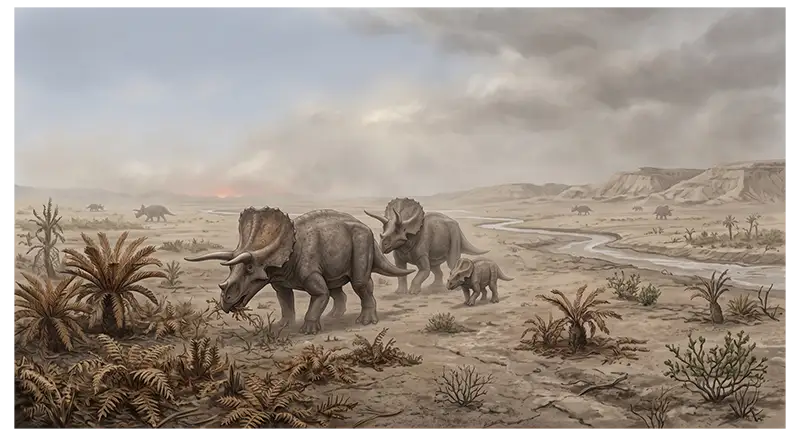
Ceratopsians survived for millions of years and remained important herbivores until the final part of the Cretaceous. Their history ended during the Cretaceous–Paleogene (K–Pg) mass extinction, about 66 million years ago. The event is strongly associated with the Chicxulub asteroid impact, which caused major environmental disruption around the world.
The impact produced changes in sunlight, temperature, vegetation, and food availability. Large terrestrial food webs were severely affected. Non-avian dinosaurs, including the remaining ceratopsians, disappeared during this extinction. Birds, which are living dinosaurs, survived along with mammals, crocodilians, turtles, and many other organisms.
The extinction of Ceratopsia therefore marked the end of a long evolutionary history that had produced remarkable diversity in skull structure, body size, feeding adaptations, and geographic distribution.
Conclusion
Ceratopsia represents one of the most distinctive branches of dinosaur evolution. From small early forms such as Psittacosaurus to enormous horned dinosaurs such as Triceratops, these animals developed remarkable changes in skull shape, feeding structures, body size, horns, and frills.
Their fossils reveal how herbivorous dinosaurs adapted to different environments and how complex anatomical features evolved through branching lineages. The diversity of ceratopsians also shows that the familiar horned dinosaurs were only one part of a much broader evolutionary group.
Although Ceratopsia disappeared during the K–Pg extinction, their fossils continue to provide important evidence about dinosaur biology, evolution, behavior, and the ecosystems of the ancient world.
No. Many early ceratopsians lacked the large horns associated with later ceratopsids. Horn development varied greatly among different branches.
Yes. Triceratops was a member of Ceratopsia and belonged to the family Ceratopsidae.
Ceratopsians were herbivores. They used strong beaks and specialized teeth to crop and process plant material.
Some large ceratopsids reached roughly 6–9 meters in length, although estimates vary among species and specimens. Triceratops was among the largest and best-known members.
Frills may have been involved in visual display, species recognition, social interactions, or protection. Their exact function likely differed among species.