
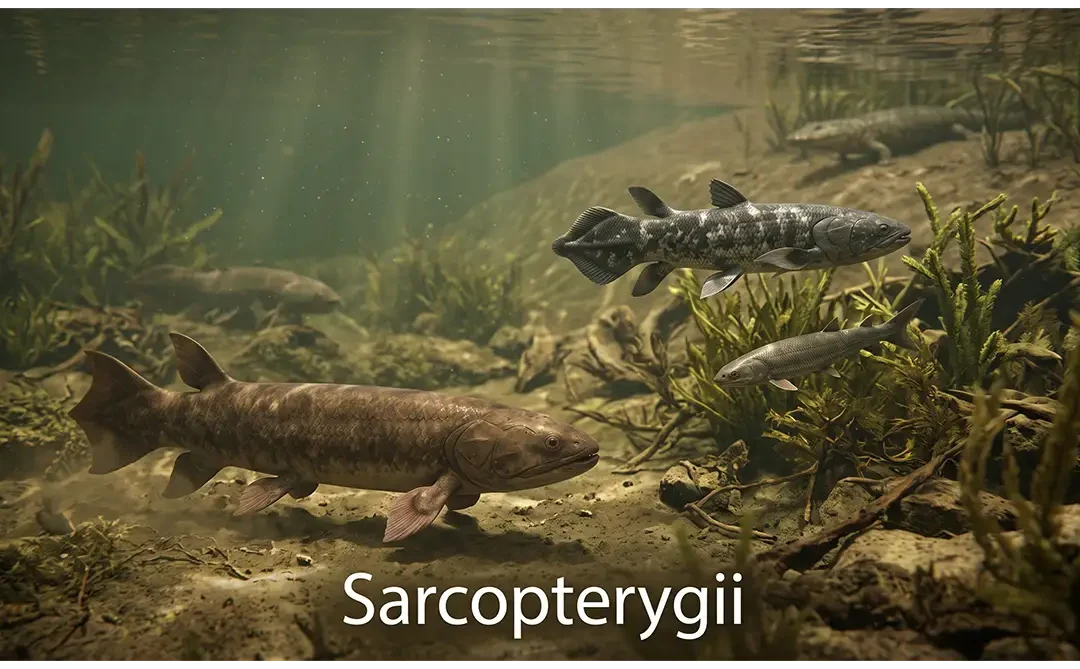
Sarcopterygii is a major group of vertebrates commonly known as the lobe-finned fishes. Their fins contain fleshy, muscular bases supported by internal bones, making them different from the thin, ray-supported fins of most ray-finned fishes. The group includes living lungfishes and coelacanths, as well as many extinct forms known from the fossil record.
Sarcopterygii is especially important because the lineage includes the ancestors and closest relatives of tetrapods, the four-limbed vertebrates that include amphibians, reptiles, birds, and mammals. Fossils from the Devonian Period show how changes in fins, skeletons, breathing systems, and other structures contributed to the evolutionary transition toward life on land.
What Is Sarcopterygii?
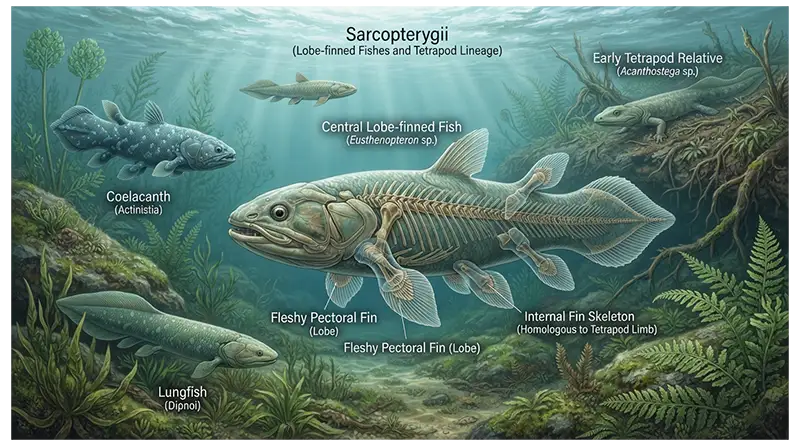
Sarcopterygii is a clade of vertebrates that includes lobe-finned fishes and the tetrapod lineage. The name comes from Greek words meaning fleshy fin. Unlike most ray-finned fishes, sarcopterygians have fins with a muscular, fleshy base containing internal skeletal elements. This arrangement gives their fins a different structure from the thin fins supported mainly by numerous fin rays in actinopterygians.
Modern Sarcopterygii includes two familiar groups of living fishes:
- Lungfishes
- Coelacanths
The group also includes many extinct Devonian and later forms. Some extinct sarcopterygians developed robust fin bones and joints that became increasingly suitable for supporting the body in shallow water. Tetrapods are also part of the sarcopterygian evolutionary lineage. Therefore, the group is much broader than the fish species that survive today.
This makes Sarcopterygii an important subject for understanding how vertebrates diversified and how the lineage leading to land vertebrates developed.
What Makes Sarcopterygians Different From Other Fishes?
Sarcopterygians have several anatomical features that distinguish them from most other fishes.
Fleshy Fins
The most recognizable feature is the lobed fin. Instead of having a fin made primarily of thin rays attached directly to the body, a sarcopterygian fin has a muscular base containing internal bones. In some extinct species, these bones were arranged in ways that provide clues about the early evolution of limb-like structures.
Internal Fin Bones
The internal skeleton of a sarcopterygian fin includes bones arranged along the fin's base and central axis. The pattern differs among species, but the presence of substantial internal bones is important because it provides a structural framework that later became highly modified in the tetrapod lineage.
Robust Skeleton
Many sarcopterygians had relatively sturdy internal skeletons. Their vertebral columns and fin structures varied considerably, but several extinct forms possessed features suited to life in shallow water or near the bottom.
Cosmoid-Type Scales in Many Fossil Forms
Many ancient sarcopterygians possessed thick, enamel-like scales often described as cosmoid scales or related forms. These scales differed from the thinner scales common in many modern fishes. Not every sarcopterygian had the same scale structure, so this feature should not be treated as universal.
Specialized Teeth
Many extinct sarcopterygians had strong teeth suited to capturing prey. Some early forms had large, robust teeth, while other lineages developed different feeding structures.
Distinctive Skull Structure
Sarcopterygian skulls show important differences from those of many ray-finned fishes. Several extinct forms had skull regions and joints that changed substantially during their evolutionary history.
These anatomical differences help paleontologists compare ancient sarcopterygians with early tetrapods.
What Are the Main Groups of Sarcopterygii?
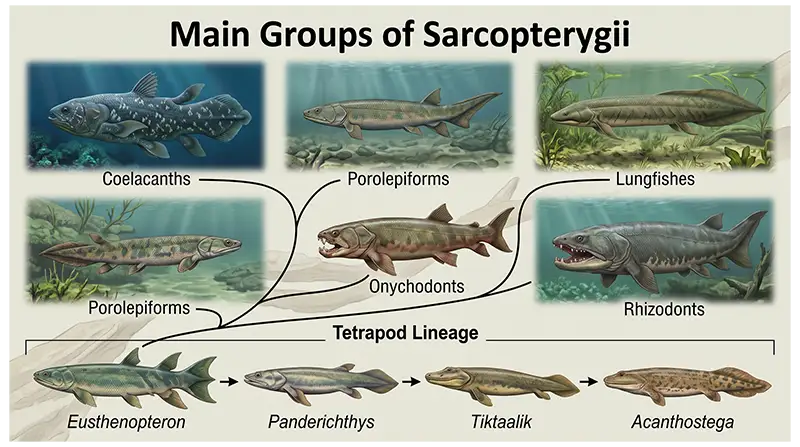
Sarcopterygii contains several major evolutionary branches, including both extinct and living groups.
Coelacanths
Coelacanths are marine sarcopterygians represented today by the genus Latimeria. They have paired lobed fins, a distinctive three-lobed tail structure, and other features that preserve aspects of the ancient sarcopterygian body plan. Their discovery as living animals was particularly important because coelacanths were previously known only from fossils.
Lungfishes
Lungfishes are freshwater sarcopterygians. They have specialized organs that allow them to obtain oxygen from air as well as from water. Modern lungfish species live in Africa, South America, and Australia. Their anatomy provides important evidence about the diversity of surviving sarcopterygians.
Porolepiforms
Porolepiforms were an extinct group of sarcopterygians that lived mainly during the Devonian. Their fossils provide information about early diversification within lobe-finned vertebrates.
Onychodonts
Onychodonts were another extinct group of ancient sarcopterygians. They possessed distinctive tooth structures and unusual skull features.
Rhizodonts
Rhizodonts were large predatory sarcopterygians that lived mainly during the Devonian and Carboniferous. Some species reached several meters in length and were important predators in ancient freshwater environments.
Tetrapod Lineage
Another major sarcopterygian branch eventually produced tetrapods. This lineage includes extinct forms that show combinations of fish-like and increasingly tetrapod-like features. Their fossils are particularly important for studying the transition from aquatic vertebrates toward animals capable of supporting themselves in terrestrial environments.
Where Did Ancient Sarcopterygians Live?
Ancient sarcopterygians occupied a wide variety of aquatic environments. Many Devonian forms lived in freshwater rivers, lakes, floodplain channels, and wetlands. Others inhabited marine environments. Their habitats changed as different lineages evolved through geological time.
Freshwater Environments
Freshwater habitats were especially important for several sarcopterygian groups. Rivers and shallow lakes provided environments where fish could encounter changing water levels, dense vegetation, low-oxygen conditions, and seasonal drying. These conditions may have favored different breathing and locomotion strategies in some lineages.
Shallow Coastal Waters
Some sarcopterygians lived in shallow marine environments. These habitats included coastal waters and areas with complex seafloor structures.
Marine Environments
Coelacanths demonstrate that the sarcopterygian lineage also includes successful marine animals. Their modern relatives live in deep coastal waters, although ancient coelacanths occupied a broader range of environments.
Changing Habitats Through Time
The distribution of sarcopterygians changed as continents shifted, climates changed, and aquatic ecosystems developed. Their fossils have therefore become useful for reconstructing ancient environments and understanding how vertebrates responded to changing conditions.
How Did Sarcopterygians Move and Feed?
Sarcopterygians used their fins, bodies, jaws, and teeth in different ways depending on the species and habitat.
Movement
Lobed fins were capable of more complex movement than a simple flexible fin surface. The internal bones and muscles allowed the fins to be controlled as functional appendages. Modern coelacanths use their paired fins for maneuvering and stabilization rather than walking on land.
Some extinct sarcopterygians had fin structures that could provide support against the substrate. In the lineage leading toward tetrapods, changes in these structures eventually contributed to the development of weight-bearing limbs. However, it is important not to assume that every lobe-finned fish used its fins for walking.
Feeding
Most sarcopterygians were predators or consumers of animal prey, although feeding habits differed among groups.
Their diets could include:
- Small fish
- Aquatic invertebrates
- Other vertebrates
- Bottom-dwelling animals
Some species had powerful jaws and large teeth suited to capturing substantial prey. Lungfishes have different feeding structures and behaviors, while coelacanths use their jaws to capture marine prey. This variety shows that lobe-finned fishes occupied different ecological roles rather than following a single feeding strategy.
What Do Sarcopterygian Fossils Reveal About Their Evolution?
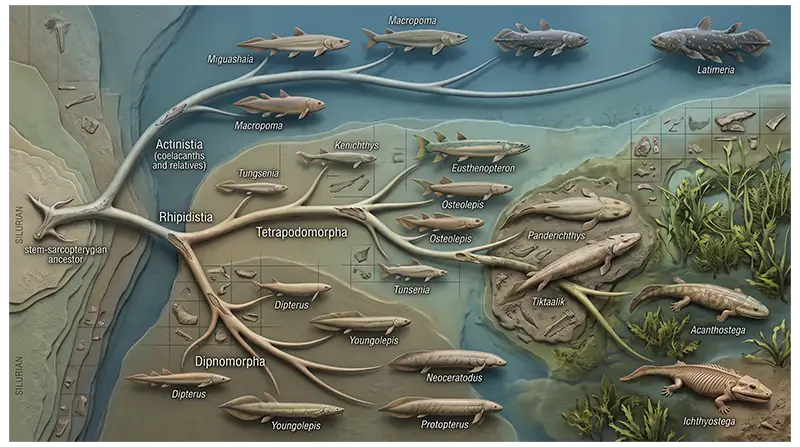
Sarcopterygian fossils provide some of the clearest evidence for major changes in vertebrate anatomy.
Fossils preserve structures such as:
- Skulls
- Jaws
- Teeth
- Vertebrae
- Ribs
- Fins
- Internal fin bones
- Limb bones
- Scales
- Soft-tissue impressions in exceptional cases
By comparing fossils from different geological periods, scientists can identify changes in the skeleton and determine how particular structures developed.
Fin to Limb Evolution
One of the most important discoveries involves the internal bones of lobe-finned fishes. In early forms, the fin contained bones arranged in a pattern that differs from modern limbs but provides important evolutionary context. In later tetrapod relatives, some of these bones became increasingly similar in position and function to the bones of limbs.
Fossils such as Tiktaalik are particularly valuable because they combine several fish-like characteristics with features associated with later tetrapods.
Fossils and Ancient Environments
Sarcopterygian fossils are also found in sedimentary rocks that preserve evidence of ancient rivers, lakes, floodplains, and coastal environments.
This allows scientists to study not only anatomy but also the environmental conditions in which these animals lived.
How Did Lobe-Finned Fishes Lead to Tetrapods?
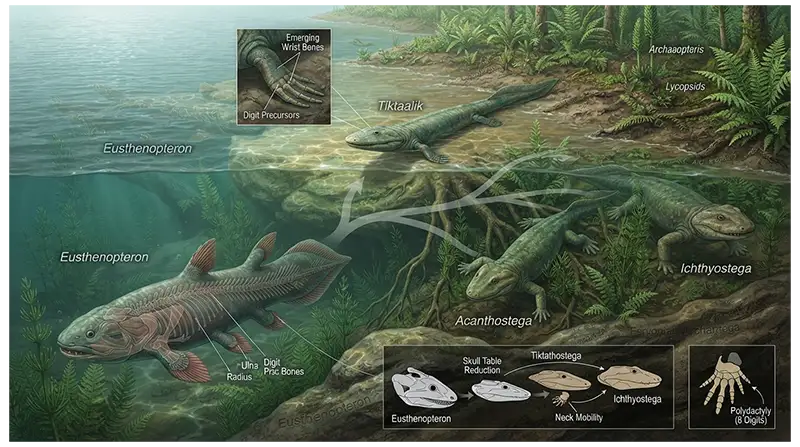
The origin of tetrapods is one of the most important chapters in sarcopterygian evolution. Tetrapods are vertebrates with limbs and digits, including amphibians, reptiles, birds, and mammals. Their ancestors evolved from a branch of lobe-finned vertebrates. This transition occurred gradually over many generations.
Changes in the Fins
The internal bones of the paired fins became increasingly robust and structurally complex in some tetrapod relatives. These changes provided a foundation for the bones that eventually formed the upper and lower parts of limbs.
Development of Digits
Later tetrapod relatives developed digits at the ends of their limbs. Early digit-bearing animals were still strongly associated with aquatic environments. This demonstrates that the evolution of limbs and digits did not immediately produce fully terrestrial animals.
Changes in the Skull and Neck
The skull and shoulder region also changed. Some tetrapod relatives developed greater separation between the head and shoulder region, allowing more independent movement of the head. This was different from the typical arrangement of many fish.
Changes in Breathing and Body Support
The transition also involved changes in breathing, body support, and movement. Some ancient sarcopterygians possessed lungs or lung-like structures, while changes in the ribs and vertebral column helped later tetrapod relatives support their bodies differently. The transition from fish-like sarcopterygians to early tetrapods was therefore a complex evolutionary process, not a single event.
What Living Sarcopterygians Exist Today?
Only a small number of sarcopterygian lineages survive today.
Coelacanths
Living coelacanths belong to the genus Latimeria. They live in marine environments and have distinctive lobed fins. Their survival into the modern world makes them important for studying the anatomy and evolution of sarcopterygians.
Lungfishes
Six living lungfish species are currently recognized, distributed among Africa, South America, and Australia. They are freshwater animals and possess specialized lungs that allow them to breathe atmospheric oxygen. African lungfishes can survive periods of drought by entering a dormant state within protective mucus cocoons and remaining in mud or sediment.
Why Living Species Matter
Modern sarcopterygians do not represent unchanged versions of ancient species. They have continued evolving for millions of years. However, their anatomy preserves important characteristics that help scientists compare living animals with fossil relatives.
Why Is Sarcopterygii Important to Evolution and Paleontology?
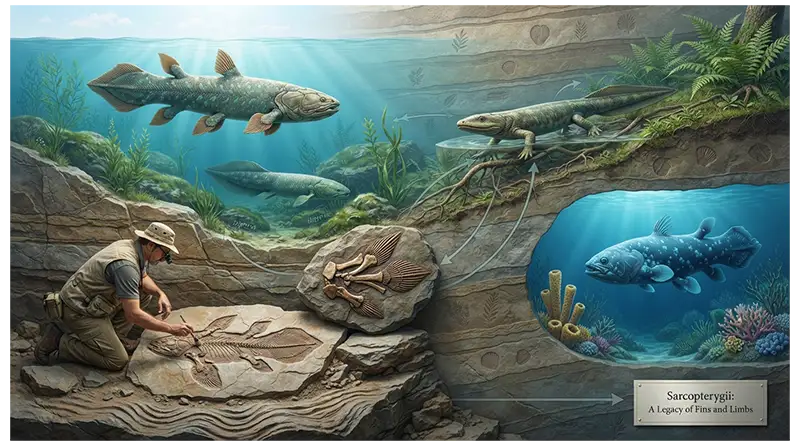
Sarcopterygii is important because it provides a major window into vertebrate evolution.
The group helps scientists understand how:
- Lobed fins evolved
- Vertebrate skeletons changed
- Feeding structures diversified
- Breathing systems developed
- Fins became increasingly limb-like
- Digits appeared
- Vertebrates began exploiting terrestrial environments
The fossil record of sarcopterygians is particularly valuable because it documents several stages in the evolutionary history leading toward tetrapods. Sarcopterygians also demonstrate how living species can preserve evolutionary features that connect modern biodiversity with ancient ecosystems.
For paleontology, fossils such as Eusthenopteron, Tiktaalik, Acanthostega, and Ichthyostega provide important evidence for understanding the transition from aquatic vertebrates to early tetrapods. The subject also connects naturally with geology because these fossils occur within sedimentary rocks that record ancient rivers, lakes, coastlines, climates, and ecosystems.
Conclusion
Sarcopterygii is a major vertebrate group whose history extends deep into the Paleozoic Era. Its members are recognized by their distinctive fleshy, internally supported paired fins, and the group includes ancient fossil forms as well as living lungfishes and coelacanths.
The most important part of its evolutionary history is the lineage that eventually produced tetrapods. Fossils show how changes in fin bones, skeletons, skulls, breathing structures, and body support contributed to this major transition. Ancient sarcopterygians were not all alike.
They occupied marine and freshwater environments, used different feeding strategies, and evolved along many separate branches. Some lineages disappeared, while others survived into the present.
Studying Sarcopterygii therefore helps connect fossils, vertebrate anatomy, evolutionary biology, geology, and the origin of life on land. It is one of the most important groups for understanding how aquatic vertebrates eventually gave rise to the extraordinary diversity of tetrapods seen today.
They are called lobe-finned fishes because their paired fins have fleshy, muscular bases containing internal skeletal bones.
Yes. Humans belong to the tetrapod lineage, which is part of the broader sarcopterygian evolutionary group.
No. Modern classifications include tetrapods within the sarcopterygian lineage, so the group extends beyond fishes.
The living non-tetrapod sarcopterygians are lungfishes and coelacanths.
Not all of them. Some extinct forms had fins capable of supporting or maneuvering the body in shallow water, while later tetrapod relatives developed true limbs and digits.