
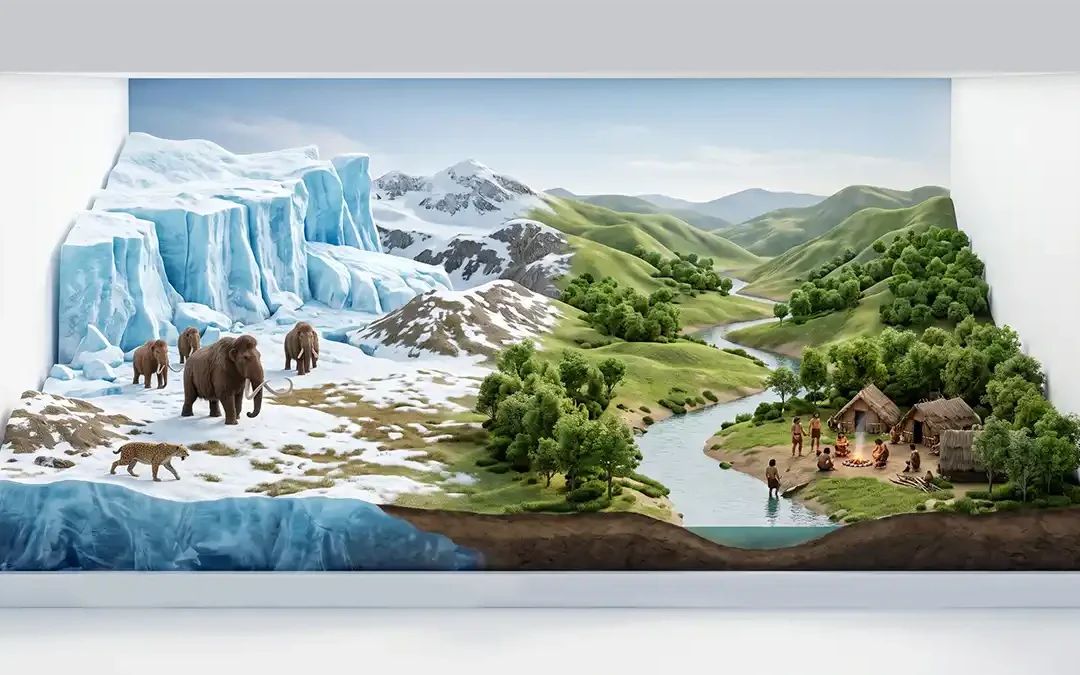
The Quaternary Period represents the active, modern stage of Earth's geologic history. It is defined by dramatic climatic swings where massive continental ice sheets repeatedly expanded and retreated, driving global sea levels to rise and plunge by more than 120 meters. These sea-level drops exposed vast continental shelves and created crucial land bridges—such as Beringia between Asia and North America, and Doggerland in northwestern Europe—that allowed plants, animals, and early humans to migrate across continents.
Because it is the most recent interval on Earth, the Quaternary provides scientists with the highest-resolution geologic archive available. Deep-sea sediment cores, glacial ice cores from Greenland and Antarctica, loess deposits, and cave speleothems preserve detailed records of chemical and temperature shifts. This rich data allows geologists to reconstruct past ocean circulation, atmospheric composition, and ecosystem changes with sub-millennial accuracy.
What Is the Quaternary Period?
The Quaternary is the uppermost period of the Cenozoic Era and is formally subdivided into two epochs: the Pleistocene and the Holocene.
The Pleistocene Epoch: Spanning from 2.58 million to 11,700 years ago, this epoch was driven by Milankovitch cycles—predictable wobbles in Earth's orbit, axial tilt, and precession that modulate incoming solar radiation. Early in the Pleistocene, glacial-interglacial cycles pulsed every 41,000 years, but shifted around one million years ago (the Mid-Pleistocene Transition) to longer, harsher 100,000-year cycles. This epoch supported specialized cold-adapted megafauna, including woolly mammoths, woolly rhinos, and sabertooth cats, while hosting the evolutionary rise of our own genus (Homo).
The Holocene Epoch: Beginning roughly 11,700 years ago at the end of the last major glacial retreat, the Holocene represents an unusually stable, warm interglacial climate. This environmental stability allowed human societies to transition from nomadic hunting and gathering to widespread agriculture, permanent settlement, and complex urbanization.
When Did the Quaternary Period Begin?
The Quaternary Period began 2.58 million years ago, marked by a major climatic threshold known as the Intensification of Northern Hemisphere Glaciation (INHG).
Prior to 2009, geologists placed the start of the Quaternary at 1.806 million years ago based on marine fossils from the Vrica section in southern Italy. However, terrestrial and marine paleoclimate records revealed that extensive continental ice sheets had already established themselves across North America and Eurasia several hundred thousand years earlier.
To ensure the geological time scale reflected this genuine climatic turning point, the International Union of Geological Sciences (IUGS) ratified the following formal markers:
Tectonic Triggers: The transition was accelerated by the tectonic closure of the Central American Seaway (the rise of the Isthmus of Panama), which redirected oceanic currents, strengthened the Gulf Stream, and delivered the moisture necessary to build vast northern ice sheets.
The GSSP Anchor: The base of the Quaternary is fixed at the Gelasian Global Boundary Stratotype Section and Point (GSSP) at Monte San Nicola in Sicily, Italy.
Geophysical Markers: The 2.58 Ma boundary aligns closely with Marine Isotope Stage 103 (MIS 103) and the Gauss-Matuyama geomagnetic reversal, where Earth's magnetic poles flipped from normal to reversed polarity.
Quaternary Period in the Geologic Time Scale
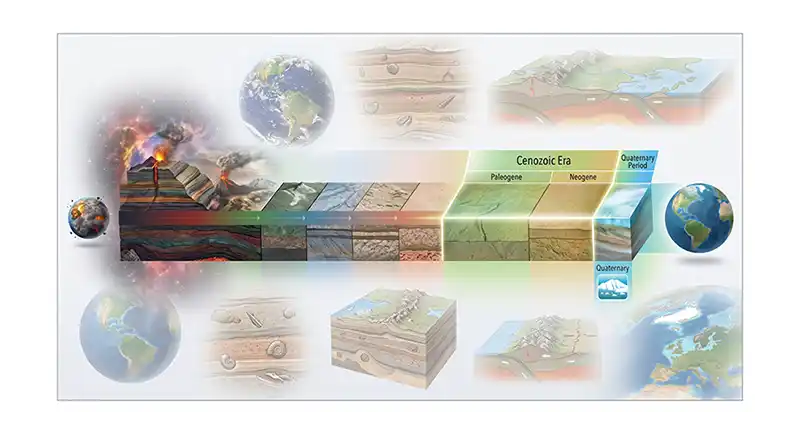
The Quaternary belongs to the Cenozoic Era, which is part of the Phanerozoic Eon. Understanding its position in the geologic time scale makes it easier to see how the Quaternary fits into Earth's much longer history.
The simplified sequence is:
Phanerozoic Eon → Cenozoic Era → Quaternary Period → Pleistocene and Holocene Epochs
The Cenozoic began after the end-Cretaceous mass extinction and includes the Paleogene, Neogene, and Quaternary. The Quaternary forms the youngest period of the Cenozoic.
Position of the Quaternary
| Geological unit | Quaternary position |
|---|---|
| Eon | Phanerozoic |
| Era | Cenozoic |
| Period | Quaternary |
| Epochs | Pleistocene and Holocene |
| Beginning | About 2.58 million years ago |
| End | Present |
The geologic time scale divides Earth's history into increasingly smaller units. Eons contain eras, eras contain periods, and periods contain epochs. The Quaternary therefore represents a relatively small part of Earth's total geological history.
Even though it occupies only the latest approximately 2.58 million years, the Quaternary has left a particularly visible record. Glacial deposits, river terraces, loess, coastal deposits, volcanic deposits, fossils, and archaeological evidence are found in many regions.
Subdivisions of the Quaternary Period
The Quaternary Period is divided into two main epochs:
- Pleistocene Epoch
- Holocene Epoch
The Pleistocene began at the base of the Quaternary, about 2.58 million years ago, while the Holocene began approximately 11,700 years ago.
Pleistocene Epoch
The Pleistocene Epoch represents most of the Quaternary Period. It began about 2.58 million years ago and ended approximately 11,700 years ago.
It is widely associated with the Ice Age, although the term "Ice Age" can refer more broadly to the long interval of Earth's history during which substantial permanent ice existed. During the Pleistocene, continental ice sheets repeatedly expanded during colder periods and retreated during warmer intervals.
These repeated climatic fluctuations affected almost every part of the Earth's surface. Expanding glaciers eroded bedrock, transported sediment, created valleys and other landforms, and changed drainage systems. When the climate warmed, melting ice contributed to rising sea levels and altered landscapes.
The Pleistocene was also an important period in human evolution. Several species of the genus Homo lived during this epoch, and humans gradually expanded into many different environments.
Holocene Epoch
The Holocene Epoch began about 11,700 years ago and continues today. It followed the end of the last major Pleistocene glacial period and represents the current warm interval of the Quaternary.
During the Holocene, glaciers generally retreated from many areas, sea level rose toward its present position, and ecosystems reorganized. Human populations also expanded dramatically.
The Holocene is especially important for understanding the development of agriculture, permanent settlements, civilizations, and modern societies. At the same time, natural climate variability continued throughout the epoch.
Formal Subdivisions
Scientists can divide the Pleistocene and Holocene into smaller units for detailed stratigraphic work. The International Commission on Stratigraphy recognizes formal subdivisions within these epochs, including the Gelasian, Calabrian, and Chibanian stages within the Pleistocene and the Greenlandian, Northgrippian, and Meghalayan stages within the Holocene.
For a general geology article, however, the most useful subdivision is simply:
Quaternary → Pleistocene + Holocene
This keeps the explanation clear while still reflecting the main structure of the period.
Major Geological Events of the Quaternary Period
The Quaternary Period experienced numerous geological and environmental changes. Many of these events were closely connected with repeated changes in climate and the expansion and retreat of glaciers.
Repeated Glaciations
One of the defining events of the Quaternary was the repeated growth of large continental ice sheets. During colder intervals, glaciers expanded across large areas of North America, Europe, and other high-latitude and mountainous regions.
The ice sheets changed the Earth's surface through erosion and deposition. They carved valleys, transported rocks and sediment, and deposited materials when the ice melted and retreated.
Sea-Level Fluctuations
Glacial cycles also caused major changes in global sea level. During colder periods, large quantities of water became stored in continental ice sheets, causing global sea level to fall. During warmer periods, melting ice returned water to the oceans, causing sea level to rise.
This relationship between ice volume and sea level strongly influenced coastal environments and continental shelves throughout the Quaternary.
Formation of Quaternary Landforms
Glacial and other surface processes produced many recognizable landforms during the Quaternary. These include:
- Glacial valleys
- Moraines
- Drumlins
- Eskers
- Outwash plains
- River terraces
- Loess deposits
- Coastal terraces
These landforms provide evidence of past environmental conditions and help scientists reconstruct Quaternary landscapes.
Changes in Rivers and Drainage Systems
Climate changes altered the amount of water flowing through rivers. Glacial periods could increase sediment supply and change drainage patterns, while warmer periods altered runoff, vegetation, and erosion.
As a result, many modern river valleys contain sedimentary records that preserve evidence of environmental changes during the Quaternary.
Tectonic and Volcanic Activity
The Quaternary was not a period of complete geological stability. Earthquakes, volcanic eruptions, crustal movements, and other tectonic processes continued throughout the period.
In some areas, tectonic activity interacted with changing climate and erosion to produce complex landscapes. Quaternary volcanic deposits are also important because they can help scientists establish the timing of environmental and archaeological events.
Quaternary Glaciations and Climate
The Quaternary Period is closely associated with major changes in Earth's climate. The Pleistocene, in particular, experienced repeated cycles of glacial and interglacial conditions. A glacial period is a colder interval when continental ice sheets and glaciers expand. An interglacial period is a warmer interval between major glacial periods when ice sheets retreat.
These cycles were not simply changes in temperature. They affected almost every part of the Earth system.
Effects of Glaciation
When glaciers expanded, they modified the landscape through erosion and deposition. Moving ice could remove rock from the surface, transport sediment over long distances, and deposit that material when the ice slowed or melted.
Glaciation also affected:
- Sea level
- River systems
- Vegetation
- Animal habitats
- Soil development
- Coastal environments
- Groundwater systems
Because these changes occurred repeatedly, the Quaternary geological record contains evidence of multiple environmental cycles.
Milankovitch Cycles
One important factor in Quaternary climate variation is changes in Earth's orbital characteristics. Scientists commonly describe three major orbital cycles:
- Eccentricity: changes in the shape of Earth's orbit around the Sun
- Obliquity: changes in the tilt of Earth's rotational axis
- Precession: changes in the orientation of Earth's rotational axis
These cycles change the amount and seasonal distribution of solar radiation received by different parts of Earth. They are known collectively as Milankovitch cycles and are an important part of explanations for the timing of long-term Quaternary climate changes.
However, orbital changes are not the only factors involved. Ice sheets, oceans, atmospheric gases, vegetation, and other climate feedbacks also influence Earth's climate.
Climate and Sea Level
Climate and sea level were closely connected during the Quaternary. When temperatures decreased and ice sheets expanded, more water was stored on land as ice. Global sea level therefore decreased. When temperatures increased and ice melted, water returned to the oceans. Global sea level then increased.
These repeated changes left important evidence in coastal sediments, marine terraces, coral deposits, and other geological records.
The Present Climate
The modern world is within the Holocene Epoch, which is part of the Quaternary Period. The Holocene followed the last major Pleistocene glacial period and represents the relatively warm climate interval in which modern human civilization developed.
Studying earlier Quaternary climate changes helps scientists understand natural climate variability and the ways in which Earth's climate system responds to environmental changes.
Life and Human Evolution During the Quaternary
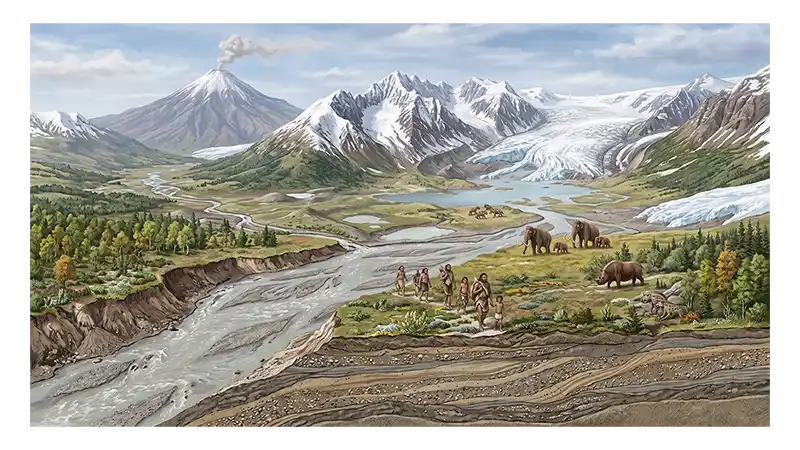
The Quaternary Period is important for studying both life on Earth and human evolution. Repeated changes in climate and landscapes caused major shifts in habitats. As environmental conditions changed, plants and animals migrated, adapted to new conditions, or disappeared from particular regions.
Quaternary Plants and Animals
The Pleistocene supported many large mammals, including mammoths, mastodons, woolly rhinoceroses, giant ground sloths, and other large animals. The exact animals varied from region to region. Some species were adapted to cold environments, while others lived in warmer areas.
Fossils from the Quaternary help scientists reconstruct ancient ecosystems. By studying fossil plants, pollen, shells, bones, and other remains, researchers can determine what environments existed in different places in the past.
Human Evolution
The Quaternary is especially important because much of the later evolution and geographic expansion of humans occurred during this period. Several members of the genus Homo lived during the Pleistocene. They developed different technologies and adapted to changing environments.
Early humans gradually expanded from Africa into other parts of the world. Their movement was influenced by environmental conditions, available resources, climate, and geography.
The fossil and archaeological records provide evidence of changes in human anatomy, technology, behavior, and geographic distribution.
Homo sapiens
Homo sapiens, the species to which modern humans belong, appeared during the later Pleistocene. Over time, modern humans spread into different parts of Africa, Asia, Europe, Australia, and eventually the Americas and other regions.
The Quaternary record therefore provides an important geological background for understanding human evolution and migration.
Human Civilization in the Holocene
The Holocene is especially important because most known human civilization developed during this epoch. After the last major glacial period, humans increasingly practiced agriculture in several parts of the world. Farming supported larger populations and encouraged permanent settlements.
Over thousands of years, human societies developed villages, towns, cities, states, and increasingly complex systems of technology and culture.
Therefore, the Quaternary connects geological processes with an important part of human prehistory and history.
Why Is the Quaternary Period Important?
The Quaternary Period is important because it provides one of the most detailed records of Earth's recent environmental history.
Understanding Past Climate
Quaternary sediments, fossils, ice cores, and other natural records allow scientists to reconstruct past climates.
Researchers can use these records to investigate:
- Past temperature changes
- Changes in precipitation
- Glacial expansion and retreat
- Sea-level fluctuations
- Changes in atmospheric conditions
- Past vegetation patterns
This information helps scientists understand how Earth's climate system has changed naturally over time.
Understanding Glacial Processes
Quaternary glaciers left extensive evidence across many parts of the world. Moraines, drumlins, glacial valleys, striations, and other landforms show how glaciers moved and modified the Earth's surface. Studying these features helps geologists understand glacial erosion, transportation, and deposition.
Understanding Modern Landscapes
Many modern landscapes were strongly influenced by Quaternary processes. Glaciers shaped valleys and mountain landscapes. Rivers deposited sediments and formed terraces. Wind transported fine particles and created deposits such as loess. Sea-level changes also modified coastlines.
Therefore, understanding the Quaternary helps explain why many present-day landscapes look the way they do.
Understanding Human Evolution
The Quaternary contains an extensive record of human evolution, migration, and adaptation. Fossils and archaeological remains provide evidence about how humans and their ancestors responded to changing climates and environments.
This makes the Quaternary important to both Earth science and human evolutionary studies.
Understanding Natural Climate Variability
The Quaternary geological record also provides a longer perspective on climate change. By comparing modern measurements with geological records from the past, scientists can better understand natural climate variability and the different processes that influence Earth's climate.
Economic Importance
Quaternary sediments can also have practical importance. Sand and gravel deposits are widely used as construction materials. In addition, unconsolidated Quaternary sediments can contain groundwater and form important aquifers in many regions.
Thus, Quaternary geology has applications in groundwater studies, engineering, construction, agriculture, environmental management, and natural-resource planning.
Quaternary Period vs. Previous Geological Periods
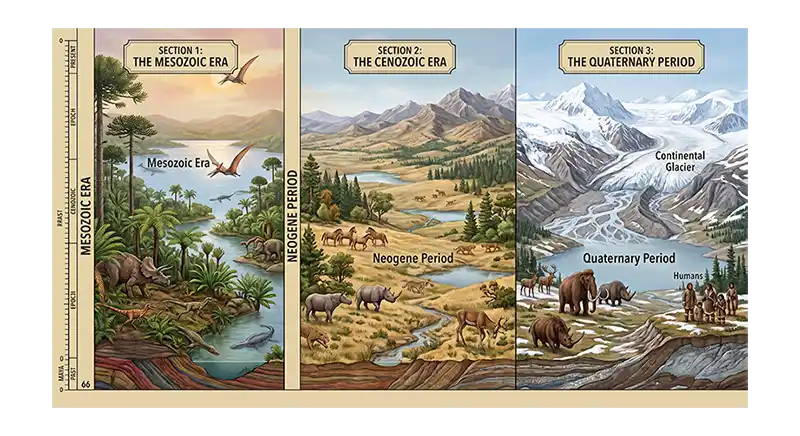
The Quaternary differs from many previous geological periods because it represents a relatively short but highly dynamic part of Earth's history.
It directly follows the Neogene Period and forms the youngest period of the Cenozoic Era.
| Feature | Quaternary Period | Neogene Period | Mesozoic Era |
| Time | About 2.58 million years ago to present | About 23 to 2.58 million years ago | About 252 to 66 million years ago |
| Main climate feature | Repeated glacial and interglacial cycles | Long-term cooling toward major Northern Hemisphere glaciation | Generally warmer global conditions with important variations |
| Major glaciation | Extensive Quaternary glaciations | Increasing glaciation toward its end | No Quaternary-style continental ice-sheet cycles |
| Human evolution | Major development and expansion of humans | Early hominins developed late in the period | No humans |
| Important deposits | Glacial, river, wind-blown, coastal, and other young sediments | Marine and terrestrial sediments | Extensive marine, terrestrial, and volcanic rocks |
| Current status | Continues today | Ended about 2.58 million years ago | Ended about 66 million years ago |
Quaternary vs. Neogene
The Neogene Period preceded the Quaternary. It includes the Miocene and Pliocene epochs. During the later Neogene, global temperatures generally declined. Northern Hemisphere glaciation became increasingly important toward the end of the Pliocene.
The Quaternary continued this trend but is particularly characterized by repeated major glacial and interglacial cycles.
Quaternary vs. Mesozoic
The Mesozoic Era was much older than the Quaternary and included the Triassic, Jurassic, and Cretaceous periods. The Mesozoic had very different climates, ecosystems, continental arrangements, and dominant organisms. Dinosaurs were a major component of many Mesozoic ecosystems, while humans did not exist.
In contrast, the Quaternary is closely associated with major glaciations, rapidly changing environments, modern ecosystems, and human evolution.
Why the Quaternary Stands Out
Although the Quaternary represents only a small fraction of Earth's total history, its geological record is exceptionally useful.
It records relatively recent changes in:
- Climate
- Ice sheets
- Sea level
- Landscapes
- Ecosystems
- Human evolution
- Sedimentation
For this reason, the Quaternary is one of the most important periods for understanding the connection between Earth's geological past and its present environment.
The Quaternary Period is the most recent period of Earth's geological history. It began about 2.58 million years ago and continues to the present.
The Quaternary Period began approximately 2.58 million years ago. It marks an important stage in Earth's recent history, particularly because of major climatic and glacial changes.
The Quaternary Period has two main epochs: the Pleistocene and the Holocene. The Pleistocene lasted from about 2.58 million years ago to 11,700 years ago, while the Holocene began about 11,700 years ago and continues today.
The Quaternary Period is important because it records major changes in climate, glaciers, sea level, landscapes, ecosystems, and human evolution. It also provides valuable evidence for understanding Earth's recent geological history.
Yes. The Quaternary includes important stages of human evolution. Several members of the genus Homo lived during the Pleistocene, and Homo sapiens appeared during the later Pleistocene. Most human civilization developed during the Holocene.
Conclusion
The Quaternary Period is the youngest period of the Cenozoic Era and began about 2.58 million years ago. It continues today and is divided into the Pleistocene and Holocene epochs.
The period is best known for repeated glacial and interglacial cycles, major changes in sea level, glacier-driven landscape development, and significant environmental changes. It also contains an important record of human evolution, migration, and the development of human civilization.
Although the Quaternary is short compared with many older geological periods, it provides an exceptionally valuable record of recent Earth history. By studying its sediments, fossils, landforms, ice records, and other evidence, scientists can better understand past climate change, glaciation, sea-level fluctuations, ecosystem changes, landscape development, and human evolution.
Because the Quaternary Period continues into the present, studying it also helps connect the geological history of Earth with the environment and landscapes we experience today.