
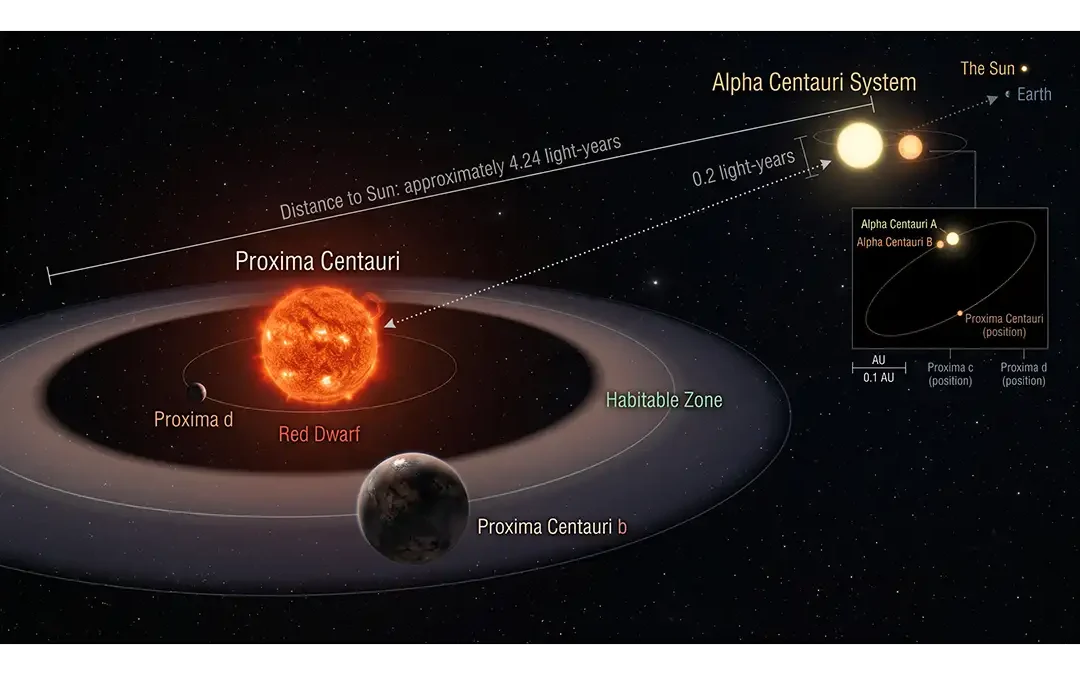
Proxima Centauri is a red dwarf star near our Solar System. It is a small, cool red dwarf located about 4.24 light-years from Earth in the constellation Centaurus. Although it is our nearest stellar neighbor, Proxima Centauri is too faint to see with the naked eye.
Proxima Centauri is especially interesting because it is part of the Alpha Centauri star system and has planets orbiting it. One of these planets, Proxima Centauri b, is located in the star's habitable zone, making it an important target in the search for potentially habitable worlds beyond our Solar System.
In this article, we will explore what Proxima Centauri is, how far away it is, its size and physical properties, its planets, whether Proxima Centauri b could support life, and whether humans could ever travel to this nearby star.
What Is Proxima Centauri?
Proxima Centauri is the nearest known star to the Sun. It is about 4.24 light-years away from Earth. Despite its closeness, it is not visible to the naked eye because it is a very faint star. The name "Proxima" itself comes from the Latin word meaning "nearest," chosen to highlight its special position relative to our Solar System.
Astronomically, Proxima Centauri is a small, cool, low-mass star known as a red dwarf (specifically an M-type main-sequence star). Red dwarfs are the most common type of star in our Milky Way galaxy, but they are so dim that none are visible from Earth without a telescope.
Geologically (in an astronomical sense), Proxima Centauri is the closest star to our Sun because of its current location in its long, slow orbit around the center of our galaxy. Stars are constantly moving, and right now, Proxima Centauri is the closest one to us. It will remain our nearest neighbor for thousands of years.
While it is its own star, Proxima Centauri is gravitational bound to a larger system. It is the third and farthest member of the Alpha Centauri system, forming a triple star system. Proxima Centauri orbits the two brighter central stars, Alpha Centauri A and Alpha Centauri B, which are also very close but slightly farther away than Proxima Centauri.
Proxima Centauri Distance, Size, and Physical Properties
Proxima Centauri is close to the Sun compared with other stars, but it is still extremely far away from Earth. Its small size and low brightness also make it very different from the Sun.
How Far Is Proxima Centauri From Earth?
Proxima Centauri is about 4.24 light-years from Earth. A light-year is the distance that light travels in one year, which is about 9.46 trillion kilometers.
This means Proxima Centauri is roughly 40 trillion kilometers away from Earth. Even though this is the closest distance to another star beyond the Sun, it is far too great for ordinary spacecraft to cross quickly.
Light travels at about 300,000 kilometers per second. At that speed, light from Proxima Centauri takes about 4.24 years to reach Earth. Therefore, when astronomers observe the star today, they are seeing light that left Proxima Centauri more than four years ago.
How Big Is Proxima Centauri?
Proxima Centauri is much smaller than the Sun. Its radius is about one-seventh of the Sun's radius, and its mass is roughly one-eighth of the Sun's mass.
Its small size is one reason why it produces much less energy than the Sun. Even though Proxima Centauri is a star, it would look extremely faint compared with the Sun if viewed from the same distance.
| Property | Proxima Centauri | Sun |
|---|---|---|
| Star type | Red dwarf | G-type star |
| Mass | About 0.12 solar masses | 1 solar mass |
| Size | Much smaller | Much larger |
| Brightness | Very low | Much higher |
| Distance from Earth | About 4.24 light-years | About 150 million km |
How Hot Is Proxima Centauri?
Proxima Centauri has a much cooler surface than the Sun. Its surface temperature is roughly 3,000 K, while the Sun's visible surface is about 5,800 K.
Because Proxima Centauri is cooler, most of the energy it gives off is in the infrared part of the electromagnetic spectrum. Its visible light is relatively weak, which is another reason it cannot be seen with the naked eye.
Why Is Proxima Centauri So Dim?
Proxima Centauri is dim mainly because it is small and relatively cool. It produces only a tiny fraction of the energy produced by the Sun.
Its low brightness does not mean that the star is inactive. Proxima Centauri is known for strong stellar flares, which are sudden increases in energy released from the star. These flares can produce intense radiation and may strongly affect planets that orbit close to the star.
Proxima Centauri Compared With the Sun
The Sun and Proxima Centauri are both stars, but they are very different. The Sun is larger, hotter, and much brighter, while Proxima Centauri is smaller, cooler, and much fainter.
However, Proxima Centauri has one major advantage for astronomical research: it is extremely close to our Solar System. Its proximity makes it one of the most important nearby stars for studying red dwarfs and planets outside the Solar System.
Does Proxima Centauri Have Planets?
Yes, scientists have confirmed that Proxima Centauri hosts multiple planets. This is exciting because it means that not only is our nearest star system habitable in theory, but it actually has planets we can study. These planets were discovered using the radial velocity method, which detects the tiny wobbles in a star's movement caused by the gravity of orbiting planets.
So far, astronomers have confirmed three planets in the system, labeled based on the order of their discovery:
- Proxima Centauri b: Discovered in 2016, this is the most famous planet. It is roughly Earth-sized (about 1.17 Earth masses) and orbits Proxima Centauri in the habitable zone (the region where liquid water could exist). It completes one orbit in just 11.2 Earth days because its host star is so faint and cool that the habitable zone is very close to the star.
- Proxima Centauri c: Discovered in 2019, this is a much larger planet, a "Super-Earth" about 7 times the mass of Earth. It orbits far outside the habitable zone in the cold "icy" part of the system, taking about 1,900 Earth days (about 5.2 years) to complete one orbit.
- Proxima Centauri d: Discovered in 2022, this is a very tiny planet, a "sub-Earth" with about 0.26 the mass of Earth. It is the closest planet to the star, orbiting every 5.1 Earth days, far too close to be habitable.
Scientists now know that Proxima Centauri has a compact system of rocky and super-Earth planets. While we don't have direct images of them, their mass, orbital periods, and approximate locations from their star are well established.
Is Proxima Centauri b Habitable?
This is one of the biggest questions in astronomy today. Proxima Centauri b orbits within the habitable zone (or "Goldilocks zone") of its star, which means it is at the right distance where it isn't too hot or too cold for liquid water to potentially exist on its surface. Since water is essential for all life as we know it, this planet is the top candidate for searching for extraterrestrial life outside our Solar System.
However, being in the habitable zone does not guarantee the possibility of life. Proxima Centauri b faces several extreme challenges. The star, being a red dwarf, is prone to powerful stellar flares and massive amounts of radiation. These flares are frequent and much more intense than anything from our Sun, potentially stripping away any atmosphere Proxima b might have and dousing the surface in deadly levels of UV and X-ray radiation.
Whether Proxima Centauri b is habitable depends heavily on whether it has a strong enough atmosphere and magnetic field to protect itself from these flares. If it does, it might still have liquid water and potentially support life (possibly simple life that lives underground or in oceans protected from surface radiation). If it has lost its atmosphere, it is likely a dry, irradiated rock, much like Mercury. So while the possibility of life exists, it is far from certain and will require much more advanced telescopes to find an answer.
Can We See Proxima Centauri From Earth?
This is a key question for stargazers. No, you cannot see Proxima Centauri with the naked eye from Earth. This is because of its physical properties. Despite being the closest star, Proxima Centauri has a very high naked-eye visibility magnitude (app. 11.13). The human eye can only see stars down to about magnitude 6 (lower numbers mean brighter objects).
However, you can easily see Proxima Centauri with a small telescope (around 3-inch or larger) or powerful binoculars under dark skies. This makes it a popular target for amateur astronomers living in the Southern Hemisphere.
Where Proxima Centauri appears in the sky is crucial for visibility. It is located in the constellation Centaurus (the Centaur), deep in the Southern Sky. This means it is never visible to people living in the United States, Canada, Europe, or other high northern latitudes. It is only visible from Southern Hemisphere locations (like South America, Australia, New Zealand, and South Africa) and very low northern latitudes near the equator. In the Southern Hemisphere, it is visible much of the year, appearing close in the sky to the much brighter stars of Alpha Centauri A and B.
How Astronomers Measure the Distance to Proxima Centauri
Measuring the vast distances to stars is one of the fundamental tasks in astronomy. Astronomers don't use conventional units like kilometers or miles because they become too large and unwieldy. Instead, they rely on a different set of units:
- Light-years: A light-year is a measure of distance, not time. It is the distance that light, which travels at about 300,000 km/s (186,000 miles/s), covers in one Earth year (approximately 9.46 trillion km or 5.88 trillion miles).
- Parsecs: A parsec is another common astronomical distance unit. One parsec equals 3.26 light-years. It is derived from a measurement method called trigonometric parallax. Proxima Centauri is about 1.3 parsecs from Earth.
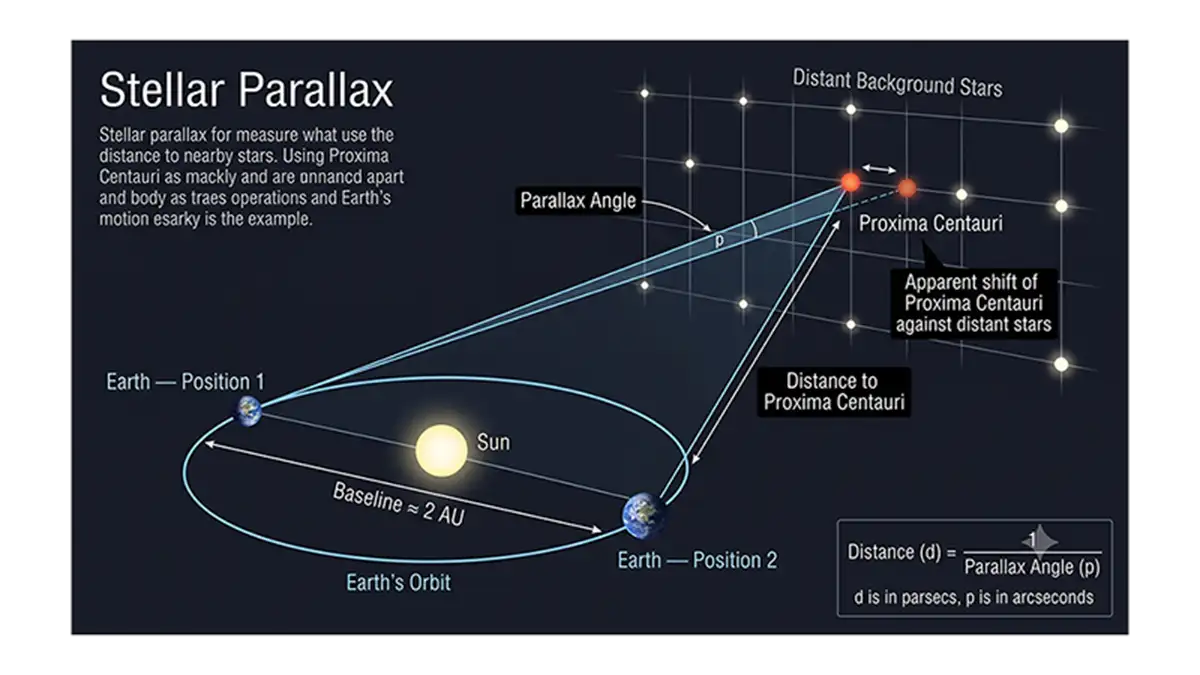
The most precise way astronomers calculate the distance to Proxima Centauri is by using a method called trigonometric stellar parallax. Here is how astronomical distance measurement works using parallax:
Imagine holding your thumb in front of you and closing one eye at a time. Your thumb seems to move against the background. Astronomers use a similar idea to measure the distance to Proxima Centauri. They observe the star when Earth is on one side of the Sun and then observe it again about six months later, when Earth is on the opposite side. Because Earth has moved, Proxima Centauri appears to shift slightly against much more distant stars.
Astronomers measure this small shift and use the angle of the shift to calculate the star’s distance. This method is called stellar parallax. The shift is extremely small, so astronomers need powerful and accurate instruments to measure it. Space missions such as the European Space Agency’s Gaia mission can measure stellar positions with very high accuracy, helping astronomers determine the distance to nearby stars like Proxima Centauri.
Proxima Centauri Facts
Here are some important facts about Proxima Centauri:
- Closest star: Proxima Centauri is the closest known star to the Sun, at about 4.24 light-years from Earth.
- Star type: It is a red dwarf, or M-type star.
- Location: It is located in the constellation Centaurus.
- Star system: Proxima Centauri is part of the Alpha Centauri three-star system.
- Size: It is much smaller than the Sun, with a radius of roughly one-seventh of the Sun's radius.
- Mass: Its mass is about one-eighth of the Sun's mass.
- Brightness: It is far less luminous than the Sun and cannot be seen with the naked eye.
- Temperature: Its surface temperature is roughly 3,000 K, much cooler than the Sun.
- Stellar activity: Proxima Centauri can produce powerful stellar flares.
- Planets: The system is known for planets including Proxima Centauri b, c, and d.
- Proxima b: Proxima Centauri b is the best-known planet in the system and orbits within the star's estimated habitable zone.
- Observation: Although it is the closest star beyond the Sun, its faintness makes it difficult to observe without a telescope.
- Scientific importance: Its proximity makes Proxima Centauri an important target for studying red dwarf stars, exoplanets, and the possibility of habitable worlds beyond the Solar System.
Conclusion
Proxima Centauri occupies a unique and powerful position in astronomy. As our nearest stellar neighbor, it represents the primary goal for future interstellar exploration and the most practical laboratory for studying exotic worlds like the Earth-sized Proxima b. While it is a dim, flare-prone red dwarf—presenting significant challenges for any potential life on its planets—its very proximity allows us to study its system in unprecedented detail. Measuring its distance with extreme accuracy, discovering its planets, and understanding its extreme physical properties are major steps forward in our ongoing quest to explore the cosmos. Proxima Centauri will remain at the center of astronomical focus for decades to come, as humanity attempts its first, crucial transition from exploring our Solar System to exploring the wider galaxy.
Proxima Centauri is a small red dwarf star in the constellation Centaurus. It is the closest known star to the Sun, located about 4.24 light-years from Earth.
Proxima Centauri is about 4.24 light-years from Earth, or roughly 40 trillion kilometers. Light takes about 4.24 years to travel between the star and Earth.
Yes. Proxima Centauri is the closest known star to the Sun and therefore the closest known star beyond our Solar System.
Yes. Proxima Centauri is part of the Alpha Centauri star system. Alpha Centauri A and Alpha Centauri B form a close pair, while Proxima Centauri is the more distant third member of the system.
Yes. Planets associated with Proxima Centauri include Proxima Centauri b, Proxima Centauri c, and Proxima Centauri d. Scientists continue to study these planets and refine what is known about their properties.