
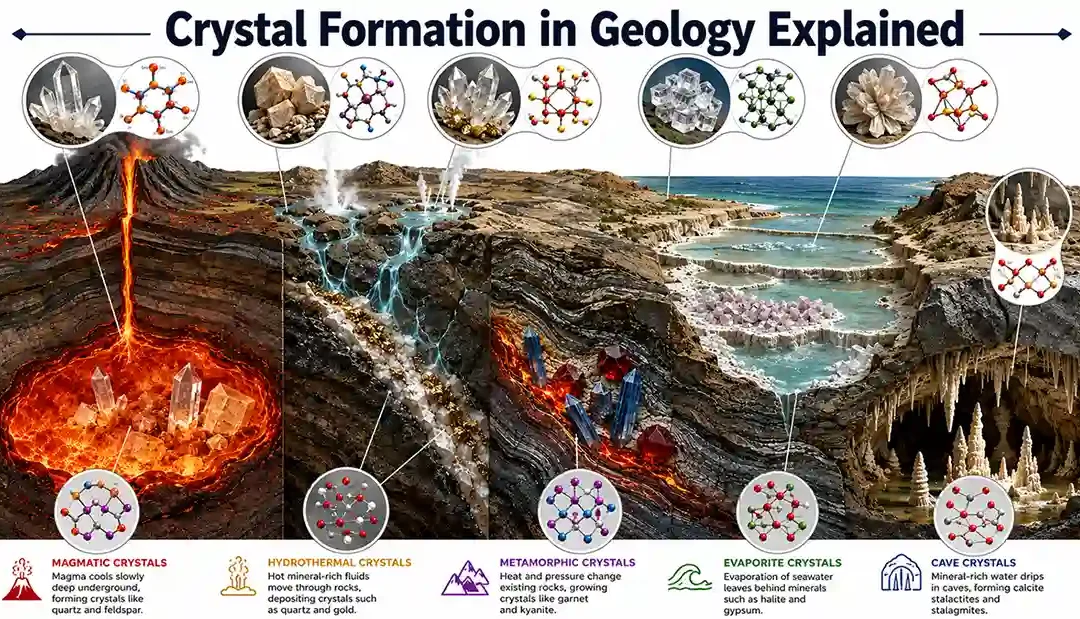
Crystals are one of nature's most remarkable creations. Every crystal begins as tiny atoms, ions, or molecules that gradually organize into a highly ordered and repeating three-dimensional pattern known as a crystal lattice. Over time, these microscopic building blocks grow into visible mineral crystals through natural geological or biological processes.
Crystal formation occurs in many environments, including cooling magma, hydrothermal systems, evaporating lakes, caves, sedimentary basins, metamorphic rocks, and even inside living organisms. Although the environments differ, every crystal forms through the same basic sequence: nucleation, crystal growth, and crystal stabilization.
Understanding how crystals form is fundamental to mineralogy, crystallography, petrology, geochemistry, materials science, and Earth science.
This topic should be studied together with Crystal Chemistry Explained, Mineralogy Explained, and Experimental Mineralogy Explained.
What Is Crystal Formation?
Crystal formation is the natural process in which atoms, ions, or molecules arrange themselves into a repeating crystal lattice.
The process requires:
- Suitable chemical elements
- Proper temperature
- Appropriate pressure
- Enough space
- Sufficient time
When these conditions are favorable, crystals begin to grow.
The Three Main Stages of Crystal Formation
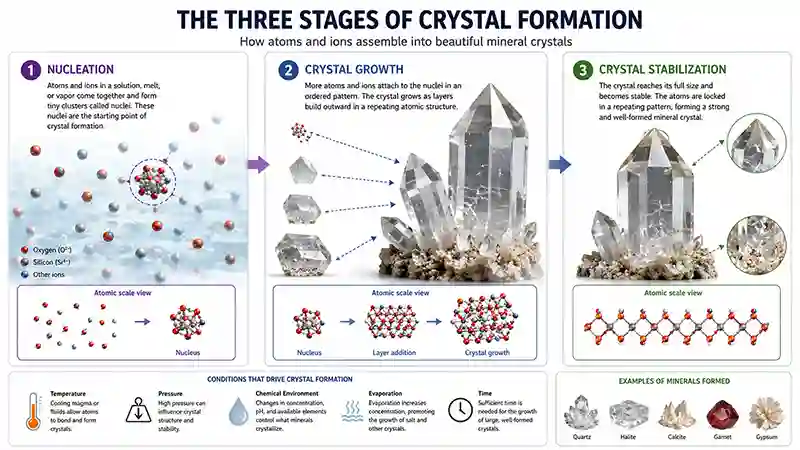
Every crystal forms through three major stages.
1. Nucleation
Crystal formation begins with nucleation.
During this stage:
- Atoms join together.
- Tiny crystal nuclei form.
- Stable crystal seeds develop.
These microscopic nuclei become the foundation for larger crystals.
2. Crystal Growth
Once a stable nucleus forms, additional atoms attach to its surface.
Crystal growth continues while:
- Atoms remain available.
- Temperature remains favorable.
- Space exists for growth.
The crystal gradually becomes larger.
3. Crystal Stabilization
Eventually crystal growth slows or stops.
Growth may end because:
- Available atoms are exhausted.
- Temperature changes.
- Pressure changes.
- Growth space becomes limited.
The finished crystal preserves the conditions under which it formed.
How Crystals Form in Nature
Crystals form in several geological environments.
Cooling Magma
As magma cools underground, minerals crystallize one after another.
Examples include:
- Quartz
- Feldspar
- Olivine
- Pyroxene
- Amphibole
Slow cooling produces larger crystals.
Hydrothermal Fluids
Hot water rich in dissolved minerals moves through fractures.
As temperature decreases:
- Quartz veins form.
- Calcite precipitates.
- Gold and sulfide minerals crystallize.
Hydrothermal systems produce many valuable ore deposits.
Evaporation
When water evaporates, dissolved minerals become concentrated.
Eventually crystals begin forming.
Examples include:
- Halite
- Gypsum
- Sylvite
These minerals commonly occur in evaporite deposits.
Metamorphism
Heat and pressure cause existing minerals to recrystallize.
Common metamorphic crystals include:
- Garnet
- Kyanite
- Sillimanite
- Staurolite
Biomineralization
Living organisms also produce crystals.
Examples include:
- Coral skeletons
- Shells
- Bones
- Teeth
- Pearls
Factors That Affect Crystal Growth
Crystal growth depends on several important factors.
Temperature
Temperature controls:
- Growth rate
- Crystal size
- Mineral stability
Slow cooling generally produces larger crystals.
Pressure
Pressure affects:
- Crystal structure
- Mineral stability
- Crystal density
Deep-Earth minerals form under extreme pressures.
Chemical Composition
Different chemical elements produce different minerals.
For example:
- Silicon and oxygen form quartz.
- Calcium and carbon form calcite.
Time
- The longer crystals grow, the larger they generally become.
- Rapid cooling produces microscopic crystals.
- Slow cooling may produce giant crystals.
Available Space
Crystals need room to grow.
Open cavities often contain:
- Well-formed quartz crystals
- Calcite crystals
- Fluorite crystals
Crowded environments produce irregular crystal shapes.
Common Crystal Shapes
Crystal shape depends on atomic arrangement.
Common forms include:
- Cubes
- Hexagonal prisms
- Octahedra
- Needles
- Plates
- Fibers
Each mineral has characteristic crystal habits.
Examples of Crystal Formation
| Mineral | Formation Environment |
|---|---|
| Quartz | Magma, Hydrothermal Fluids |
| Feldspar | Cooling Magma |
| Diamond | Earth's Mantle |
| Calcite | Marine Water, Caves |
| Halite | Evaporating Water |
| Garnet | Metamorphic Rocks |
| Gypsum | Evaporite Basins |
| Pyrite | Hydrothermal Systems |
Geological Importance
Understanding crystal formation helps geologists:
- Identify mineral origins
- Reconstruct geological history
- Interpret magma evolution
- Study hydrothermal systems
- Understand metamorphism
- Explore mineral deposits
Crystal growth records Earth's geological processes.
Laboratory Crystal Growth
Scientists also grow crystals in laboratories.
Common methods include:
- Hydrothermal growth
- Czochralski method
- Flux growth
- Chemical Vapor Deposition (CVD)
- High-Pressure High-Temperature (HPHT)
Laboratory-grown crystals support scientific research and industry.
Laboratory Investigation
Crystal formation is studied using:
- Petrographic Microscopy
- X-Ray Diffraction (XRD)
- Scanning Electron Microscopy (SEM)
- Electron Microprobe Analysis (EPMA)
- Raman Spectroscopy
- Cathodoluminescence
- Experimental Mineralogy
These techniques reveal crystal structures and growth histories.
Applications
Understanding crystal formation is important in:
- Mineralogy
- Crystallography
- Geochemistry
- Petrology
- Gemology
- Materials Science
- Mining
- Semiconductor Manufacturing
Advantages of Studying Crystal Formation
Studying crystal formation helps scientists:
- Explain mineral origins
- Predict crystal growth
- Discover new mineral deposits
- Improve synthetic crystal production
- Develop advanced materials
- Better understand Earth's evolution
Limitations
Studying crystal formation has several challenges:
- Many natural crystal-forming processes occur over thousands to millions of years.
- Geological environments are often more complex than laboratory experiments.
- Multiple factors such as temperature, pressure, and fluid chemistry interact simultaneously.
- Some crystal growth processes cannot be observed directly in nature.
For comprehensive understanding, combine this topic with:
- Crystal Growth in Minerals Explained
- Crystal Chemistry Explained
- Experimental Mineralogy Explained
- Mineralogy Explained
- Natural vs Synthetic Minerals Explained
- Atomic Structure of Minerals Explained
- Crystal Structure of Minerals Explained
- Biomineralization Explained
Comparison Table
| Crystal Formation Process | Typical Environment | Common Minerals |
| Magmatic Crystallization | Cooling Magma | Quartz, Feldspar |
| Hydrothermal Growth | Hot Fluids | Quartz, Pyrite |
| Evaporation | Salt Lakes | Halite, Gypsum |
| Metamorphism | Heat and Pressure | Garnet, Kyanite |
| Biomineralization | Living Organisms | Calcite, Hydroxyapatite |
Summary Table
| Feature | How Crystals Form |
| Main Stages | Nucleation, Growth, Stabilization |
| Major Controls | Temperature, Pressure, Chemistry, Time |
| Formation Environments | Magmatic, Hydrothermal, Sedimentary, Metamorphic, Biological |
| Study Methods | XRD, SEM, Petrography, Experimental Mineralogy |
| Geological Importance | Mineral Formation and Earth Processes |
Crystals form when atoms, ions, or molecules arrange themselves into a repeating crystal lattice through nucleation and crystal growth under suitable temperature, pressure, and chemical conditions.
Crystals form in cooling magma, hydrothermal fluids, evaporating lakes, caves, metamorphic rocks, sedimentary environments, and even inside living organisms.
Nucleation is the first stage of crystal formation in which tiny groups of atoms come together to create stable crystal seeds that later grow into larger crystals.
Crystal size depends mainly on growth time, cooling rate, available space, and environmental conditions. Slow cooling generally produces larger crystals.
Yes. Scientists grow crystals using hydrothermal methods, chemical vapor deposition (CVD), high-pressure high-temperature (HPHT) systems, the Czochralski method, and other crystal growth techniques for research and industrial applications.
Final Thoughts
Crystal formation is one of the most fundamental processes in Earth science. From microscopic crystal nuclei to spectacular quartz geodes, giant feldspar crystals, and diamonds formed deep within Earth's mantle, every crystal records the physical and chemical conditions of its environment. Whether formed by cooling magma, hydrothermal fluids, evaporation, metamorphism, or biological activity, crystals provide valuable insights into Earth's history and natural processes.
By combining mineralogy, crystallography, crystal chemistry, and experimental mineralogy, scientists continue to uncover how crystals grow, evolve, and influence everything from mountain building and ore formation to modern technology and advanced materials.
Continue Learning
Expand your knowledge of crystal science with these related guides:
- Natural vs Synthetic Minerals Explained
- Atomic Structure of Minerals Explained
- Crystal Structure of Minerals Explained
- Biomineralization Explained