
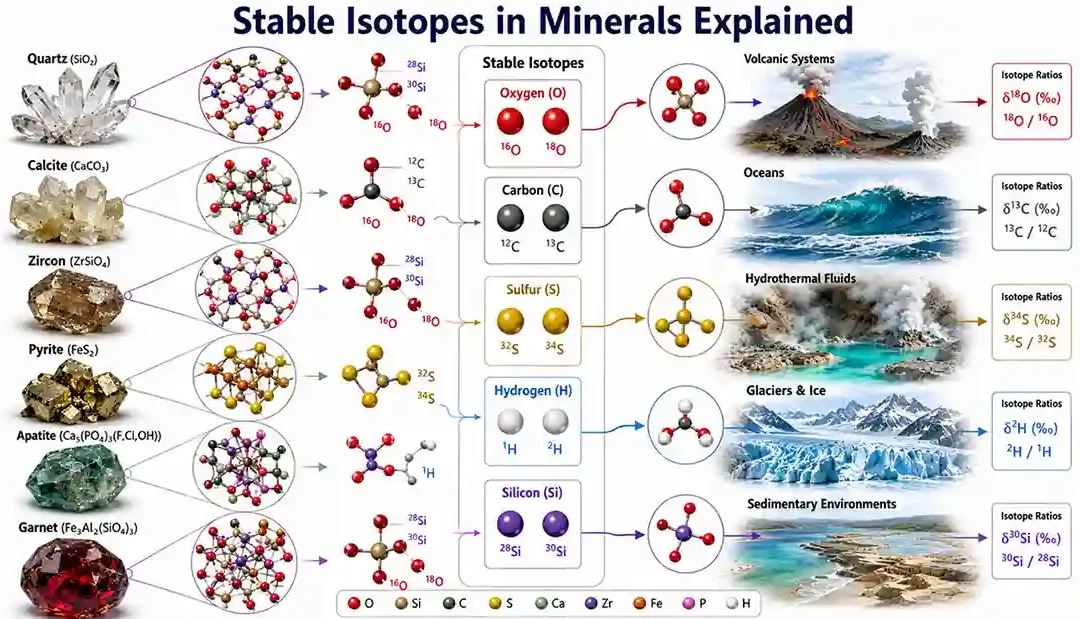
Stable isotopes are naturally occurring forms of chemical elements that have the same number of protons but different numbers of neutrons. Unlike radioactive isotopes, stable isotopes do not decay over time, making them valuable tools for studying geological processes that occurred millions or even billions of years ago.
Minerals preserve stable isotope signatures from the environments in which they formed. By measuring isotope ratios in minerals such as quartz, calcite, zircon, pyrite, apatite, and garnet, geologists can determine formation temperatures, identify fluid sources, reconstruct ancient climates, trace magma evolution, and understand hydrothermal systems.
Stable isotope analysis is now an essential technique in mineralogy, geochemistry, petrology, environmental geology, paleoclimatology, and mineral exploration.
This topic should be studied together with Mineral Chemistry Analysis, Hydrothermal Minerals Explained, and Experimental Mineralogy Explained.
What Are Stable Isotopes?
Stable isotopes are atoms of the same element that have:
- The same number of protons
- Different numbers of neutrons
- Different atomic masses
- No radioactive decay
Because they remain stable through time, they preserve valuable geological information.
Stable Isotopes vs Radioactive Isotopes
| Stable Isotopes | Radioactive Isotopes |
|---|---|
| Do not decay | Decay over time |
| Used for environmental studies | Used for age dating |
| Record formation conditions | Record geological ages |
| Constant through time | Change with radioactive decay |
Both are important, but they serve different purposes.
How Stable Isotopes Become Incorporated into Minerals
During mineral formation:
- Dissolved elements enter fluids or magma.
- Minerals crystallize.
- Stable isotopes become locked into the crystal structure.
- The isotope ratios preserve information about the environment of formation.
Different temperatures and fluids produce different isotope signatures.
Major Stable Isotope Systems
Oxygen Isotopes (¹⁶O / ¹⁸O)
Oxygen isotopes are among the most widely studied.
Common minerals:
- Quartz
- Zircon
- Feldspar
- Calcite
Applications:
- Paleoclimate
- Hydrothermal systems
- Magma evolution
- Metamorphism
Carbon Isotopes (¹²C / ¹³C)
Carbon isotopes occur mainly in carbonate minerals.
Common minerals:
- Calcite
- Dolomite
Applications:
- Carbon cycle
- Marine environments
- Organic matter
- Petroleum geology
Sulfur Isotopes (³²S / ³⁴S)
Sulfur isotopes are widely used in ore deposits.
Common minerals:
- Pyrite
- Chalcopyrite
- Galena
- Sphalerite
Applications:
- Ore genesis
- Hydrothermal fluids
- Volcanic systems
Hydrogen Isotopes (¹H / ²H)
Hydrogen isotopes occur in:
- Micas
- Amphiboles
- Clay minerals
Applications:
- Groundwater studies
- Hydrothermal alteration
- Weathering
Silicon Isotopes (²⁸Si / ³⁰Si)
Silicon isotopes are important in silicate minerals.
Common minerals:
- Quartz
- Feldspar
Applications:
- Weathering
- Ocean chemistry
- Silica cycling
Other Stable Isotopes
Additional systems include:
- Nitrogen (¹⁴N / ¹⁵N)
- Magnesium (²⁴Mg / ²⁶Mg)
- Iron (⁵⁴Fe / ⁵⁶Fe)
- Calcium (⁴⁰Ca / ⁴⁴Ca)
- Lithium (⁶Li / ⁷Li)
These provide insights into specialized geological and environmental processes.
Stable Isotope Fractionation
Isotope fractionation occurs because lighter and heavier isotopes behave slightly differently during physical and chemical processes.
Fractionation depends on:
- Temperature
- Pressure
- Mineral type
- Fluid composition
- Chemical reactions
Lower temperatures generally produce larger isotope fractionation.
Common Minerals Used in Stable Isotope Studies
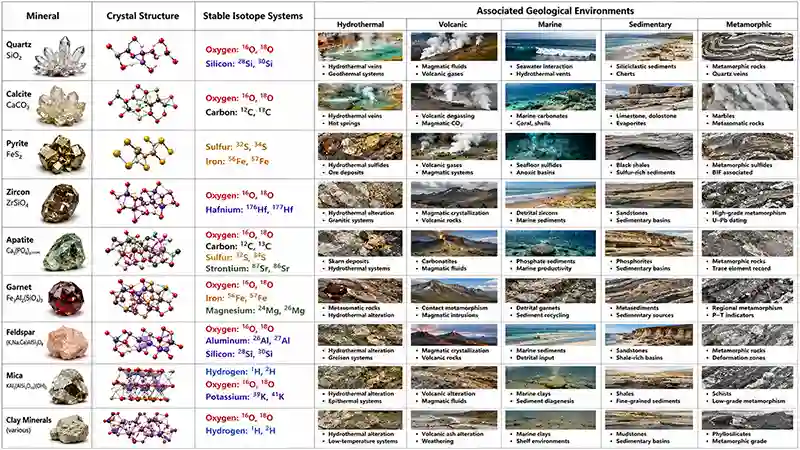
Frequently analyzed minerals include:
- Quartz
- Calcite
- Dolomite
- Zircon
- Garnet
- Pyrite
- Chalcopyrite
- Apatite
- Feldspar
- Mica
Each mineral records different geological information.
Geological Importance
Stable isotopes help geologists:
- Determine mineral formation temperatures
- Trace fluid sources
- Study magma evolution
- Reconstruct paleoclimates
- Interpret metamorphism
- Investigate hydrothermal systems
They provide evidence that cannot be obtained from mineral chemistry alone.
Environmental Importance
Stable isotope studies contribute to:
- Climate reconstruction
- Groundwater tracing
- Carbon cycling
- Ocean chemistry
- Pollution studies
- Environmental monitoring
They are widely used beyond traditional geology.
Laboratory Analysis
Stable isotope ratios are measured using:
- Isotope Ratio Mass Spectrometry (IRMS)
- Secondary Ion Mass Spectrometry (SIMS)
- Laser Ablation Systems
- Gas Source Mass Spectrometry
- Multi-Collector ICP-MS
Results are commonly reported using delta (δ) notation.
Applications
Stable isotope studies are widely used in:
- Mineralogy
- Geochemistry
- Petrology
- Economic Geology
- Environmental Geology
- Paleoclimatology
- Hydrogeology
- Planetary Science
Advantages of Stable Isotope Analysis
Stable isotope studies help scientists:
- Reconstruct ancient environments
- Trace fluid movement
- Understand ore formation
- Investigate climate change
- Study groundwater systems
- Interpret mineral formation conditions
Limitations
Stable isotope analysis has several limitations:
- Isotope ratios may be altered by later geological processes.
- Accurate interpretation requires careful sampling and preparation.
- Different geological processes may produce overlapping isotope signatures.
- Specialized laboratory instruments are required for precise measurements.
For comprehensive understanding, combine this topic with:
- Mineral Chemistry Analysis
- Geochemistry Explained
- Hydrothermal Minerals Explained
- Experimental Mineralogy Explained
- Petrographic Microscopy
- X-Ray Diffraction in Mineralogy
- Electron Microprobe Analysis
- Mineralogy Explained
Comparison Table
| Stable Isotope System | Common Minerals | Main Applications |
| Oxygen | Quartz, Zircon | Paleoclimate, Hydrothermal Systems |
| Carbon | Calcite, Dolomite | Carbon Cycle, Marine Geology |
| Sulfur | Pyrite, Chalcopyrite | Ore Deposits |
| Hydrogen | Mica, Amphibole | Groundwater, Alteration |
| Silicon | Quartz, Feldspar | Weathering, Ocean Chemistry |
Summary Table
| Feature | Stable Isotopes in Minerals |
| Definition | Non-Radioactive Isotopes Preserved in Minerals |
| Main Isotope Systems | Oxygen, Carbon, Sulfur, Hydrogen, Silicon |
| Primary Method | Isotope Ratio Mass Spectrometry (IRMS) |
| Major Applications | Geochemistry, Climate, Ore Deposits |
| Geological Importance | Tracing Mineral Formation and Fluid Sources |
Stable isotopes are non-radioactive forms of elements preserved within mineral crystals. Their isotope ratios record information about the conditions under which the minerals formed.
They help geologists determine formation temperatures, trace the origin of fluids, reconstruct ancient climates, study magma evolution, and investigate ore-forming processes.
The most common systems are oxygen, carbon, sulfur, hydrogen, and silicon isotopes, although many other stable isotopes are also used in specialized research.
Quartz, calcite, dolomite, zircon, pyrite, garnet, apatite, feldspar, mica, and clay minerals are frequently used in stable isotope studies.
Scientists use techniques such as Isotope Ratio Mass Spectrometry (IRMS), Secondary Ion Mass Spectrometry (SIMS), laser ablation systems, and Multi-Collector ICP-MS to measure isotope ratios with high precision.
Final Thoughts
Stable isotopes preserved within minerals provide one of the most powerful tools for understanding Earth's geological history. From tracing hydrothermal fluids and reconstructing ancient climates to identifying ore-forming processes and studying magma evolution, isotope signatures reveal information that cannot be observed directly in the field.
By combining isotope geochemistry with mineralogy, petrology, and modern analytical instruments such as IRMS, SIMS, and Multi-Collector ICP-MS, scientists can investigate processes ranging from microscopic crystal growth to global geochemical cycles. Stable isotope analysis remains an essential technique in modern Earth science, environmental research, and mineral exploration.
Continue Learning
Continue exploring mineral chemistry and geochemistry with these related guides: