
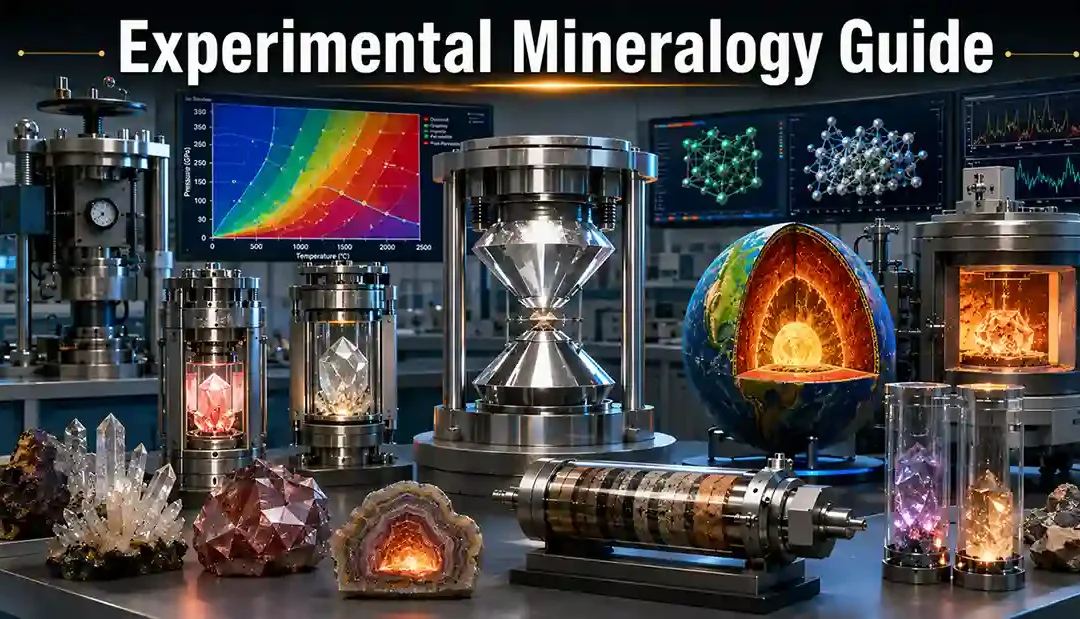
Experimental mineralogy is the branch of mineralogy that recreates natural geological conditions in a laboratory to understand how minerals form, grow, transform, and remain stable. Instead of relying only on field observations, scientists reproduce the high temperatures, extreme pressures, chemical environments, and fluid conditions found deep within Earth to study mineral behavior directly.
Experimental mineralogy has revolutionized Earth science by allowing researchers to simulate processes such as magma crystallization, metamorphism, hydrothermal alteration, mantle mineral formation, and crystal growth. It also helps explain how minerals respond to changing temperature, pressure, and chemistry over geological time.
Today, experimental mineralogy plays a vital role in mineralogy, petrology, geochemistry, volcanology, planetary science, and materials research.
This topic should be studied together with Mineralogy Explained, Mineral Stability Explained, and X-Ray Diffraction in Mineralogy.
What Is Experimental Mineralogy?
Experimental mineralogy is the scientific study of minerals through controlled laboratory experiments.
Researchers recreate geological environments to investigate:
- Mineral formation
- Crystal growth
- Phase transformations
- Mineral stability
- Chemical reactions
- High-pressure processes
- High-temperature processes
The goal is to understand natural mineral-forming processes by observing them under controlled conditions.
Why Experimental Mineralogy Is Important
Many geological processes occur deep underground where direct observation is impossible.
Laboratory experiments allow scientists to:
- Simulate Earth's mantle
- Reproduce volcanic environments
- Study hydrothermal systems
- Measure mineral stability
- Test geological theories
Experimental results can then be compared with natural rocks and minerals.
Main Variables Controlled in Experiments
Scientists carefully control:
- Temperature
- Pressure
- Chemical composition
- Oxygen availability
- Water content
- Carbon dioxide content
- Time
Even small changes in these variables can produce different minerals.
Major Experimental Techniques
High-Temperature Experiments
Minerals are heated in specialized furnaces.
These experiments study:
- Magma crystallization
- Melting temperatures
- Crystal growth
- Mineral stability
Temperatures often exceed 1,500°C.
High-Pressure Experiments
High-pressure devices simulate deep-Earth conditions.
Common equipment includes:
- Diamond anvil cell
- Multi-anvil press
- Piston-cylinder apparatus
These systems reproduce pressures found hundreds of kilometers beneath Earth's surface.
Hydrothermal Experiments
Minerals are grown from hot, pressurized fluids.
Scientists investigate:
- Quartz growth
- Ore mineral formation
- Fluid-rock interaction
- Hydrothermal alteration
Hydrothermal autoclaves commonly operate at temperatures above 300°C.
Crystal Growth Experiments
Researchers observe how crystals develop under different conditions.
These studies examine:
- Crystal size
- Growth rate
- Crystal shape
- Defect formation
Phase Equilibrium Experiments
These experiments determine the stability ranges of minerals under different temperatures and pressures. Results are used to construct phase diagrams.
Laboratory Equipment
Common experimental equipment includes:
- High-temperature furnaces
- Diamond anvil cells
- Multi-anvil presses
- Piston-cylinder apparatus
- Hydrothermal autoclaves
- Vacuum furnaces
- Controlled-atmosphere furnaces
- High-pressure reaction vessels
These instruments reproduce natural geological environments.
Minerals Commonly Studied
Experimental mineralogy frequently investigates:
- Quartz
- Feldspar
- Olivine
- Pyroxene
- Garnet
- Amphibole
- Calcite
- Diamond
- Graphite
- Magnetite
- Clay minerals
These minerals represent major rock-forming and economically important mineral groups.
Experimental Mineralogy and Earth’s Interior
Experimental studies help scientists understand:
- Mantle mineralogy
- Core-mantle boundary
- Magma evolution
- Plate tectonics
- Subduction zones
- Volcanic processes
Many deep-Earth minerals were first predicted experimentally before being discovered in nature.
Experimental Mineralogy and Planetary Science
Laboratory experiments also simulate conditions on:
- Mars
- Moon
- Mercury
- Venus
- Asteroids
- Meteorites
These studies improve our understanding of planetary evolution beyond Earth.
Geological Importance
Experimental mineralogy helps geologists:
- Interpret rock formation
- Explain mineral stability
- Understand metamorphism
- Reconstruct magma evolution
- Investigate hydrothermal systems
- Validate geological models
It bridges theoretical geology with real-world observations.
Laboratory Analysis After Experiments
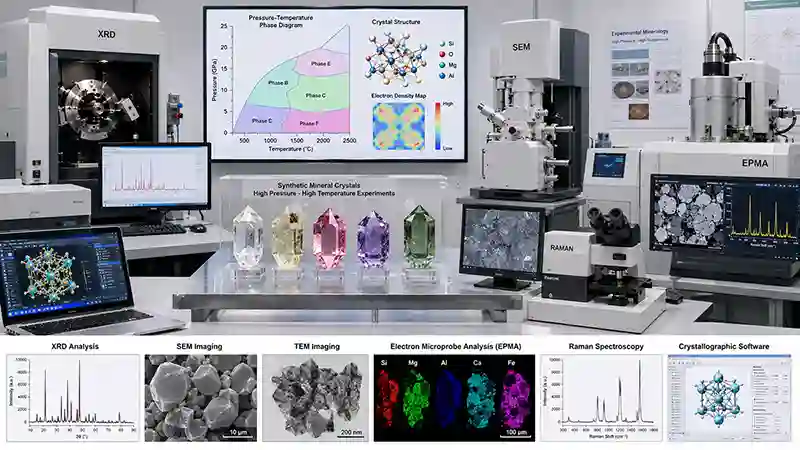
Minerals produced in experiments are analyzed using:
- X-Ray Diffraction (XRD)
- Electron Microprobe Analysis (EPMA)
- Scanning Electron Microscopy (SEM)
- Transmission Electron Microscopy (TEM)
- Raman Spectroscopy
- X-Ray Fluorescence (XRF)
These techniques confirm mineral identity and crystal structure.
Applications
Experimental mineralogy is widely used in:
- Mineralogy
- Petrology
- Geochemistry
- Volcanology
- Planetary Science
- Materials Science
- Economic Geology
- Environmental Geology
Advantages of Experimental Mineralogy
Studying minerals experimentally allows scientists to:
- Recreate geological processes
- Test scientific hypotheses
- Measure mineral stability
- Understand crystal growth
- Simulate deep-Earth environments
- Improve geological models
Limitations
Experimental mineralogy has several limitations:
- Laboratory experiments may simplify complex natural systems.
- Some geological processes take millions of years and cannot be reproduced completely.
- Extremely high-pressure experiments require specialized and expensive equipment.
- Results must always be compared with natural rocks and minerals for validation.
For comprehensive understanding, combine this topic with:
- Mineralogy Explained
- Crystal Chemistry Explained
- Mineral Stability Explained
- Mineral Polymorphism Explained
- X-Ray Diffraction in Mineralogy
- Electron Microprobe Analysis
- Petrographic Microscopy
- Mineral Chemistry Analysis
Comparison Table
| Experimental Method | Main Purpose | Typical Equipment |
|---|---|---|
| High-Temperature | Magma & Crystal Formation | Furnace |
| High-Pressure | Mantle Simulation | Diamond Anvil Cell |
| Hydrothermal | Mineral Growth from Fluids | Autoclave |
| Crystal Growth | Growth Mechanisms | Growth Chamber |
| Phase Equilibrium | Stability Determination | Pressure Vessel |
Summary Table
| Feature | Experimental Mineralogy |
| Definition | Laboratory Study of Mineral Formation |
| Main Variables | Temperature, Pressure, Fluids, Chemistry |
| Common Equipment | Diamond Anvil Cell, Furnace, Autoclave |
| Main Analysis Methods | XRD, SEM, EPMA, Raman |
| Geological Importance | Mineral Formation and Earth Processes |
Experimental mineralogy is the laboratory study of minerals under controlled temperature, pressure, and chemical conditions to understand how they form, grow, transform, and remain stable.
It allows scientists to recreate geological processes that occur deep inside Earth, helping explain mineral formation, magma evolution, metamorphism, and hydrothermal activity.
Researchers commonly use diamond anvil cells, piston-cylinder apparatus, multi-anvil presses, hydrothermal autoclaves, and high-temperature furnaces.
Quartz, feldspar, olivine, pyroxene, garnet, amphibole, calcite, diamond, graphite, magnetite, and clay minerals are among the most frequently investigated.
Scientists examine experimental samples using X-ray diffraction (XRD), electron microprobe analysis (EPMA), scanning electron microscopy (SEM), transmission electron microscopy (TEM), Raman spectroscopy, and X-ray fluorescence (XRF).
Final Thoughts
Experimental mineralogy enables scientists to recreate Earth's geological environments within the laboratory, providing direct insight into how minerals form, transform, and respond to changing conditions. By controlling temperature, pressure, fluids, and chemical composition, researchers can investigate processes that normally occur deep within Earth's crust and mantle over vast geological timescales.
Combined with modern analytical techniques such as X-ray diffraction, electron microscopy, Raman spectroscopy, and geochemical analysis, experimental mineralogy has become one of the most powerful tools for understanding mineral evolution, magma crystallization, metamorphism, hydrothermal systems, and planetary geology. It remains a cornerstone of modern Earth science and mineral research.
Continue Learning
Expand your understanding of mineral formation with these related guides: