
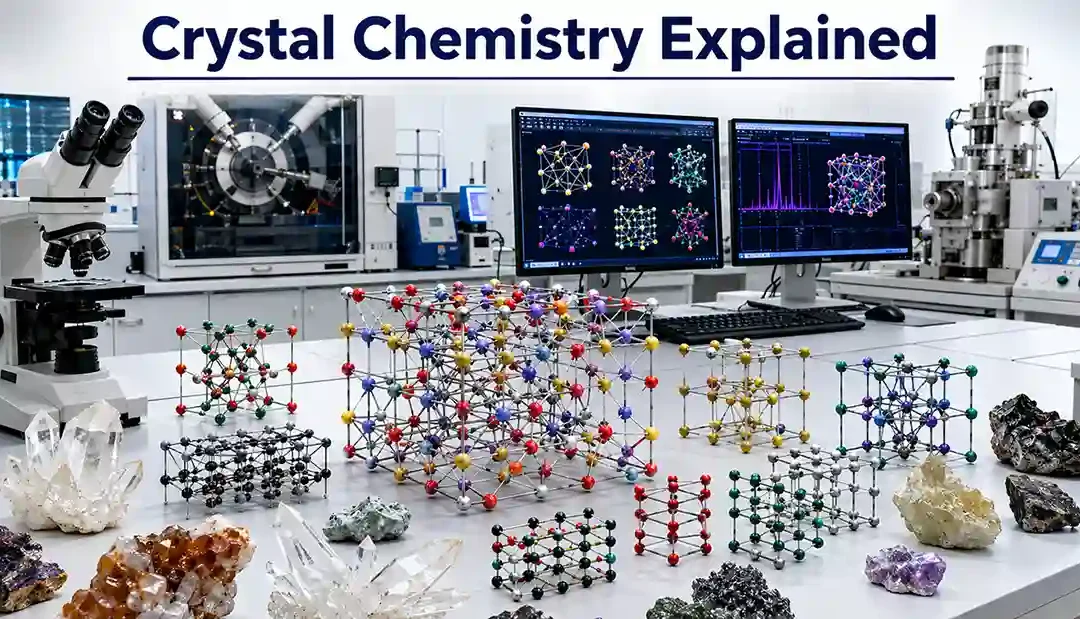
Crystal chemistry is the branch of mineralogy that studies the relationship between a mineral's chemical composition and its crystal structure. It explains how atoms, ions, and chemical bonds are arranged within crystals and how these arrangements determine a mineral's physical, chemical, optical, and mechanical properties.
Every mineral has a unique internal atomic structure. Even minerals with similar chemical compositions may develop completely different crystal structures, resulting in different properties. Likewise, minerals with similar crystal structures may contain different chemical elements through ionic substitution.
Crystal chemistry forms the foundation of mineralogy, crystallography, petrology, geochemistry, materials science, and economic geology.
This topic should be studied together with Crystal Structure of Minerals, Mineralogy Explained, and Mineral Chemistry Analysis.
What Is Crystal Chemistry?
Crystal chemistry studies how chemical elements are arranged inside mineral crystals.
It focuses on:
- Atomic arrangement
- Crystal lattices
- Chemical bonding
- Ionic substitution
- Crystal defects
- Mineral stability
- Element distribution
It explains why minerals have different structures and properties despite sharing similar chemical compositions.
Why Crystal Chemistry Is Important
The arrangement of atoms controls nearly every mineral property.
Crystal chemistry helps explain:
- Hardness
- Cleavage
- Density
- Color
- Optical properties
- Electrical conductivity
- Magnetic properties
- Chemical stability
Without crystal chemistry, modern mineralogy would not be possible.
Building Blocks of Crystal Chemistry
Mineral crystals are built from:
- Atoms
- Ions
- Chemical bonds
- Crystal lattices
These components combine to form stable crystal structures.
Chemical Bonding in Minerals
Several bond types occur in minerals.
Ionic Bonds
Form through attraction between oppositely charged ions.
Examples:
- Halite
- Fluorite
- Calcite
Covalent Bonds
Electrons are shared between atoms.
Examples:
- Diamond
- Quartz
Covalent bonds are among the strongest chemical bonds.
Metallic Bonds
Electrons move freely throughout the structure.
Examples:
- Native Gold
- Native Copper
- Native Silver
These minerals conduct electricity efficiently.
Van der Waals Bonds
Weak attractive forces between atomic layers.
Examples:
- Graphite
- Molybdenite
These weak bonds produce excellent cleavage.
Crystal Lattices
A crystal lattice is the regular three-dimensional arrangement of atoms.
Every mineral has a characteristic lattice that controls:
- Crystal shape
- Cleavage
- Density
- Optical behavior
The lattice repeats throughout the crystal.
Coordination Number
The coordination number is the number of neighboring ions surrounding an atom.
Common coordination numbers include:
- 4
- 6
- 8
- 12
Coordination depends mainly on ionic size and electrical charge.
Ionic Radius
Different ions have different atomic sizes.
Large ions:
- Potassium
- Calcium
Small ions:
- Silicon
- Aluminum
Ion size strongly influences crystal structure.
Ionic Substitution
Ionic substitution occurs when one ion replaces another without changing the crystal structure.
Common substitutions include:
- Iron ↔ Magnesium
- Sodium ↔ Calcium
- Aluminum ↔ Silicon
This process creates solid solution series in many minerals.
Goldschmidt's Rules
Goldschmidt's Rules explain when ionic substitution occurs.
Substitution depends on:
- Ionic size
- Electrical charge
- Temperature
- Pressure
These rules help predict mineral chemistry.
Crystal Chemistry of Common Minerals
Quartz
- Framework silicate
- Strong covalent bonding
- High chemical stability
Feldspar
- Framework aluminosilicate
- Extensive sodium-potassium-calcium substitution
Olivine
- Iron-magnesium solid solution
- Isolated silica tetrahedra
Pyroxene
- Single-chain silicate
- Variable iron, magnesium, and calcium composition
Garnet
- Complex crystal chemistry
- Extensive solid solution
Calcite
- Calcium carbonate
- Strong ionic bonding
Halite
- Sodium chloride
- Cubic ionic lattice
Diamond
- Pure carbon
- Three-dimensional covalent network
- Highest natural hardness
Graphite
- Pure carbon
- Layered covalent sheets
- Weak interlayer bonding
Magnetite
- Mixed iron oxidation states
- Responsible for magnetic properties
Crystal Chemistry and Mineral Properties
Crystal chemistry controls many mineral characteristics.
| Property | Crystal Chemistry Influence |
|---|---|
| Hardness | Bond Strength |
| Cleavage | Bond Direction |
| Density | Atomic Mass |
| Color | Trace Elements |
| Magnetism | Iron Content |
| Conductivity | Electron Mobility |
Changes in atomic structure produce different physical behaviors.
Geological Importance
Crystal chemistry helps geologists:
- Classify minerals
- Understand mineral stability
- Study metamorphic reactions
- Interpret magma evolution
- Investigate weathering
- Explore ore deposits
It links chemistry with geological processes.
Laboratory Investigation
Crystal chemistry is studied using:
- X-Ray Diffraction (XRD)
- Electron Microprobe Analysis (EPMA)
- Scanning Electron Microscopy (SEM)
- Transmission Electron Microscopy (TEM)
- Raman Spectroscopy
- X-Ray Fluorescence (XRF)
- Single-Crystal Diffraction
These techniques determine atomic structure and chemical composition.
Applications
Crystal chemistry is widely used in:
- Mineralogy
- Crystallography
- Petrology
- Geochemistry
- Economic Geology
- Materials Science
- Environmental Geology
- Planetary Science
Advantages of Studying Crystal Chemistry
Studying crystal chemistry helps scientists:
- Understand mineral structures
- Explain mineral properties
- Predict mineral stability
- Discover new mineral species
- Improve resource exploration
- Develop advanced materials
Limitations
Crystal chemistry has several limitations:
- Complex mineral structures often require advanced analytical instruments.
- Many minerals contain extensive solid-solution series that complicate classification.
- Crystal defects and trace elements may alter ideal structures.
- Accurate interpretation generally requires combining crystallographic and chemical analyses.
For comprehensive understanding, combine crystal chemistry with:
- Crystal Structure of Minerals
- Mineralogy Explained
- Mineral Chemistry Analysis
- Optical Mineralogy Explained
- X-Ray Diffraction in Mineralogy
- Electron Microprobe Analysis
- Petrographic Microscopy
- Optical Properties of Minerals
Comparison Table
| Crystal Chemistry Concept | Description | Example |
| Ionic Bond | Electron Transfer | Halite |
| Covalent Bond | Electron Sharing | Quartz, Diamond |
| Metallic Bond | Free Electrons | Gold |
| Van der Waals Bond | Weak Attraction | Graphite |
| Ionic Substitution | Ion Replacement | Olivine, Feldspar |
| Solid Solution | Variable Composition | Garnet |
Summary Table
| Feature | Crystal Chemistry |
| Main Focus | Atomic Structure and Chemical Composition |
| Building Blocks | Atoms, Ions, Bonds, Crystal Lattices |
| Major Processes | Bonding, Ionic Substitution, Solid Solution |
| Common Study Methods | XRD, EPMA, SEM, Raman |
| Geological Importance | Mineral Structure and Stability |
Crystal chemistry is the study of how atoms, ions, and chemical bonds are arranged within mineral crystals and how these arrangements determine mineral properties.
It explains why minerals have different hardness, density, cleavage, optical properties, stability, and chemical behavior, even when they contain similar elements.
Ionic substitution is the replacement of one ion by another of similar size and charge within a crystal structure without significantly changing the overall crystal lattice.
The main bond types are ionic, covalent, metallic, and van der Waals bonds. Each bond type influences mineral properties differently.
Geologists use X-ray diffraction (XRD), electron microprobe analysis (EPMA), scanning electron microscopy (SEM), transmission electron microscopy (TEM), Raman spectroscopy, X-ray fluorescence (XRF), and crystallographic software to investigate mineral structures and compositions.
Final Thoughts
Crystal chemistry connects chemistry with crystallography to explain why minerals have unique structures and properties. From the strong covalent bonds of diamond to the layered structure of graphite and the extensive ionic substitutions found in feldspar and olivine, crystal chemistry provides the framework for understanding mineral behavior at the atomic scale.
By combining crystallographic techniques with mineral chemistry, petrography, and spectroscopy, geologists can identify minerals, interpret geological processes, predict mineral stability, and explore valuable natural resources. Crystal chemistry remains one of the most fundamental disciplines in mineralogy, geochemistry, petrology, and materials science.
Continue Learning
Continue building your mineralogy knowledge with these related guides: