
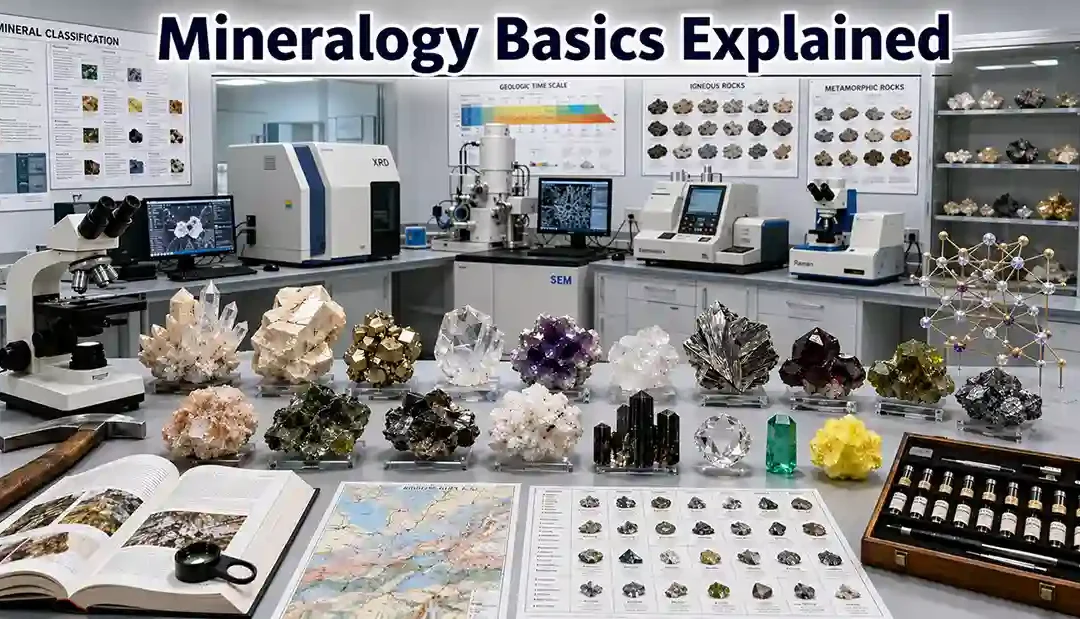
Mineralogy is the scientific study of minerals, including their composition, crystal structure, physical properties, chemical characteristics, formation, classification, and distribution within Earth and other planetary bodies. It is one of the oldest and most fundamental branches of geology because minerals are the basic building blocks of rocks and provide valuable information about Earth's origin, evolution, and geological processes.
Modern mineralogy combines field observations with advanced laboratory techniques to identify minerals, determine their chemical composition, understand how they form, and evaluate their economic importance. Mineralogy also plays a vital role in mining, petroleum exploration, environmental science, planetary geology, archaeology, materials science, and gemstone research.
Whether studying a common quartz crystal or a rare lithium-bearing pegmatite mineral, mineralogy helps scientists understand Earth's history and discover the natural resources that support modern civilization.
This topic serves as a foundation for almost every subject in geology and should be studied together with What Is a Mineral?, Mineral Identification Guide, Mineral Classification, and Crystal Structure of Minerals.
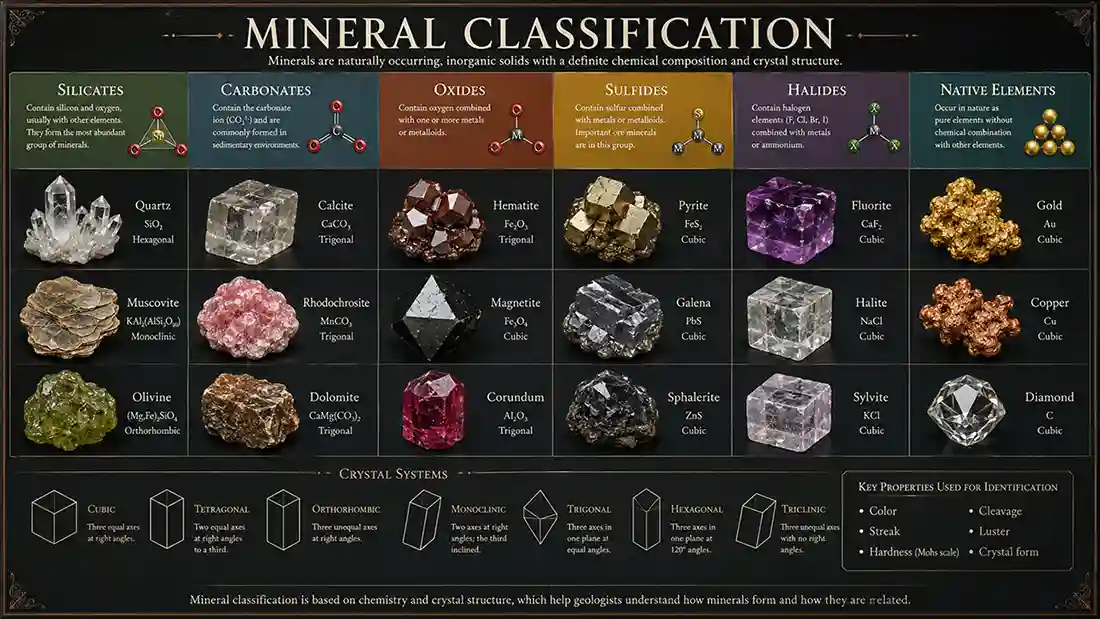
What Is Mineralogy?
Mineralogy is the branch of Earth science that focuses on the study of naturally occurring minerals.
It investigates:
- Mineral composition
- Crystal structure
- Physical properties
- Chemical properties
- Mineral formation
- Mineral stability
- Mineral occurrence
- Mineral classification
Mineralogy forms the basis of petrology, economic geology, geochemistry, and many other geological disciplines.
What Is a Mineral?
A mineral is a naturally occurring, inorganic solid that has:
- A definite chemical composition
- An ordered crystal structure
- Naturally formed origin
- Characteristic physical properties
More than 6,000 mineral species have been officially recognized worldwide, although only a few hundred are common in Earth's crust.
History of Mineralogy
The study of minerals dates back thousands of years.
Important milestones include:
- Ancient civilizations used minerals for tools, pigments, and jewelry.
- Greek philosopher Theophrastus described minerals around 300 BCE.
- Georgius Agricola published De Re Metallica in 1556, laying the foundation for modern mineralogy.
- René Just Haüy established crystallography in the late 1700s.
- Modern mineralogy now relies on X-ray diffraction, electron microscopy, spectroscopy, and geochemical analysis.
Today, mineralogy is a highly interdisciplinary science.
Major Branches of Mineralogy
Mineralogy includes several specialized fields.
Descriptive Mineralogy
Focuses on:
- Mineral identification
- Physical properties
- Classification
- Occurrence
Chemical Mineralogy
Studies:
- Chemical composition
- Element substitution
- Solid solution
- Mineral reactions
Crystal Mineralogy
Examines:
- Crystal systems
- Crystal symmetry
- Atomic arrangement
- Crystal growth
Optical Mineralogy
Uses polarized light microscopy to identify minerals.
Commonly studied properties include:
- Birefringence
- Pleochroism
- Interference colors
- Extinction
Economic Mineralogy
Focuses on minerals of economic value such as:
- Gold
- Copper
- Iron
- Lithium
- Rare Earth Elements
Experimental Mineralogy
Recreates geological conditions in laboratories to understand mineral formation.
Environmental Mineralogy
Studies interactions between minerals and:
- Water
- Soil
- Atmosphere
- Pollution
Planetary Mineralogy
Investigates minerals on:
- Moon
- Mars
- Meteorites
- Asteroids
What Do Mineralogists Study?
Mineralogists investigate:
- Crystal structure
- Chemical composition
- Physical properties
- Optical properties
- Mineral formation
- Stability
- Weathering
- Alteration
- Economic potential
Their work combines field mapping with laboratory analysis.
Mineral Identification Methods
Minerals are identified using both field and laboratory techniques.
Field Identification
- Color
- Streak
- Hardness
- Cleavage
- Fracture
- Luster
- Specific gravity
- Magnetism
- Acid reaction
Laboratory Identification
- Petrographic Microscopy
- X-Ray Diffraction (XRD)
- Scanning Electron Microscopy (SEM)
- Electron Microprobe Analysis (EPMA)
- Raman Spectroscopy
- X-Ray Fluorescence (XRF)
- Infrared Spectroscopy
- ICP-MS Geochemistry
These techniques provide precise mineral identification and chemical analysis.
Why Mineralogy Is Important
Mineralogy helps scientists:
- Understand Earth's crust
- Classify rocks
- Interpret geological history
- Discover ore deposits
- Explore groundwater resources
- Study environmental contamination
- Develop industrial materials
- Investigate planetary evolution
Without mineralogy, modern geology would not exist.
Mineralogy in Different Fields
| Field | Importance of Mineralogy |
|---|---|
| Geology | Rock and Earth history |
| Mining | Ore discovery |
| Petroleum Geology | Reservoir quality |
| Environmental Science | Pollution studies |
| Civil Engineering | Construction materials |
| Planetary Science | Extraterrestrial minerals |
| Gemology | Gem identification |
| Archaeology | Ancient materials |
Common Minerals Studied in Mineralogy
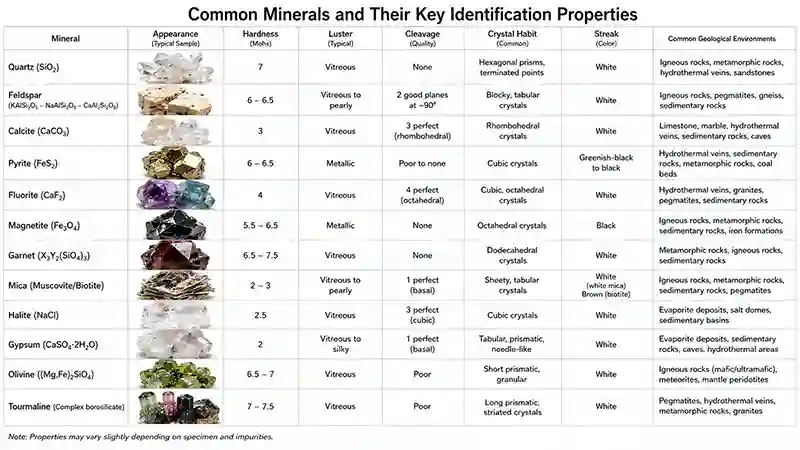
Mineralogists commonly study:
- Quartz
- Feldspar
- Calcite
- Dolomite
- Mica
- Garnet
- Olivine
- Pyroxene
- Amphibole
- Magnetite
- Hematite
- Pyrite
- Fluorite
- Halite
- Gypsum
- Apatite
- Tourmaline
These minerals occur in nearly every geological environment.
Geological Importance
Mineralogy helps geologists:
- Understand plate tectonics
- Reconstruct ancient environments
- Interpret magma evolution
- Study metamorphism
- Analyze sedimentary basins
- Investigate hydrothermal systems
Minerals preserve evidence of Earth's geological history.
Economic Importance
Mineralogy supports exploration and extraction of:
- Gold
- Silver
- Copper
- Iron
- Aluminum
- Lithium
- Nickel
- Rare Earth Elements
- Industrial minerals
- Gemstones
It is fundamental to modern mining and resource development.
Laboratory Investigation
Modern mineralogy relies on advanced laboratory techniques.
Common instruments include:
- Petrographic Microscope
- X-Ray Diffraction (XRD)
- Scanning Electron Microscope (SEM)
- Electron Microprobe Analyzer (EPMA)
- Raman Spectrometer
- X-Ray Fluorescence (XRF)
- ICP-MS
- FTIR Spectrometer
These methods determine mineral structure, chemistry, and origin with high precision.
Applications
Mineralogy is essential in:
- Geology
- Economic Geology
- Mining Engineering
- Petroleum Geology
- Environmental Science
- Planetary Science
- Materials Science
- Gemology
- Archaeology
Advantages of Studying Mineralogy
Studying mineralogy helps scientists:
- Identify minerals accurately
- Understand Earth's evolution
- Discover mineral resources
- Improve mining efficiency
- Develop new industrial materials
- Protect the environment
- Explore other planets
Limitations
Studying mineralogy may be challenging because:
- Many minerals have similar physical properties.
- Fine-grained minerals often require advanced laboratory techniques for identification.
- Weathering and alteration can obscure original mineral characteristics.
- Accurate classification frequently depends on crystallographic and chemical analyses.
For comprehensive understanding, combine mineralogy with:
- What Is a Mineral?
- Mineral Identification Guide
- Mineral Classification
- Crystal Structure of Minerals
- Optical Properties of Minerals
- Petrographic Microscopy
- X-Ray Diffraction in Mineralogy
- Mineral Chemistry Analysis
Comparison Table
| Branch of Mineralogy | Primary Focus | Common Techniques |
| Descriptive Mineralogy | Identification & Classification | Hand Specimen Analysis |
| Chemical Mineralogy | Composition | XRF, EPMA |
| Crystal Mineralogy | Crystal Structure | XRD |
| Optical Mineralogy | Optical Properties | Petrographic Microscope |
| Economic Mineralogy | Ore Minerals | Geochemistry |
| Experimental Mineralogy | Mineral Formation | High-Pressure Experiments |
| Environmental Mineralogy | Mineral-Environment Interaction | SEM, XRD |
| Planetary Mineralogy | Extraterrestrial Minerals | Spectroscopy, Remote Sensing |
Summary Table
| Feature | Mineralogy |
| Definition | Scientific Study of Minerals |
| Main Subjects | Composition, Structure, Properties, Formation |
| Major Branches | Descriptive, Chemical, Crystal, Optical, Economic |
| Common Laboratory Methods | Petrography, XRD, SEM, EPMA, Raman |
| Geological Importance | Foundation of Earth Science |
Mineralogy is the scientific study of minerals, including their composition, crystal structure, physical properties, chemical characteristics, formation, classification, and occurrence.
Mineralogy helps scientists understand Earth's composition, classify rocks, discover mineral resources, explore ore deposits, investigate environmental processes, and study the evolution of our planet and other planetary bodies.
Major branches include descriptive mineralogy, chemical mineralogy, crystal mineralogy, optical mineralogy, economic mineralogy, experimental mineralogy, environmental mineralogy, and planetary mineralogy.
Mineralogists use hand specimen tests, petrographic microscopes, X-ray diffraction (XRD), scanning electron microscopy (SEM), electron microprobe analysis (EPMA), Raman spectroscopy, X-ray fluorescence (XRF), and ICP-MS.
Mineralogy is widely used in geology, mining, petroleum exploration, environmental science, engineering geology, materials science, gemology, archaeology, and planetary science.
Final Thoughts
Mineralogy is one of the most fundamental branches of Earth science because it provides the knowledge needed to understand the composition, structure, origin, and evolution of minerals—the building blocks of rocks and the Earth's crust. From identifying a simple quartz crystal to discovering critical minerals for clean energy technologies, mineralogy connects scientific research with practical applications across numerous disciplines.
By integrating field observations with modern laboratory techniques such as petrographic microscopy, X-ray diffraction, electron microprobe analysis, Raman spectroscopy, and geochemical investigations, mineralogists can reveal the history of Earth's geological processes and contribute to sustainable resource exploration. Whether in mining, environmental protection, planetary exploration, or academic research, mineralogy remains an essential science for understanding our planet and its natural resources.
Continue Learning
Build a strong foundation in mineral science with these related guides:
- Petrographic Microscopy
- X-Ray Diffraction in Mineralogy
- Mineral Chemistry Analysis