
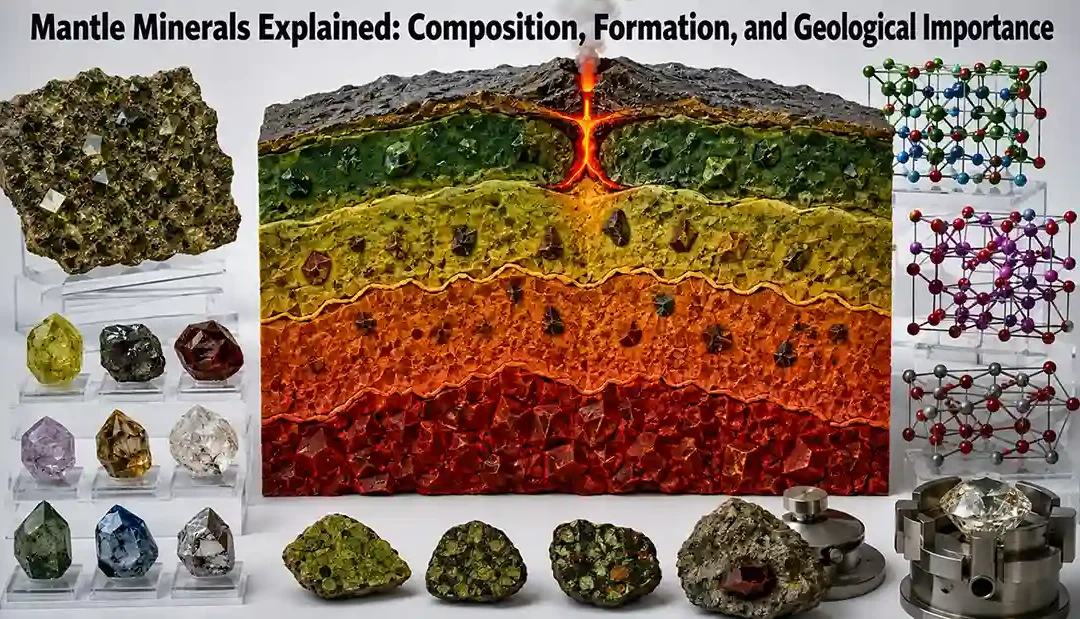
Earth's mantle is the thickest layer of the planet, extending from the base of the crust to the outer core at a depth of approximately 2,900 kilometers. It accounts for nearly 84% of Earth's volume and about 67% of Earth's mass. Although it is mostly solid, the mantle behaves plastically over long periods, allowing convection currents that drive plate tectonics.
The mantle is composed primarily of magnesium- and iron-rich silicate minerals that formed under extremely high temperatures and pressures. Unlike the quartz- and feldspar-rich continental crust, the mantle is dominated by olivine, pyroxene, garnet, spinel, and high-pressure minerals such as wadsleyite, ringwoodite, bridgmanite, and ferropericlase.
Understanding mantle minerals helps geologists explain magma generation, volcanic activity, earthquakes, mantle convection, plate tectonics, and the evolution of Earth's interior.
This topic should be studied together with Minerals and Earth's Crust.
What Are Mantle Minerals?
Mantle minerals are the minerals that make up Earth's mantle beneath the crust.
They are characterized by:
- High magnesium content
- High iron content
- Dense crystal structures
- Stability under extreme pressure
- High melting temperatures
These minerals differ significantly from the rock-forming minerals that dominate Earth's crust.
Structure of Earth’s Mantle
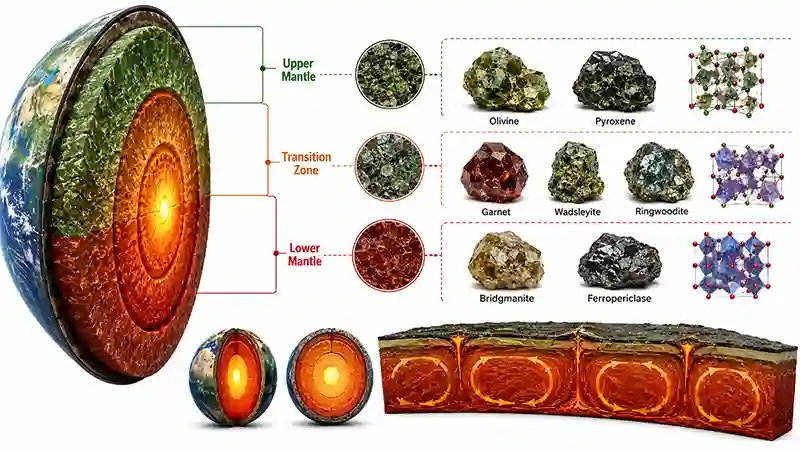
The mantle is divided into three main regions.
Upper Mantle (35–410 km)
Contains:
- Peridotite
- Partial melt in some regions
- Mantle convection
Dominant minerals:
- Olivine
- Orthopyroxene
- Clinopyroxene
- Spinel
- Garnet
Transition Zone (410–660 km)
High pressure transforms minerals into denser structures.
Dominant minerals:
- Wadsleyite
- Ringwoodite
- Majorite Garnet
Lower Mantle (660–2,900 km)
Extreme pressure stabilizes dense mineral phases.
Dominant minerals:
- Bridgmanite
- Ferropericlase
- Calcium Silicate Perovskite
Chemical Composition of the Mantle
The mantle consists mainly of:
- Oxygen
- Magnesium
- Silicon
- Iron
- Calcium
- Aluminum
These elements combine to form magnesium-iron silicate minerals.
Major Mantle Minerals
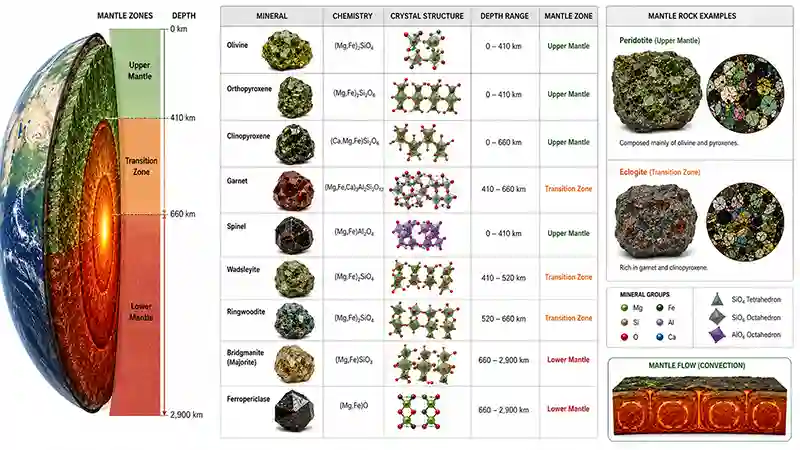
Olivine
Olivine is the most abundant mineral in the upper mantle.
Characteristics:
- Olive green
- Rich in magnesium and iron
- Hardness 6.5–7
- High melting temperature
Common rock:
- Peridotite
Orthopyroxene
Orthopyroxene commonly occurs with olivine.
Characteristics:
- Brown to green
- Two cleavages near 90°
- Magnesium-rich
Common rock:
- Peridotite
Clinopyroxene
Clinopyroxene contains more calcium than orthopyroxene.
Common in:
- Peridotite
- Mantle xenoliths
Garnet
High-pressure garnet is common in the deeper upper mantle.
Characteristics:
- Dense crystal structure
- High-pressure stability
Common rocks:
- Garnet Peridotite
- Eclogite
Spinel
Spinel is stable in part of the upper mantle.
Characteristics:
- Dense oxide mineral
- Indicator of mantle pressure conditions
Wadsleyite
Wadsleyite forms when olivine transforms at approximately 410 km depth.
Characteristics:
- High-pressure polymorph of olivine
- Can store significant amounts of water
Ringwoodite
Ringwoodite forms deeper within the transition zone.
Characteristics:
- Dense olivine polymorph
- Important deep-mantle water reservoir
Bridgmanite
Bridgmanite is the most abundant mineral inside Earth.
Characteristics:
- Magnesium silicate perovskite
- Stable only under lower mantle pressures
It cannot survive at Earth's surface.
Ferropericlase
Ferropericlase is the second most abundant lower mantle mineral.
Characteristics:
- Magnesium-iron oxide
- High density
Calcium Silicate Perovskite
A common lower mantle mineral.Contributes significantly to lower mantle composition.
Accessory Mantle Minerals
Accessory mantle minerals include:
- Chromite
- Ilmenite
- Rutile
- Sulfides
- Diamond (under specific conditions)
These minerals provide important clues about mantle evolution.
Mantle Rocks
The mantle consists mainly of ultramafic rocks.
Common mantle rocks include:
| Mantle Rock | Major Minerals |
|---|---|
| Peridotite | Olivine, Pyroxene |
| Dunite | Olivine |
| Harzburgite | Olivine, Orthopyroxene |
| Lherzolite | Olivine, Orthopyroxene, Clinopyroxene |
| Eclogite | Garnet, Omphacite |
These rocks are occasionally brought to the surface as mantle xenoliths.
Mantle Convection and Minerals
Mantle minerals participate in convection driven by Earth's internal heat.
These processes control:
- Plate tectonics
- Volcanism
- Earthquakes
- Mountain building
- Continental movement
Mineral phase transitions also influence mantle dynamics.
Mantle Minerals and Magma Formation
Partial melting of mantle rocks produces magma.
Typical magma sources include:
- Mid-ocean ridges
- Hotspots
- Subduction zones
Mantle minerals such as olivine and pyroxene melt partially to generate basaltic magma.
Mantle Xenoliths
Scientists cannot drill directly into the mantle, so much of our knowledge comes from mantle xenoliths.
These are fragments of mantle rock carried to the surface by volcanic eruptions.
They commonly contain:
- Olivine
- Pyroxene
- Garnet
- Spinel
Xenoliths provide direct evidence of mantle composition.
Laboratory Identification
Scientists study mantle minerals using:
- Petrographic Microscopy
- Electron Microprobe Analysis (EPMA)
- X-Ray Diffraction (XRD)
- Scanning Electron Microscopy (SEM)
- Raman Spectroscopy
- High-pressure laboratory experiments
These methods reveal mineral chemistry, crystal structures, and stability fields.
Importance of Mantle Minerals
Studying mantle minerals helps geologists:
- Understand Earth's interior
- Explain plate tectonics
- Interpret mantle convection
- Investigate volcanic activity
- Estimate mantle temperatures
- Study Earth's deep water cycle
- Reconstruct planetary evolution
Mantle minerals provide direct evidence of deep Earth processes.
Applications
Mantle mineral studies are important in:
- Mineralogy
- Petrology
- Geophysics
- Volcanology
- Plate tectonics
- Economic geology
- Planetary science
Advantages of Studying Mantle Minerals
Studying mantle minerals allows scientists to:
- Understand deep Earth composition
- Explain magma generation
- Investigate mantle dynamics
- Reconstruct tectonic evolution
- Interpret seismic data
- Explore mantle-derived mineral resources
Limitations
Mantle minerals are difficult to study because:
- Most cannot be sampled directly.
- High-pressure minerals become unstable at the surface.
- Much evidence comes from xenoliths, seismic studies, and laboratory experiments.
- Deep mantle conditions must often be inferred indirectly.
For comprehensive interpretation, combine mantle mineral studies with:
- Minerals and Earth's Crust
- Plate Tectonics and Minerals
- Mineral Formation
- Volcanic Minerals
- Petrographic Microscopy
- X-Ray Diffraction in Mineralogy
- Mineral Chemistry Analysis
Comparison Table
| Mantle Zone | Dominant Minerals | Approximate Depth |
| Upper Mantle | Olivine, Pyroxene, Garnet, Spinel | 35–410 km |
| Transition Zone | Wadsleyite, Ringwoodite, Majorite | 410–660 km |
| Lower Mantle | Bridgmanite, Ferropericlase, Calcium Silicate Perovskite | 660–2,900 km |
Summary Table
| Feature | Mantle Minerals |
| Main Composition | Magnesium-Iron Silicates |
| Dominant Mineral | Olivine (Upper Mantle) |
| Deepest Major Mineral | Bridgmanite |
| Common Study Methods | Petrography, EPMA, XRD, SEM |
| Geological Importance | Plate Tectonics, Mantle Convection, Magma Formation |
The upper mantle is dominated by olivine, orthopyroxene, clinopyroxene, garnet, and spinel. In the lower mantle, bridgmanite and ferropericlase become the dominant minerals.
Bridgmanite is considered the most abundant mineral in Earth because it makes up much of the lower mantle, which accounts for the largest portion of the planet's volume.
Quartz is stable at relatively low pressures and in silica-rich compositions. The mantle is richer in magnesium and iron and experiences much higher pressures, favoring minerals such as olivine and pyroxene.
Mantle xenoliths are fragments of mantle rock carried to the surface by volcanic eruptions. They provide direct samples of the upper mantle for scientific study.
Scientists study mantle minerals using mantle xenoliths, high-pressure laboratory experiments, petrographic microscopy, X-ray diffraction (XRD), electron microprobe analysis (EPMA), scanning electron microscopy (SEM), Raman spectroscopy, and seismic data.
Final Thoughts
Mantle minerals form the foundation of Earth's interior and play a central role in controlling plate tectonics, volcanic activity, mantle convection, and the evolution of our planet. From olivine-rich peridotites in the upper mantle to the immense abundance of bridgmanite in the lower mantle, these minerals reveal how Earth behaves beneath the crust.
By combining mantle xenolith studies, high-pressure experiments, petrographic microscopy, mineral chemistry, X-ray diffraction, and geophysical observations, scientists continue to improve our understanding of Earth's deep interior. The study of mantle minerals remains one of the most important fields in mineralogy, petrology, geophysics, and planetary science.
Continue Learning
Continue exploring Earth's interior with these related guides:
- Minerals and Earth's Crust
- Plate Tectonics and Minerals
- Volcanic Minerals
- Minerals in Igneous Rocks
- Mineral Formation Explained
- Petrographic Microscopy
- X-Ray Diffraction in Mineralogy
- Mineral Chemistry Analysis