
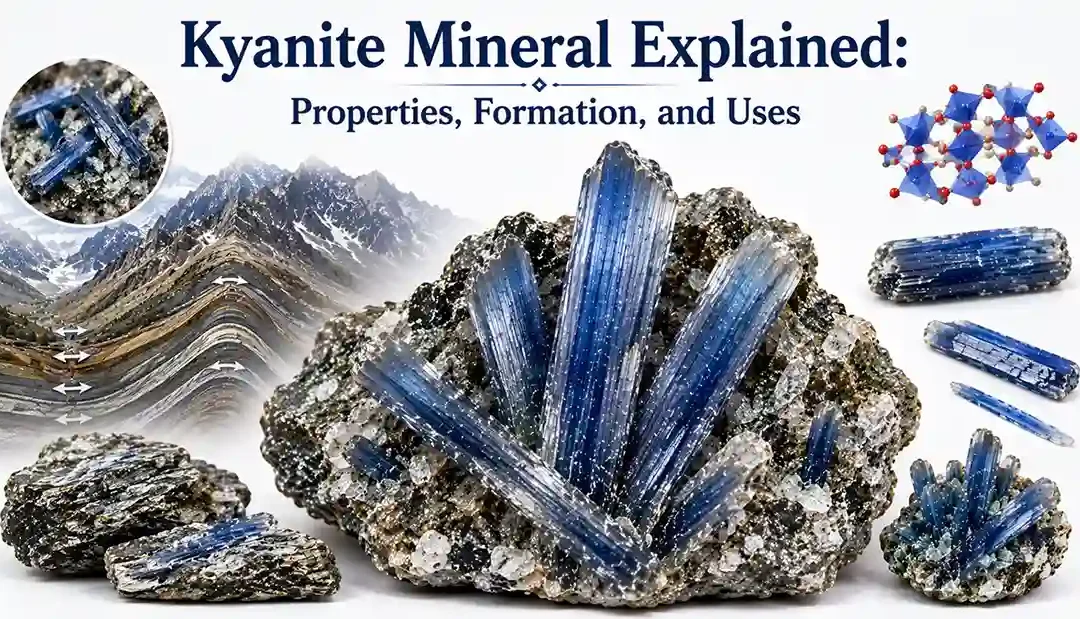
Kyanite is a distinctive blue aluminum silicate mineral commonly found in metamorphic rocks. It is especially important because it forms under high-pressure metamorphic conditions and helps geologists reconstruct the temperature and pressure history of rocks.
Kyanite is famous for its:
- beautiful blue color
- elongated bladed crystals
- unusual hardness variations
- role as an index mineral
Its presence often indicates significant tectonic activity and mountain-building processes.
What Is Kyanite?
Kyanite is an aluminum silicate mineral. Its chemical formula is: . Kyanite belongs to a group of minerals known as Aluminum Silicate Polymorphs
which includes:
- Kyanite
- Andalusite
- Sillimanite
All three have the same chemical composition but different crystal structures.
Basic Properties of Kyanite
| Property | Value |
|---|---|
| Chemical Formula | Al₂SiO₅ |
| Mineral Group | Nesosilicate |
| Crystal System | Triclinic |
| Hardness | 4.5–7 |
| Streak | White |
| Luster | Vitreous to Pearly |
Why Is Kyanite Unique?
Kyanite has one of the most unusual properties in mineralogy.
Variable Hardness
Kyanite has different hardness values depending on the crystal direction.
Parallel to Crystal Length
Hardness ≈ 4.5–5
Across Crystal Width
Hardness ≈ 6.5–7
This property is called anisotropic hardness and is one of the best identification features of kyanite.
Crystal Structure of Kyanite
Kyanite contains:
- aluminum atoms
- silicon tetrahedra
- oxygen atoms
Its tightly packed crystal structure forms:
- elongated blades
- fibrous aggregates
- columnar crystals
The crystal arrangement is responsible for its directional hardness.
Learn more → crystal structure in minerals
Crystal System of Kyanite
Kyanite belongs to the triclinic crystal system. Its crystallographic relationship is:
Common crystal habits include:
- bladed crystals
- fibrous aggregates
- radiating clusters
Learn more → triclinic crystal system
Physical Properties of Kyanite
| Property | Description |
|---|---|
| Color | Blue, gray, white, green |
| Streak | White |
| Luster | Vitreous to pearly |
| Hardness | 4.5–7 |
| Cleavage | Perfect in one direction |
| Transparency | Transparent to translucent |
| Specific Gravity | 3.5–3.7 |
How Kyanite Forms
Kyanite forms during:
Regional Metamorphism
High-pressure conditions create kyanite-bearing rocks.
Mountain Building
Common in continental collision zones.
Deep Crustal Metamorphism
Forms at significant depths within Earth's crust.
Aluminum-Rich Rocks
Develops in rocks rich in aluminum minerals.
Kyanite as an Index Mineral
Kyanite is considered an Index Mineral because it forms only within specific pressure-temperature conditions.
Its presence often indicates:
- moderate to high pressure
- regional metamorphism
- tectonic compression
Geologists use kyanite to estimate metamorphic grade.
Learn more → garnet mineral explained
Kyanite, Andalusite, and Sillimanite
These three minerals share the same chemical formula:
However, they form under different conditions.
| Mineral | Pressure | Temperature |
|---|---|---|
| Kyanite | High | Moderate |
| Andalusite | Low | Moderate |
| Sillimanite | High Temperature | Variable |
This makes them valuable indicators of metamorphic environments.
Common Rocks Containing Kyanite
Kyanite commonly occurs in:
- schist
- gneiss
- quartzite
- metamorphic pelitic rocks
These rocks often form during continental collisions and mountain-building events.
Industrial Uses of Kyanite
Kyanite has several industrial applications.
Refractory Materials
Used in high-temperature furnaces.
Ceramics
Improves heat resistance.
Porcelain
Added to specialty ceramic products.
Gemstones
Transparent blue crystals are sometimes cut into gems.
Major Uses of Kyanite
| Industry | Application |
|---|---|
| Refractories | Furnace linings |
| Ceramics | Heat-resistant products |
| Porcelain | Specialty ceramics |
| Jewelry | Gemstones |
Kyanite in Mineral Identification
Geologists identify kyanite using:
- blue color
- bladed crystals
- variable hardness
- perfect cleavage
- metamorphic rock associations
Its anisotropic hardness is often the most reliable identification feature.
Learn more → mineral identification guide
Kyanite Identification Summary
| Property | Kyanite |
|---|---|
| Formula | Al₂SiO₅ |
| Hardness | 4.5–7 |
| Crystal System | Triclinic |
| Cleavage | Perfect |
| Color | Blue |
| Mineral Group | Nesosilicate |
Kyanite is an aluminum silicate mineral with the formula Al₂SiO₅.
Kyanite is an index mineral used to determine metamorphic pressure conditions.
Kyanite has different hardness values in different crystal directions.
Kyanite belongs to the triclinic crystal system.
Kyanite is typically found in schist, gneiss, quartzite, and other metamorphic rocks.
Final Thoughts
Kyanite is one of the most important metamorphic minerals because it records the pressure conditions under which rocks formed. Its beautiful blue color, distinctive bladed crystals, and unusual hardness make it both scientifically valuable and visually striking.
From mountain-building events deep within Earth's crust to industrial refractory materials, kyanite provides important insights into metamorphism and mineral formation.