
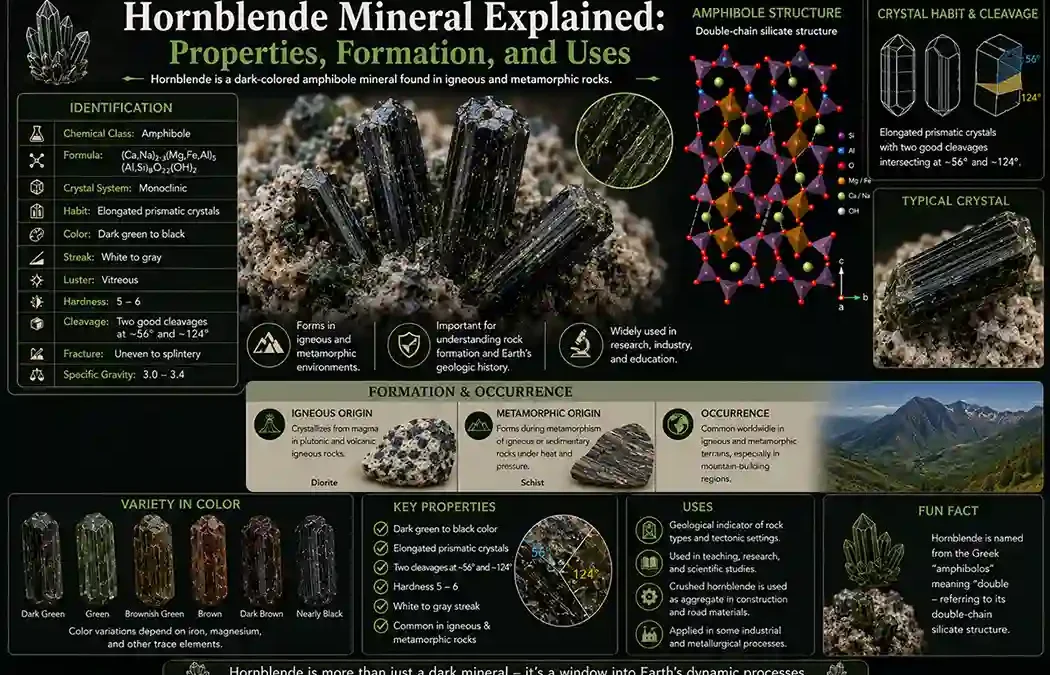
Hornblende is the most common member of the amphibole mineral group and one of the most important rock-forming minerals in geology. It is typically dark green to black and is commonly found in igneous and metamorphic rocks.
Hornblende is important because it:
- forms in a wide range of geological environments
- helps geologists interpret rock formation conditions
- is a major component of many igneous and metamorphic rocks
- demonstrates the structure of amphibole minerals
Because of its dark color and elongated crystals, hornblende is often mistaken for pyroxene, but several key properties help distinguish the two minerals.
Learn more → what is a mineral
What Is Hornblende?
Hornblende is a complex amphibole silicate mineral. A generalized chemical formula is:
Hornblende contains varying amounts of:
- calcium
- magnesium
- iron
- aluminum
- silicon
- oxygen
It belongs to the amphibole mineral group.
Why Is Hornblende Dark?
Hornblende's dark color is caused primarily by Iron and Magnesium
These elements produce:
- dark green colors
- black colors
- dark brown shades
The abundance of iron and magnesium classifies hornblende as a ferromagnesian mineral similar to biotite, pyroxene, and olivine.
Learn more → biotite mineral explained
Crystal Structure of Hornblende
Hornblende belongs to the amphibole group and contains a double-chain silicate structure. Its crystal structure consists of linked silicate tetrahedra arranged in double chains.
This structure contributes to:
- elongated crystal forms
- characteristic cleavage
- moderate hardness
Learn more → crystal structure in minerals
Crystal System of Hornblende
Hornblende belongs to the monoclinic crystal system. Its crystallographic relationship is:
Hornblende commonly forms:
- elongated prisms
- needle-like crystals
- granular aggregates
Learn more → monoclinic crystal system
Physical Properties of Hornblende
| Property | Description |
|---|---|
| Color | Dark green to black |
| Streak | White to gray |
| Luster | Vitreous |
| Hardness | 5–6 |
| Cleavage | Two directions |
| Fracture | Uneven |
| Specific Gravity | 3.0–3.5 |
Hornblende Cleavage
Hornblende exhibits cleavage at approximately 56° and 124°. This is one of the most important identification features. The cleavage angles help distinguish hornblende from pyroxene, which has cleavage near 90°.
Learn more → mineral cleavage -vs- fracture
How Hornblende Forms
Hornblende forms through several geological processes.
Igneous Crystallization
Forms in intermediate and felsic magmas.
Metamorphism
Develops under heat and pressure.
Hydrothermal Activity
Can form through alteration processes.
Regional Metamorphism
Common in metamorphic terrains.
Hornblende in Igneous Rocks
Hornblende commonly occurs in:
Diorite
One of the most common minerals.
Andesite
Frequently found in volcanic rocks.
Granite
Occurs as an accessory mineral.
Syenite
Present in many alkaline igneous rocks.
Common Hornblende-Bearing Rocks
| Rock Type | Occurrence |
|---|---|
| Diorite | Common |
| Andesite | Common |
| Granite | Accessory |
| Syenite | Common |
Hornblende in Metamorphic Rocks
Hornblende commonly occurs in:
- amphibolite
- gneiss
- schist
- hornfels
The presence of hornblende often indicates moderate to high-grade metamorphism.
Hornblende vs Pyroxene
| Property | Hornblende | Pyroxene |
|---|---|---|
| Cleavage Angles | 56° & 124° | ~90° |
| Crystal Habit | Elongated | Blocky |
| Structure | Double Chain | Single Chain |
| Water Content | Contains OH | Usually Dry |
The cleavage angle difference is the easiest identification method.
Geological Importance of Hornblende
Hornblende helps geologists determine:
- metamorphic conditions
- magma composition
- tectonic environments
- rock history
Its presence provides valuable information about how rocks formed.
Industrial and Scientific Uses
Hornblende has limited industrial use but is important in:
Geological Research
Understanding metamorphism and igneous processes.
Educational Collections
Common teaching mineral.
Petrology
Studying rock origins and evolution.
Geochronology
Used in age-dating studies.
Major Uses of Hornblende
| Field | Application |
|---|---|
| Geology | Rock studies |
| Education | Mineral collections |
| Research | Petrology |
| Geochronology | Radiometric dating |
Hornblende in Mineral Identification
Geologists identify hornblende using:
- dark green to black color
- elongated crystals
- cleavage at 56° and 124°
- hardness of 5–6
- vitreous luster
Its cleavage angles are usually the most reliable identification feature.
Learn more → mineral-identification-guide
Hornblende Identification Summary
| Property | Hornblende |
|---|---|
| Hardness | 5–6 |
| Crystal System | Monoclinic |
| Cleavage | 56° & 124° |
| Color | Dark Green–Black |
| Structure | Double Chain Silicate |
| Mineral Group | Amphibole |
Hornblende is the most common amphibole mineral and an important rock-forming silicate mineral.
Hornblende is typically dark green, dark brown, or black.
Its elongated crystals and cleavage angles of approximately 56° and 124° are key identification features.
Hornblende belongs to the monoclinic crystal system.
Hornblende occurs in igneous rocks such as diorite and andesite and metamorphic rocks such as amphibolite and gneiss.
Final Thoughts
Hornblende is one of the most important amphibole minerals and a major component of many igneous and metamorphic rocks. Its distinctive cleavage angles, dark color, and double-chain silicate structure make it a valuable mineral for identification and geological interpretation.
By studying hornblende, geologists gain insights into magma evolution, metamorphic processes, and the geological history of Earth's crust.