
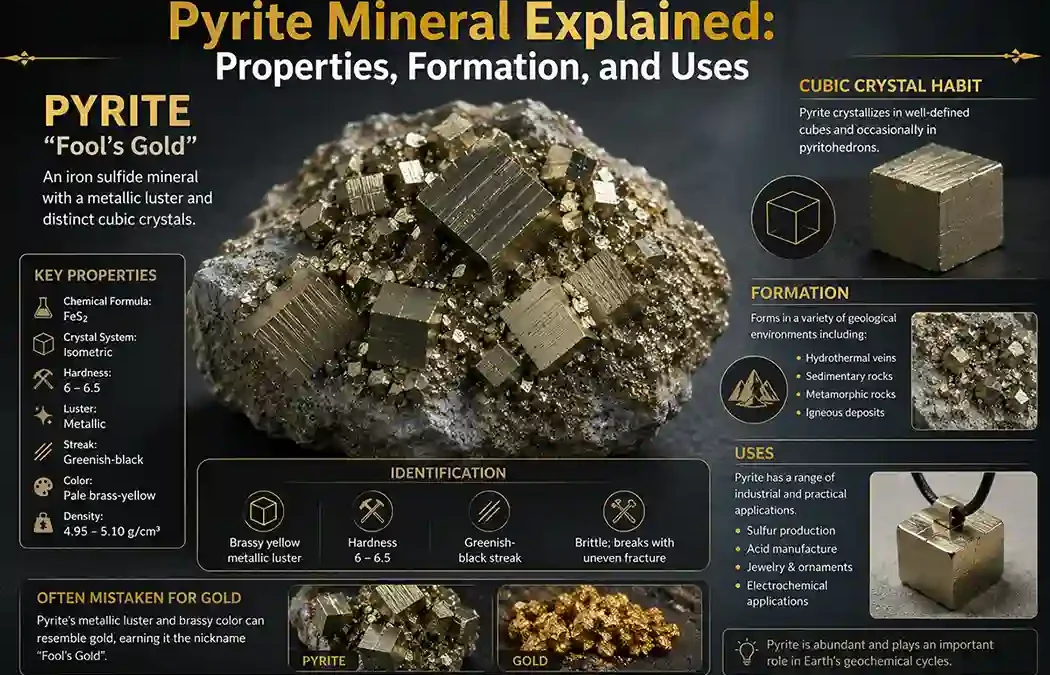
Pyrite is one of the most recognizable minerals in the world because of its bright metallic appearance and gold-like color. Often called "Fool's Gold," pyrite has fooled prospectors for centuries into thinking they had discovered real gold.
Despite its appearance, pyrite is an iron sulfide mineral with very different physical and chemical properties from gold.
Pyrite is important because it:
- occurs in many rock types
- helps geologists understand ore deposits
- contains sulfur and iron
- forms beautiful crystal specimens
- serves as an indicator of geological processes
Learn more → what-is-a-mineral
What Is Pyrite?
Pyrite is an iron sulfide mineral. Its chemical formula is FeS2
Pyrite consists of:
- iron (Fe)
- sulfur (S)
It belongs to the sulfide mineral group and is one of the most abundant sulfide minerals on Earth.
Basic Properties of Pyrite
| Property | Value |
|---|---|
| Chemical Formula | FeS₂ |
| Mineral Group | Sulfide |
| Crystal System | Isometric (Cubic) |
| Hardness | 6–6.5 |
| Streak | Greenish-black |
| Luster | Metallic |
Why Is Pyrite Called Fool's Gold?
Pyrite resembles gold because of its:
- brassy yellow color
- metallic luster
- reflective surfaces
However, pyrite differs from gold because:
| Property | Pyrite | Gold |
|---|---|---|
| Hardness | 6–6.5 | 2.5–3 |
| Color | Brassy yellow | Golden yellow |
| Streak | Greenish-black | Yellow |
| Density | Lower | Much higher |
These differences make identification relatively easy.
Crystal System of Pyrite
Pyrite belongs to the Isometric Crystal System. Its crystal relationship is
This high symmetry produces:
- cubes
- pyritohedrons
- octahedrons
Learn more → isometric crystal system
Common Crystal Forms of Pyrite
Pyrite commonly forms:
Cube
The most famous pyrite crystal shape.
Pyritohedron
A twelve-faced crystal form unique to pyrite.
Octahedron
Less common but well-developed in some deposits.
Many specimens show combinations of these forms.
Common Pyrite Crystal Forms
| Crystal Form | Appearance |
|---|---|
| Cube | Six square faces |
| Pyritohedron | Twelve pentagonal faces |
| Octahedron | Eight triangular faces |
Physical Properties of Pyrite
| Property | Description |
|---|---|
| Color | Brass-yellow |
| Streak | Greenish-black |
| Luster | Metallic |
| Hardness | 6–6.5 |
| Cleavage | Poor |
| Fracture | Uneven to conchoidal |
| Density | Moderate |
Pyrite Hardness
Pyrite has a hardness of 6–6.5 on the Mohs Scale
This means pyrite:
- can scratch glass
- is much harder than gold
- resists abrasion
Hardness is one of the easiest ways to distinguish pyrite from gold.
How Pyrite Forms
Pyrite forms in several geological environments.
Hydrothermal Veins
Hot fluids deposit pyrite crystals.
Sedimentary Rocks
Pyrite develops in oxygen-poor environments.
Metamorphic Rocks
Heat and pressure can recrystallize pyrite.
Igneous Systems
Pyrite forms from sulfur-rich magmas.
Pyrite in Sedimentary Rocks
Pyrite is common in:
- shale
- coal
- mudstone
- limestone
It often forms when organic matter decomposes in low-oxygen environments. This process creates favorable conditions for iron sulfide formation.
Pyrite and Ore Deposits
Pyrite is associated with many ore deposits.
Commonly occurs with:
- gold
- copper
- lead
- zinc
- silver
Because of this association, pyrite is an important exploration mineral.
Weathering of Pyrite
When exposed to oxygen and water, pyrite can oxidize.
The simplified reaction is:
4FeS2+15O2+8H2O→2Fe2O3+8H2SO4
This process may produce:
- iron oxides
- sulfuric acid
Pyrite weathering plays an important role in environmental geology.
Industrial Uses of Pyrite
Historically, pyrite was used for:
Sulfur Production
Source of sulfur and sulfuric acid.
Chemical Industry
Raw material for industrial chemicals.
Jewelry and Collecting
Beautiful crystals are popular among collectors.
Education
Used in geology and mineralogy studies.
Major Uses of Pyrite
| Industry | Use |
|---|---|
| Chemical | Sulfur production |
| Mining | Ore indicator |
| Education | Mineral specimens |
| Collecting | Decorative crystals |
Pyrite in Mineral Identification
Geologists identify pyrite using:
- metallic luster
- brass-yellow color
- hardness of 6–6.5
- greenish-black streak
- cubic crystals
These features distinguish pyrite from gold and other metallic minerals.
Learn more → mineral identification guide
Pyrite Identification Summary
| Property | Pyrite |
|---|---|
| Formula | FeS₂ |
| Hardness | 6–6.5 |
| Streak | Greenish-black |
| Crystal System | Isometric |
| Luster | Metallic |
| Cleavage | Poor |
Pyrite is composed of iron and sulfur with the formula FeS₂.
Its metallic appearance and yellow color resemble gold.
Pyrite has a hardness of 6–6.5 on the Mohs Hardness Scale.
Pyrite belongs to the isometric (cubic) crystal system.
Pyrite itself is usually not highly valuable, but it is important in geology and may occur near valuable ore deposits.
Final Thoughts
Pyrite is one of the most famous minerals in geology due to its striking metallic appearance and association with gold deposits. Its cubic crystals, iron sulfide composition, and widespread occurrence make it an essential mineral for both scientific study and mineral collecting.
Understanding pyrite helps geologists identify ore-forming processes, interpret geological environments, and distinguish Fool's Gold from real gold.