
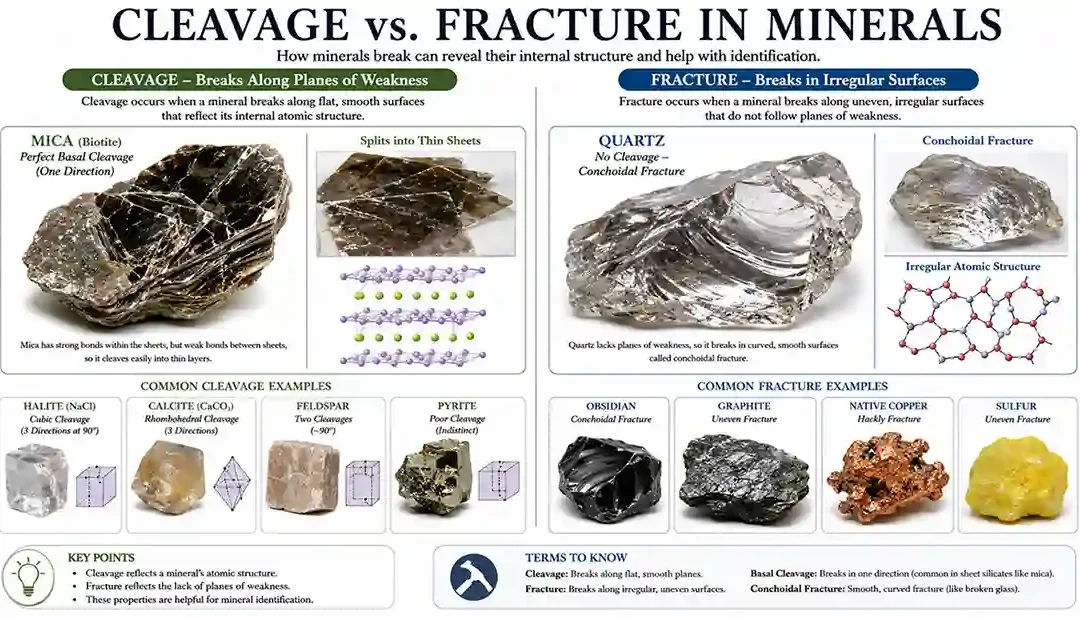
When minerals break, they do not all break in the same way. Some minerals split along smooth, flat surfaces, while others break irregularly and produce rough or curved edges.
Geologists use two important properties to describe how minerals break:
- Cleavage
- Fracture
These properties are controlled by a mineral's crystal structure and atomic bonding. Understanding cleavage and fracture helps scientists identify minerals, interpret crystal structures, and classify geological materials.
Because many minerals have similar colors or luster, cleavage and fracture often provide more reliable identification clues.
Learn more → crystal-structure-in-minerals
Cleavage vs Fracture Overview
| Property | Cleavage | Fracture |
|---|---|---|
| Break Pattern | Flat surfaces | Irregular surfaces |
| Controlled By | Crystal structure | Random breakage |
| Appearance | Smooth planes | Rough or curved |
| Identification Value | Very high | High |
What Is Mineral Cleavage?
Mineral cleavage is the tendency of a mineral to break along flat, smooth planes. These planes occur where atomic bonds are weaker inside the crystal structure.
When force is applied, the mineral separates along predictable surfaces. Cleavage is often one of the most useful mineral identification properties.
Why Cleavage Occurs
Cleavage develops because:
- atomic bonds are not equally strong in all directions
- certain crystal planes contain weaker bonds
- minerals naturally separate along these planes
The internal crystal structure determines the number and direction of cleavage planes.
Types of Mineral Cleavage
One Direction Cleavage
Minerals split into sheets.
Example: Mica
Two Direction Cleavage
Minerals break into elongated blocks.
Example: Feldspar
Three Direction Cleavage
Minerals break into cubes or rhombohedrons.
Examples:
- Halite
- Calcite
Common Minerals with Cleavage
| Mineral | Cleavage Type |
|---|---|
| Muscovite | One direction |
| Biotite | One direction |
| Feldspar | Two directions |
| Calcite | Three directions |
| Halite | Three directions |
What Is Mineral Fracture?
Mineral fracture is an irregular breakage that does not follow crystal planes. When a mineral lacks cleavage or breaks across cleavage planes, fracture occurs.
Fracture produces:
- rough surfaces
- uneven edges
- curved break patterns
Why Fracture Occurs
Fracture develops when:
- crystal bonds are equally strong in all directions
- no preferred breakage planes exist
- force exceeds mineral strength
Many minerals show fracture because they do not possess strong cleavage directions.
Conchoidal Fracture
The most famous fracture type is conchoidal fracture
Characteristics:
- smooth curved surfaces
- shell-like appearance
- sharp edges
Common Examples
- Quartz
- Obsidian
- Chert
Conchoidal fracture often resembles broken glass.
Uneven Fracture
Uneven fracture produces:
- rough surfaces
- irregular breakage
- jagged edges
Common Examples
- Many ore minerals
- Massive mineral specimens
This is one of the most widespread fracture types.
Splintery and Fibrous Fracture
Some minerals break into:
- splinters
- fibers
Examples
- Chrysotile
- Certain amphiboles
These fracture patterns reflect the mineral's internal structure.
Common Fracture Types
| Fracture Type | Appearance |
|---|---|
| Conchoidal | Curved, shell-like |
| Uneven | Rough and irregular |
| Splintery | Sharp splinters |
| Fibrous | Thread-like fibers |
Cleavage vs Fracture in Mineral Identification
Geologists often examine broken mineral surfaces to identify specimens.
Cleavage Clues
- flat reflective surfaces
- repeated breakage directions
- smooth crystal planes
Fracture Clues
- irregular surfaces
- curved patterns
- no preferred break direction
These observations help distinguish minerals that otherwise appear similar.
Learn more → mineral-identification-guide
Crystal Structure Controls Breakage
Both cleavage and fracture are controlled by the crystal structure
Atomic arrangement determines:
- bond strength
- cleavage planes
- fracture behavior
This is why crystal structure is fundamental to mineral identification.
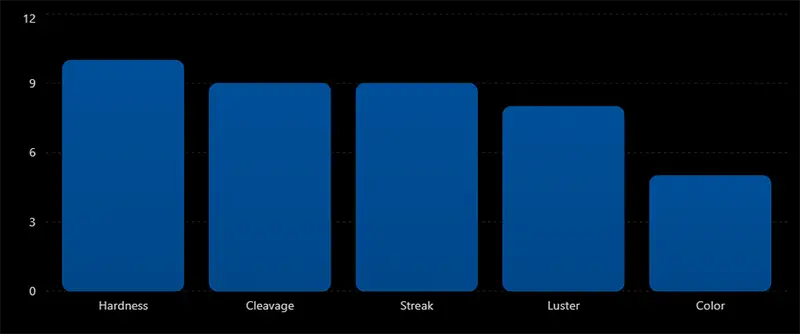
Identification Value of Mineral Properties
Identification Value of Mineral Properties
Cleavage is among the most reliable properties used by geologists.
Cleavage is the tendency of a mineral to break along smooth, flat crystal planes.
Fracture is irregular breakage that does not follow crystal planes.
Mica is well known for splitting into very thin sheets.
Quartz is one of the best examples of conchoidal fracture.
Final Thoughts
Mineral cleavage and fracture are among the most important properties used in geology and mineral identification. Cleavage produces predictable, smooth breakage along crystal planes, while fracture creates irregular or curved surfaces when no preferred breakage directions exist.
Understanding these properties helps geologists identify minerals, interpret crystal structures, and better understand how Earth’s materials are formed.