
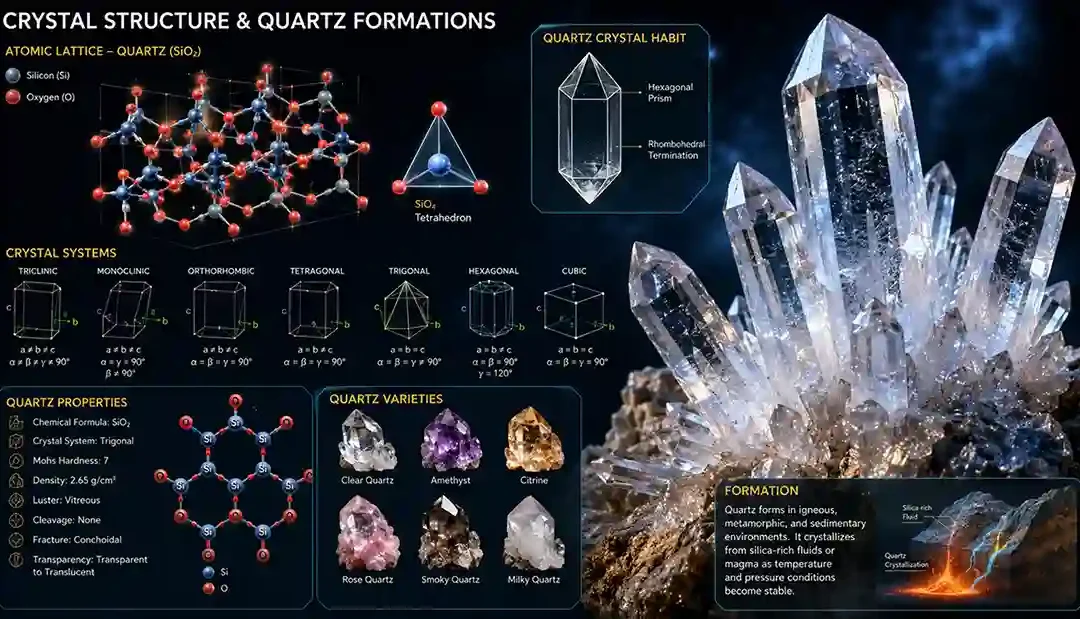
Crystal structure is one of the most important characteristics of minerals. It describes how atoms are arranged inside a mineral in a repeating geometric pattern called a crystal lattice.
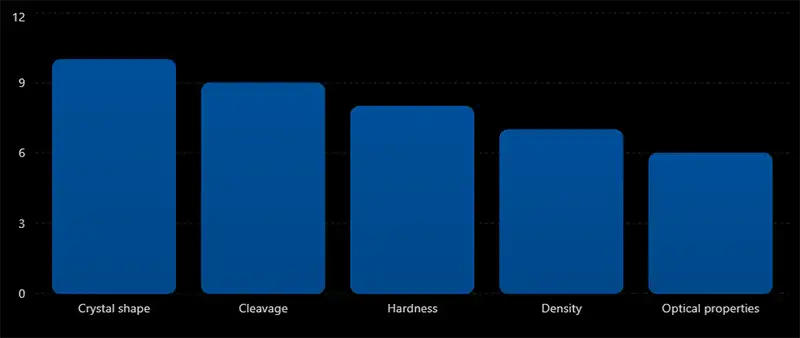
This atomic arrangement controls many mineral properties, including:
- crystal shape
- hardness
- cleavage
- density
- optical behavior
Even though minerals may appear different on the surface, their internal crystal structure follows organized patterns formed during mineral growth.
Scientists study crystal structures to better understand:
- mineral formation
- geological environments
- physical and chemical properties
Learn more → what is a mineral
Main Features Controlled by Crystal Structure
Mineral Properties Controlled by Crystal Structure
Crystal structure strongly influences many mineral characteristics.
What Is Crystal Structure?
A crystal structure is the organized arrangement of atoms inside a mineral. Atoms repeat in a regular geometric pattern known as a crystal lattice.This repeating structure forms naturally as minerals grow.
Even tiny mineral crystals contain:
- repeating atomic patterns
- symmetrical structures
- geometric organization
Crystal Lattice Explained
A crystal lattice is the repeating three-dimensional arrangement of atoms within a mineral.
The lattice determines:
- crystal symmetry
- bonding strength
- mineral stability
Different atomic arrangements create different mineral types.
Example
Quartz and diamond both contain strong atomic bonds, but their crystal structures are very different.
How Mineral Crystals Form
Mineral crystals form when atoms slowly organize during:
- magma cooling
- evaporation
- chemical precipitation
- metamorphic processes
As minerals grow, atoms align into repeating crystal patterns.
Slow crystal growth often produces:
- larger crystals
- clearer crystal faces
- better symmetry
Learn more → how minerals form
Crystal Growth Conditions
| Growth Condition | Crystal Result |
|---|---|
| Slow cooling | Large crystals |
| Rapid cooling | Small crystals |
| High pressure | Dense structures |
| Open space growth | Well-formed crystal faces |
Crystal structure develops differently under different geological conditions.
Crystal Systems in Minerals
Minerals are grouped into crystal systems based on crystal symmetry and geometry.
Scientists recognize:
- cubic
- tetragonal
- orthorhombic
- monoclinic
- triclinic
- hexagonal
- trigonal systems
Each system has different:
- axis lengths
- crystal angles
- symmetry patterns
Cubic Crystal System
The cubic system contains minerals with:
- equal crystal axes
- symmetrical cube-like structures
Examples
- Halite
- Pyrite
- Galena
Cubic minerals often form square or cube-shaped crystals.
Hexagonal Crystal System
Hexagonal minerals form six-sided crystal shapes.
Example
- Quartz
Quartz commonly grows as:
- six-sided prisms
- pointed crystal ends
Hexagonal symmetry is very common in silicate minerals.
Crystal Structure and Cleavage
Crystal structure strongly affects cleavage. Minerals break along planes where atomic bonds are weaker.
Example
- Mica splits into thin sheets because of layered atomic structure.
Crystal Structure and Hardness
Crystal Structure and Mineral Hardness
Atomic bonding strength affects mineral hardness.
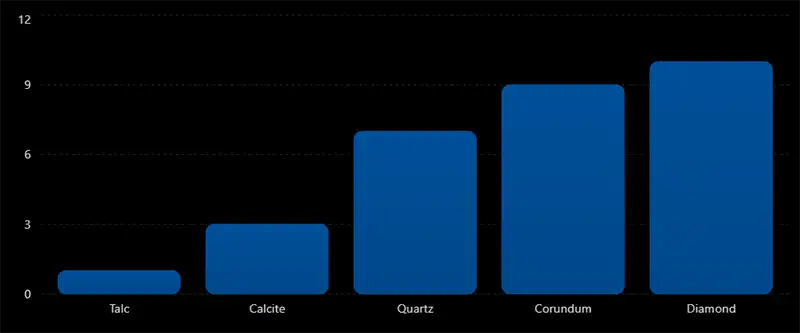
Strong atomic bonding typically results in higher mineral hardness. Diamond’s extremely strong crystal structure makes it the hardest natural mineral.
Crystal Habit vs Crystal Structure
| Crystal Habit | Crystal Structure |
|---|---|
| External crystal shape | Internal atomic arrangement |
| Visible to the eye | Microscopic atomic pattern |
| Example: needle-like | Example: hexagonal lattice |
Crystal habit is influenced by crystal structure.
Why Crystal Structure Matters in Geology
Crystal structure helps scientists:
- identify minerals
- classify crystal systems
- understand mineral formation
- study geological environments
Crystal analysis is important in:
- mineralogy
- mining
- materials science
- gemstone research
X-Ray Crystallography
Scientists study crystal structures using X-ray crystallography
This method reveals:
- atomic positions
- crystal symmetry
- bonding patterns
It is one of the most important tools in modern mineralogy.
Common Minerals and Crystal Systems
| Mineral | Crystal System |
|---|---|
| Quartz | Hexagonal |
| Halite | Cubic |
| Calcite | Trigonal |
| Feldspar | Monoclinic/Triclinic |
| Diamond | Cubic |
Different minerals form different crystal systems.
Crystal Structure and Gemstones
Crystal structure influences gemstone:
- brilliance
- cleavage
- durability
- optical effects
Gemologists study crystal structures to classify and evaluate gemstones.
It is the repeating arrangement of atoms inside a mineral.
It controls many mineral properties such as hardness and cleavage.
A repeating three-dimensional atomic arrangement in a crystal.
Diamond has one of the strongest natural crystal structures.
Final Thoughts
Crystal structure is the hidden atomic framework that controls how minerals form, grow, and behave. From crystal systems and lattice geometry to hardness and cleavage, crystal structure is one of the foundations of mineralogy and geology.
Understanding crystal structures helps scientists identify minerals, study Earth processes, and explore the microscopic organization of natural materials.
Start learning here → characteristics of minerals