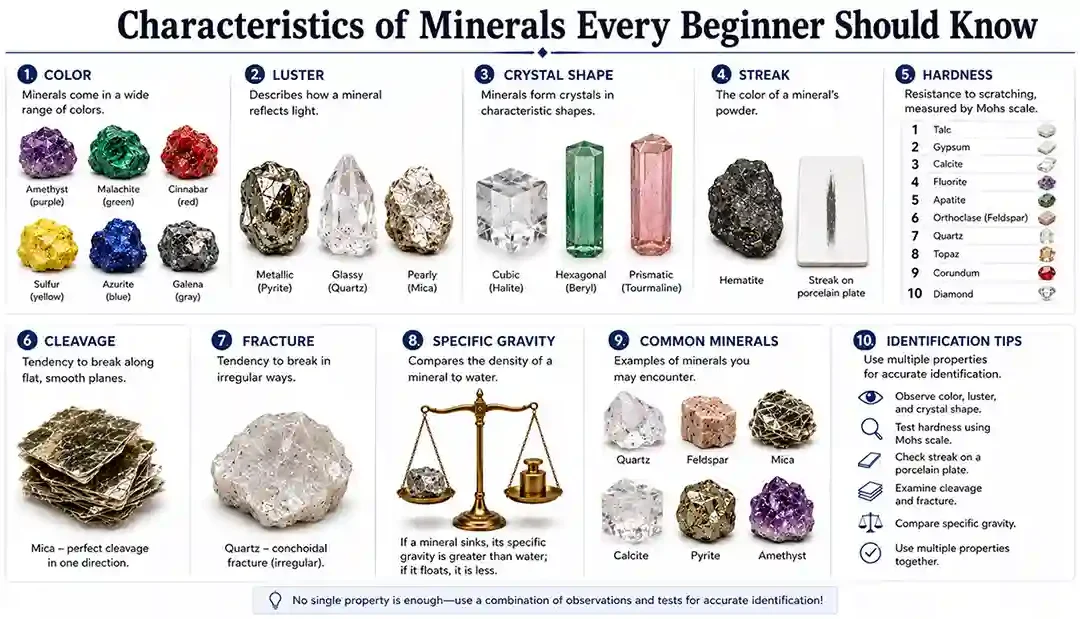
Minerals can look very different from one another, and scientists use their physical and chemical properties to identify them accurately. These features are called the characteristics of minerals.
By studying mineral characteristics, geologists can:
- identify unknown minerals
- classify rocks
- understand geological processes
- locate valuable resources
Some mineral characteristics are easy to observe, while others require scientific testing.
The most important mineral properties include:
- color
- hardness
- luster
- streak
- cleavage
- crystal shape
Learn more → what is a mineral
Main Characteristics of Minerals
Important Characteristics of Minerals
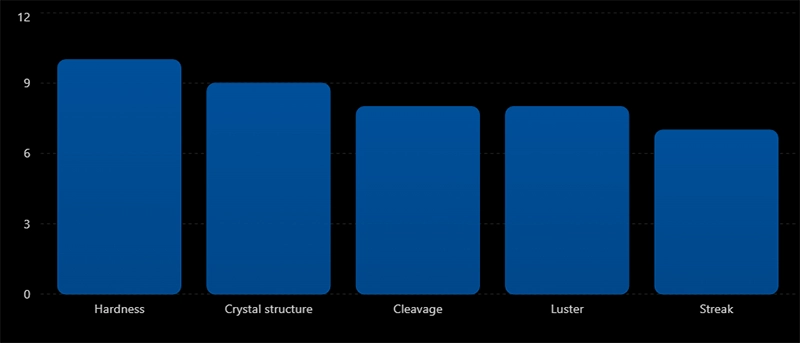
Scientists use these mineral properties for identification and classification.
Mineral Color
Color is one of the easiest mineral characteristics to notice.
Minerals may appear:
- red
- green
- black
- white
- metallic
- transparent
However, color alone is not always reliable for identification.
Some minerals appear in multiple colors because of impurities.
Example
Quartz may be:
- purple (amethyst)
- pink (rose quartz)
- clear
- smoky gray
Crystal Structure and Shape
Minerals contain ordered crystal structures. Atoms arrange themselves in repeating patterns that create crystal shapes.
Common Crystal Shapes
- cubic
- hexagonal
- prismatic
- needle-like
Crystal structure strongly affects:
- hardness
- cleavage
- appearance
Hardness
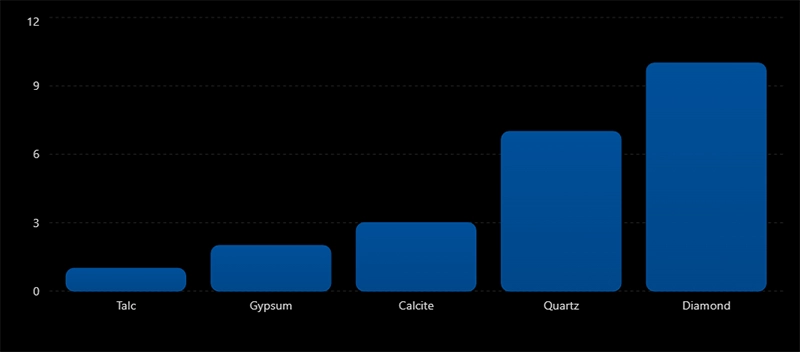
Hardness measures how resistant a mineral is to scratching. Scientists use the Mohs Hardness Scale, which ranks minerals from:
- 1 (softest)
to - 10 (hardest)
Examples
- Talc = 1
- Quartz = 7
- Diamond = 10
Mohs Hardness Scale
Mohs Hardness Scale Examples
Common minerals arranged by scratch hardness.
Luster
Luster describes how a mineral reflects light.
Main Types of Luster
- metallic
- glassy
- dull
- silky
- pearly
Examples
- Pyrite has metallic luster
- Quartz has glassy luster
Luster helps geologists identify minerals quickly.
Streak
Streak is the color of a mineral in powdered form. Scientists test streaks by rubbing minerals across a streak plate
Example
- Hematite may look silver or black
- but its streak is reddish-brown
Streak is often more reliable than surface color.
Cleavage and Fracture
Cleavage describes how minerals break along flat planes. Fracture describes irregular breaking patterns.
Examples
- Mica splits into thin sheets
- Quartz breaks with curved fracture surfaces
Cleavage vs Fracture
| Property | Description |
|---|---|
| Cleavage | Breaks along flat planes |
| Fracture | Breaks irregularly |
| Example Cleavage | Mica |
| Example Fracture | Quartz |
Density and Specific Gravity
Some minerals feel:
- unusually heavy
or - surprisingly light
Scientists measure this using.
Dense minerals often contain heavy elements like:
- iron
- lead
- copper
Transparency
Transparency describes how light passes through minerals.
Categories
- transparent
- translucent
- opaque
Examples
- Clear quartz = transparent
- Pyrite = opaque
Magnetism
Some minerals react to magnets.
Example
Magnetite
It is naturally magnetic and easy to identify. Magnetism can help distinguish certain ore minerals.
Why Mineral Characteristics Matter
| Characteristic | Used For |
|---|---|
| Hardness | Scratch testing |
| Luster | Surface appearance |
| Streak | Powder color |
| Cleavage | Breaking patterns |
| Crystal shape | Mineral classification |
Geologists often combine multiple properties for accurate identification.
Mineral Identification in Geology
Scientists use mineral characteristics to:
- classify rocks
- study Earth history
- locate ore deposits
- understand geological environments
These properties are essential in:
- mineralogy
- mining
- environmental geology
- Earth science education
Learn more → how minerals form
Color, hardness, luster, streak, cleavage, and crystal structure.
Scientists often rely on multiple properties together, especially hardness and streak.
A mineral’s resistance to scratching.
It controls many mineral properties and crystal shapes.
Final Thoughts
The characteristics of minerals help scientists identify, classify, and understand Earth’s natural materials. From hardness and luster to crystal structure and streak, each property provides clues about how minerals formed and how they behave.
Learning mineral characteristics is one of the most important foundations of geology and mineral identification.