
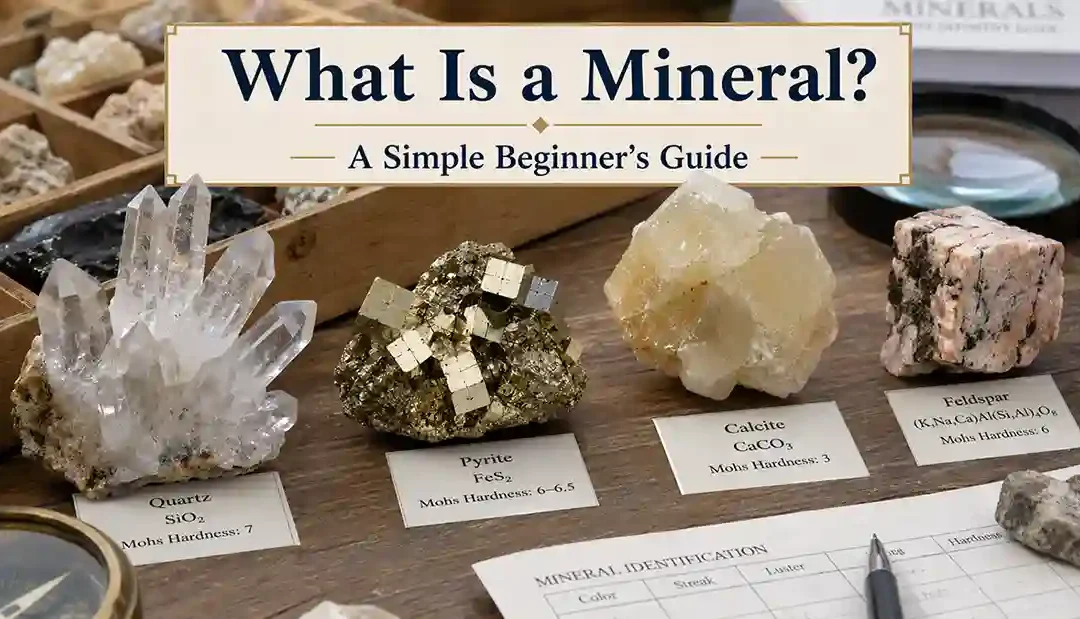
Minerals are the basic building blocks of rocks and one of the most important parts of Earth’s crust. Everything from mountains and soil to smartphones and buildings depends on minerals in some way.
In geology, a mineral is a naturally occurring solid substance with a specific chemical composition and crystal structure.
Scientists study minerals to understand:
- how rocks form
- how Earth changes over time
- where valuable resources are found
There are thousands of known minerals on Earth, but only a small number are common rock-forming minerals.
Learn more → plate tectonics and earthquakes
The Five Main Characteristics of Minerals
Main Characteristics of Minerals
Scientists use these features to define true minerals in geology.
| Property | Importance |
|---|---|
| Naturally occurring | 10 |
| Solid form | 10 |
| Inorganic | 9 |
| Crystal structure | 9 |
| Chemical composition | 8 |
What Defines a Mineral?
To be considered a true mineral, a substance must meet five scientific requirements.
1. Naturally Occurring
Minerals form naturally through geological processes. This means laboratory-made materials are usually not considered minerals.
Examples of natural mineral formation include:
- cooling magma
- evaporation
- underground chemical reactions
2. Solid Substance
Minerals must exist in solid form. Liquids and gases are not minerals.
For example:
- water is not a mineral
- ice CAN be considered a mineral because it is naturally occurring and solid
3. Inorganic Material
Most minerals are inorganic substances. This means they are not produced by living organisms.
Examples:
- quartz
- calcite
- pyrite
However, a few minerals may form through biological processes under special conditions.
4. Specific Chemical Composition
Each mineral contains a defined chemical formula
For example:
- Quartz = SiO₂
- Halite = NaCl
- Calcite = CaCO₃
Small variations may occur, but minerals usually maintain a recognizable chemical composition.
5. Crystal Structure
Minerals have atoms arranged in ordered crystal structures
This atomic arrangement controls:
- crystal shape
- hardness
- cleavage
- optical properties
Learn more → crystal structure explained
Minerals vs Rocks
| Minerals | Rocks |
|---|---|
| Single substance | Combination of minerals |
| Specific chemical formula | Mixed composition |
| Crystal structure | Multiple mineral grains |
| Example: Quartz | Example: Granite |
Rocks are made from one or more minerals.
How Minerals Form
Minerals form through several geological processes, including:
- cooling magma
- evaporation of water
- heat and pressure underground
- hydrothermal fluids
Different conditions create different minerals.
Learn more → how minerals form
Common Mineral Properties
Scientists identify minerals using physical properties such as:
- color
- hardness
- luster
- streak
- cleavage
- density
These features help geologists classify minerals accurately.
Common Rock-Forming Minerals
Some minerals are extremely common in Earth’s crust.
Examples Include
- Quartz
- Feldspar
- Mica
- Calcite
- Amphibole
These minerals help form:
- igneous rocks
- sedimentary rocks
- metamorphic rocks
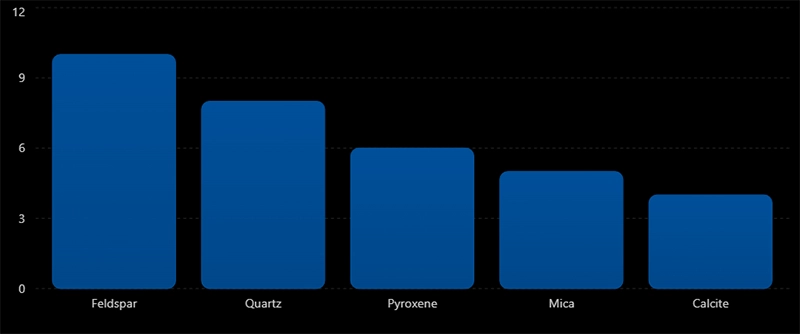
Most Common Minerals in Earth’s Crust
Common Minerals in Earth’s Crust
Some minerals are much more abundant in Earth’s crust than others.
Why Minerals Are Important
Minerals are essential for:
- construction
- technology
- energy production
- manufacturing
- jewelry
- agriculture
Modern society depends heavily on minerals such as:
- copper
- lithium
- iron
- gold
- rare earth elements
Minerals in Everyday Life
Minerals are found in:
- phones
- batteries
- buildings
- vehicles
- electronics
- cosmetics
Even table salt is a mineral halite.
Mineral Science and Geology
The study of minerals is called mineralogy
Mineralogists study:
- crystal structures
- mineral formation
- chemical composition
- physical properties
This field helps scientists better understand Earth’s history and resources.
A naturally occurring inorganic solid with a specific chemical composition and crystal structure.
No — rocks are made from one or more minerals.
Feldspar is considered the most abundant crustal mineral group.
They are essential for technology, construction, energy, and many everyday products.
Final Thoughts
Minerals are the foundation of geology and one of the most important natural components of Earth’s crust. From crystal structures and rock formation to technology and construction, minerals play a major role in both Earth science and modern human life.
Understanding what minerals are helps build a strong foundation for learning geology, rocks, crystals, and Earth processes.