
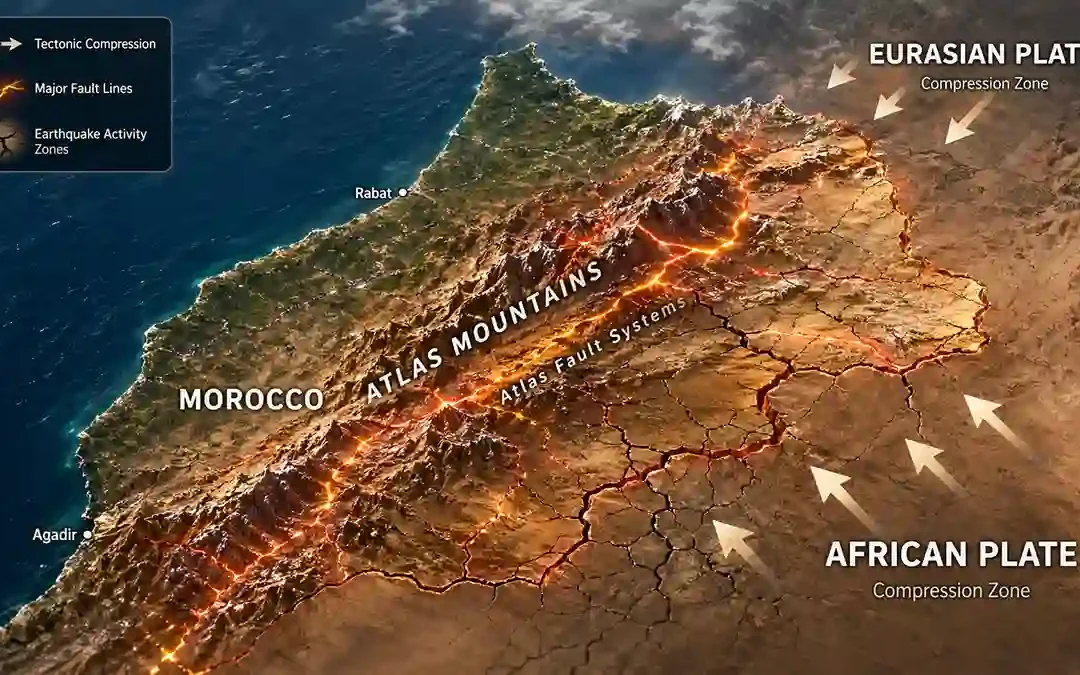
Morocco is not usually considered one of the world’s most active earthquake regions. But the country still experiences damaging earthquakes — especially near mountain regions and tectonic fault zones.
What makes Morocco interesting is that its earthquakes often surprise people because seismic activity is less frequent than in places like Japan or Chile.
If you’re new to earthquakes, begin here → what is an earthquake
Morocco’s Main Seismic Zones
| Region | Risk Level | Main Cause |
|---|---|---|
| Atlas Mountains | High | Tectonic compression |
| Northern Morocco | High | Plate interaction near Mediterranean |
| Rif Mountains | Moderate–High | Fault systems |
| Atlantic Coast | Moderate | Distributed tectonic stress |
| Southern Morocco | Low | Stable crust |
Morocco’s earthquakes are mainly concentrated in mountainous northern regions
To understand how tectonic stress forms → fault lines
Why Do Earthquakes Happen in Morocco?
Morocco’s earthquakes are linked to the interaction between the African Plate and the Eurasian Plate.
Here’s the simplified process:
- The African Plate slowly moves north
- It pushes against Eurasia
- The crust compresses and deforms
- Faults accumulate stress
- Earthquakes occur when rocks suddenly shift
This tectonic pressure affects northern Morocco most strongly.
Learn more → causes of earthquakes
Morocco’s Three Main Earthquake Behaviors
Atlas Mountain Earthquakes
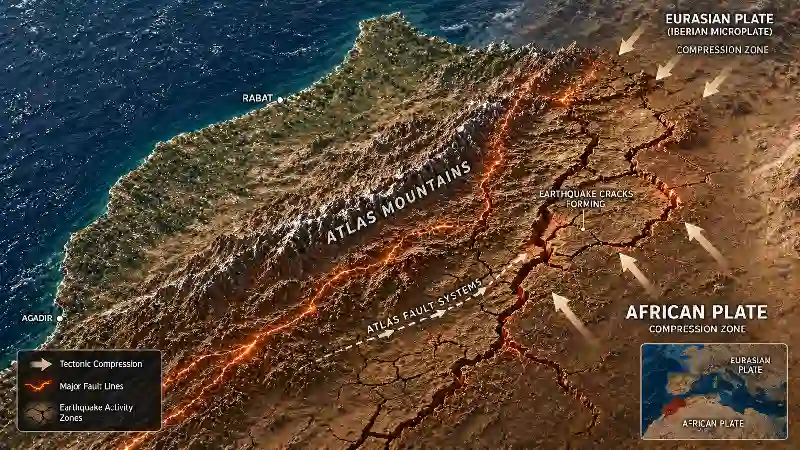
The Atlas Mountains experience earthquakes caused by crust compression.
- Active mountain faults
- Moderate to strong earthquakes possible
- Stress builds slowly over long periods
This region experienced the major 2023 Morocco earthquake.
Explore earthquake types
Northern Morocco & Mediterranean Faults
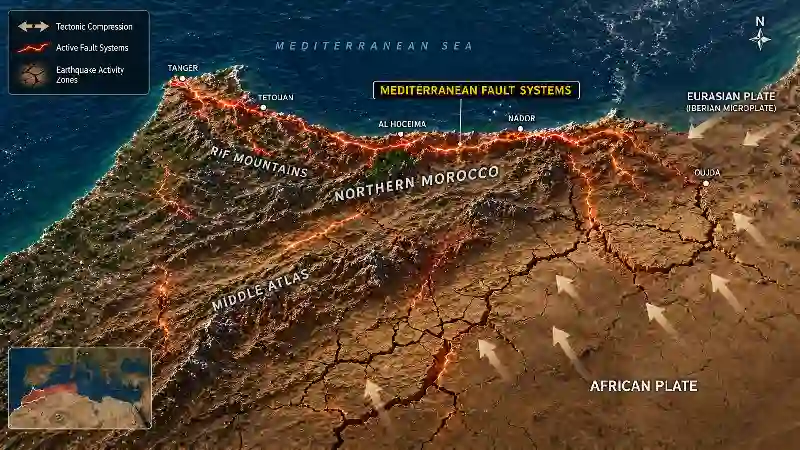
Northern Morocco is influenced by Mediterranean tectonic systems.
- Complex fault interaction
- Shallow earthquakes possible
- Seismic activity spreads across mountain regions
Hidden Inland Fault Activity
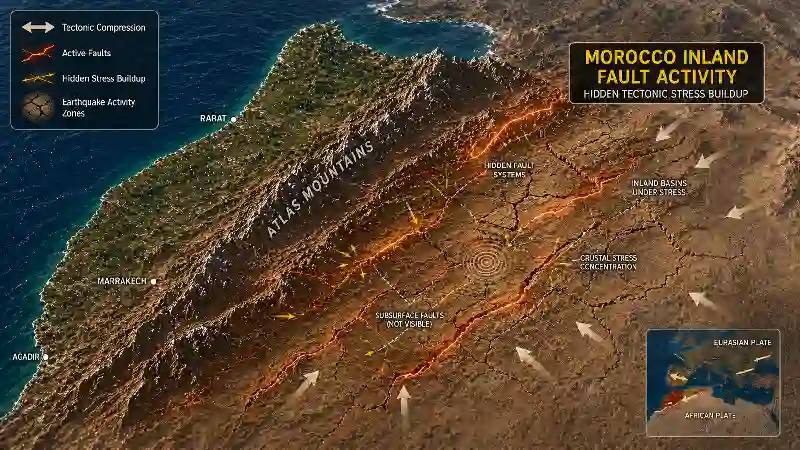
Some Moroccan earthquakes occur away from obvious plate boundaries.
- Reactivation of older faults
- Distributed tectonic stress
- Less predictable earthquake locations
This shows that even relatively stable regions can still experience earthquakes.
Recent Earthquake Activity in Morocco
Morocco experiences fewer earthquakes than many major seismic regions, but activity still occurs regularly.
Recent patterns show:
- Earthquakes concentrated in mountain regions
- Moderate shallow earthquakes
- Aftershock sequences after larger events
The 2023 earthquake increased global attention on Morocco’s seismic risks.
Notable Earthquakes in Morocco
Past earthquakes reveal Morocco’s seismic history.
- 2023 Marrakesh–Safi Earthquake (M6.8)
One of Morocco’s strongest recent earthquakes. - 1960 Agadir Earthquake (M5.8)
A devastating shallow earthquake despite moderate magnitude. - 2004 Al Hoceima Earthquake (M6.3)
Significant earthquake in northern Morocco.
Understand magnitude vs impact
Morocco vs Other Earthquake Regions
Morocco’s earthquakes are different from major Pacific regions.
- Morocco → tectonic compression + mountain faults
- Italy → shallow distributed fault systems
- Nepal → strong continental collision
- California → transform faults like the San Andreas Fault
Morocco’s seismic activity is moderate but still capable of producing destructive earthquakes.
Can Earthquakes in Morocco Be Predicted?
No — earthquakes cannot be predicted precisely.
Scientists can:
- monitor seismic activity
- map active faults
- estimate long-term risk
But exact timing remains uncertain.
Learn more → Can earthquakes be predicted
Because of tectonic pressure between the African and Eurasian plates.
The Atlas Mountains and northern regions.
Less common than some countries, but still possible.
Yes — especially in mountain fault zones.
Final Thoughts
Morocco’s earthquakes may not happen as often as in some other countries, but the region still sits under ongoing tectonic pressure. From the Atlas Mountains to the Mediterranean fault systems, Morocco shows how even moderate seismic regions can experience destructive earthquakes.
Understanding these patterns helps explain why earthquake risk exists even outside the world’s most famous seismic zones.