
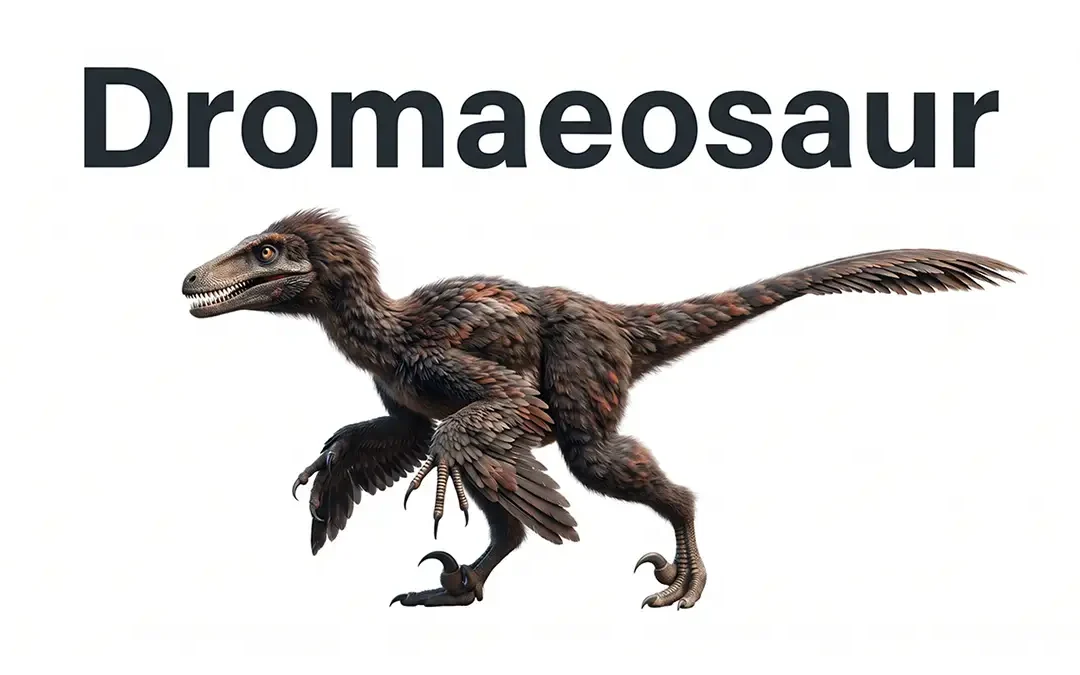
Dromaeosaurs were a group of meat-eating theropod dinosaurs known for their sharp teeth, grasping hands, long tails, and enlarged claws on their feet. Many species also had feathers. Their fossils show that these dinosaurs were diverse in size, appearance, and lifestyle, ranging from small forms capable of gliding to larger predators that lived on the ground.
The group belongs to the family Dromaeosauridae, which includes well-known dinosaurs such as Velociraptor, Deinonychus, Utahraptor, and Microraptor. Dromaeosaurids lived during the Cretaceous Period and were close evolutionary relatives of birds. Their skeletons and feather fossils provide important evidence about the evolution of bird-like features among theropod dinosaurs.
Although popular culture often portrays dromaeosaurs as large, coordinated pack hunters, the fossil record gives a more complex picture. Some aspects of their anatomy are well understood, while their hunting methods and social behavior remain subjects of scientific study.
What Is a Dromaeosaur?
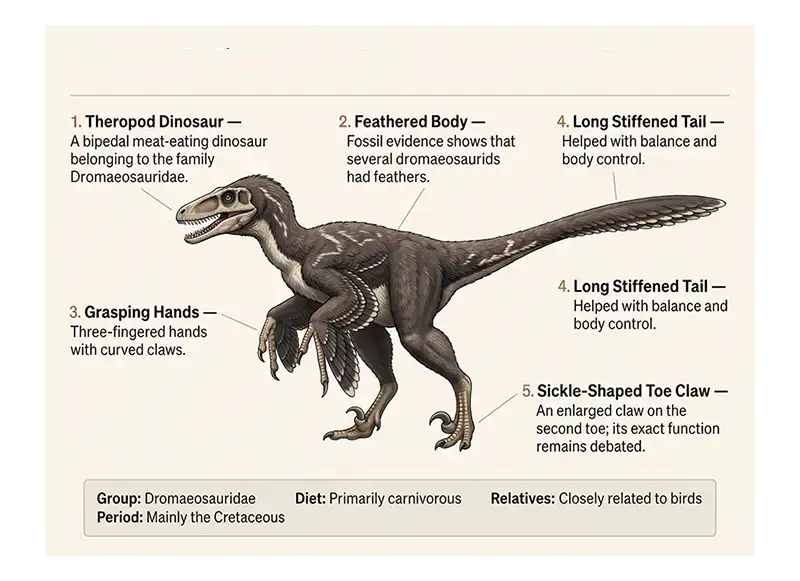
A dromaeosaur is a member of a group of theropod dinosaurs commonly known as dromaeosaurids. The name Dromaeosauridae refers to the family, while Velociraptor and Deinonychus are genera within it.
Dromaeosaurs were generally carnivorous, meaning they ate other animals. Their bodies typically included a relatively narrow skull, sharp teeth, three-fingered hands, strong hind limbs, and a long tail. Many species possessed feathers, although the amount and arrangement of feathering varied.
They were part of the larger theropod group, which also included animals such as Tyrannosaurus and the ancestors of modern birds. However, dromaeosaurs were not simply smaller versions of large theropods. They had their own combination of anatomical features and evolutionary adaptations.
Dromaeosaurids occupied different ecological roles. Small species could catch insects or other small animals, while larger species were capable of attacking bigger prey. Their diversity suggests that they adapted to several environments and feeding opportunities.
How Are Dromaeosaurs Classified?
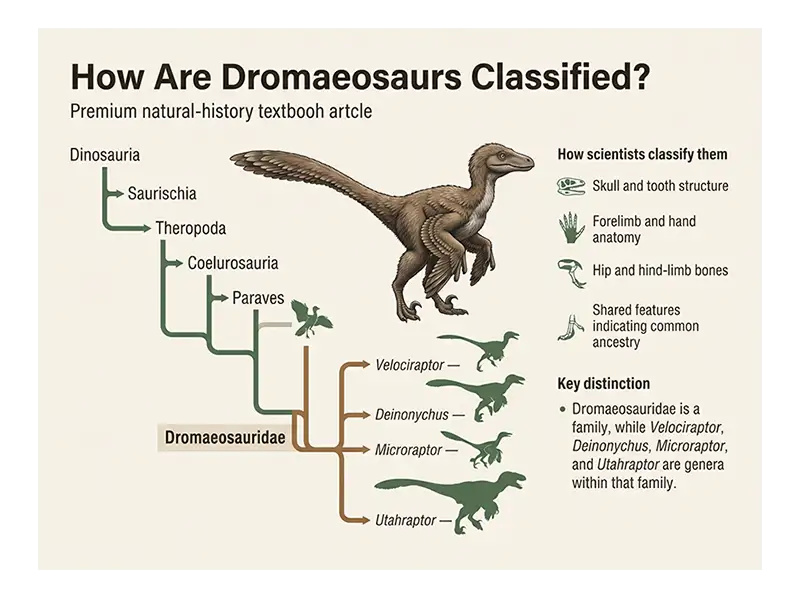
Dromaeosaurs belong to the family Dromaeosauridae within the theropod dinosaurs. Their classification reflects shared anatomical features and evolutionary relationships identified through comparisons of fossil skeletons.
Their broader classification can be summarized as follows:
- Dinosauria: The group containing dinosaurs.
- Saurischia: One of the two major dinosaur lineages.
- Theropoda: A group that includes mostly bipedal dinosaurs, including birds.
- Paraves: A group of small-bodied, bird-related theropods that includes dromaeosaurids, troodontids, and birds.
- Dromaeosauridae: The family containing dromaeosaurs.
Scientists divide dromaeosaurids into several evolutionary branches. These include groups containing Velociraptor and its relatives, the microraptorines, and other lineages with different body proportions and specializations. The exact placement of some species can change as new fossils are discovered or existing specimens are studied in greater detail.
Classification is based on evidence such as skull shape, teeth, hip structure, limb proportions, and details of the hands and feet. Researchers compare these features to determine which species share a more recent common ancestor.
A family classification does not mean that every member looked or behaved alike. Dromaeosaurids differed substantially in body size, feather structure, habitat, and likely feeding habits.
What Did Dromaeosaurs Look Like?
Most familiar dromaeosaurs had a lightly built body, a long tail, relatively large hind limbs, and a skull lined with sharp teeth. They usually walked on two legs. Their arms were equipped with curved claws that could help them grasp or hold objects. The head varied between species. Some had relatively long, narrow snouts, while others had shorter or more robust skulls.
Their teeth were adapted for eating animal material, but tooth shape and size differed among species.The tail was often long and stiffened by elongated bony extensions from the vertebrae. These structures helped keep the tail from bending freely from side to side. The tail likely played an important role in balance and body control during movement.
Feathers are known in several dromaeosaurids. Some fossils preserve long feathers on the arms and legs, while others show evidence of simpler feather coverings. This means that many dromaeosaurs probably looked more like feathered animals than the scaly reptiles often shown in older illustrations.
There was no single appearance shared by every member of the family. A small, feathered species such as Microraptor looked very different from the much larger Utahraptor.
What Made Dromaeosaur Anatomy Special?
Dromaeosaurs combined several features that made them distinctive among theropods. Their anatomy included grasping forelimbs, curved hand claws, a long tail, and an enlarged claw on the second toe of each foot. The hands had three functional fingers with curved claws. These could have helped capture prey, hold food, climb, or perform other tasks depending on the species.
The degree of flexibility and strength in the forelimbs varied across the family. Their hind limbs supported bipedal movement. The feet had three main weight-bearing toes, while the second toe carried the enlarged claw commonly associated with dromaeosaurs. This claw could be raised away from the ground during walking, reducing direct contact with the ground surface.
The tail contained structural features that limited excessive sideways movement. Such stiffness could help control the body's position while turning or changing direction. The exact role of the tail differed with body proportions and movement style.
These features should be considered together rather than as separate weapons. The hands, legs, tail, and feet formed a coordinated body system that supported movement and feeding. Different species used this body plan in different ways.
Did Dromaeosaurs Have Feathers?
Evidence shows that feathers were present in several dromaeosaurids. Fossils of Microraptor preserve extensive feather impressions, including long feathers on the arms and legs. Other specimens, such as Velociraptor fossils with quill knobs on the forearm bone, provide evidence for attachment points for large feathers.
Quill knobs are small bumps on bones where the ligaments supporting certain feathers attached. Their presence in Velociraptor strongly supports the conclusion that it had substantial feathers on its forelimbs, even though feathers are not preserved directly in that specimen.
Feathers likely served more than one purpose during dinosaur evolution. They could provide insulation, support display, help protect the body, or assist with movement. In some small dromaeosaurids, long feathers may have contributed to controlled aerial movement or gliding.
However, not every feathered dinosaur was capable of powered flight. Feathered limbs alone do not prove that an animal could fly like a modern bird. Flight ability depended on several factors, including feather shape, wing structure, muscle power, and overall body proportions.
The fossil evidence also does not establish the exact color of every dromaeosaur. In some exceptionally preserved fossils, microscopic structures have helped scientists infer aspects of feather color, but such findings cannot be applied automatically to the entire family.
Why Did Dromaeosaurs Have Sickle-Shaped Toe Claws?
One of the best-known features of dromaeosaurs is the large, curved claw on the second toe of each foot. It is often called the sickle claw because of its curved shape. The claw was especially prominent in animals such as Deinonychus and Velociraptor.
The second toe had joints that allowed the claw to be held above the ground during normal movement. This arrangement may have protected the claw from excessive wear and kept it ready for use during interactions with prey or other objects.
Scientists have proposed several possible functions. The claw may have helped grip prey, inflict wounds, or provide leverage during close contact. It could also have played a role in climbing or other behaviors in some species, although these possibilities are not equally supported for every dromaeosaur.
Its precise role remains debated. The claw's shape alone cannot prove that it was used to slash prey in the way often shown in films. Researchers examine its curvature, strength, joint movement, and wear patterns, alongside the animal's overall anatomy, to test different explanations.
The claw was only one part of the foot. The muscles, tendons, joints, and other toes also influenced how the animal could move and apply force. Understanding the claw therefore requires looking at the entire limb rather than treating it as an isolated weapon.
What Did Dromaeosaurs Eat?
Dromaeosaurs were mainly carnivorous, but their diets likely differed by species and body size. Sharp teeth, recurved tooth tips, and serrated edges in many species were useful for cutting or gripping animal tissue.
Potential food sources included small vertebrates and other animals. Larger dromaeosaurs may have been able to attack larger prey, while smaller species could have fed on insects, lizards, small mammals, or other available animals. These examples are reasonable ecological possibilities, not a confirmed menu for every species.
Fossils provide direct clues about diet. In some cases, preserved stomach contents or prey remains associated with a predator offer unusually strong evidence. Bite marks on bones can also help scientists identify feeding activity, although matching a bite to a particular dinosaur is not always possible.
Tooth shape is another source of information. Researchers compare tooth size, curvature, serrations, and wear to estimate how an animal processed food. Such evidence can indicate broad feeding patterns, but it rarely reveals every item the animal ate.
Dromaeosaurs were not necessarily specialized to hunt large dinosaurs. Their range of body sizes suggests that different species could have relied on different prey and feeding strategies. Scavenging may also have contributed to their diets, as it does in many living carnivores.
How Did Dromaeosaurs Move?
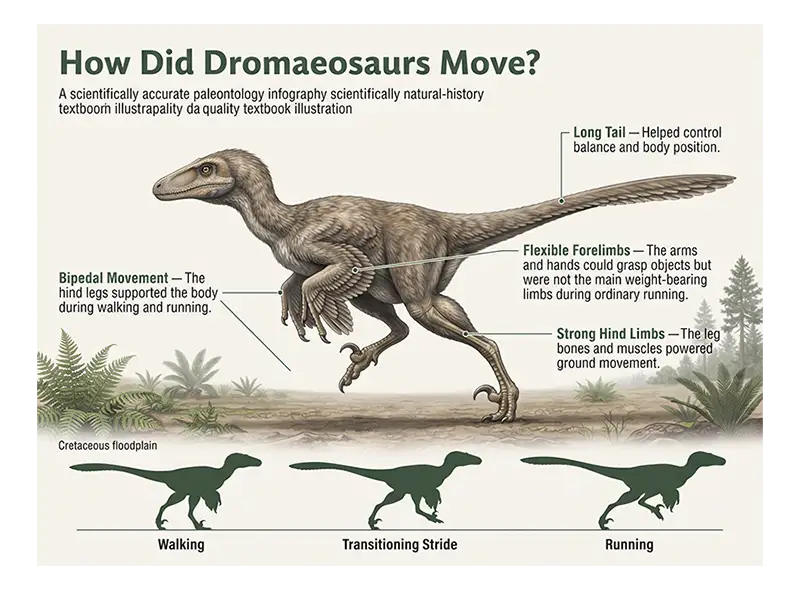
Most dromaeosaurs were bipedal, moving on their hind legs while keeping their forelimbs free. Their limb proportions, foot bones, and tail structure help scientists estimate how they travelled and controlled their bodies.
The long tail likely helped stabilize the body during movement. Its stiffened structure could have reduced unwanted twisting and helped the animal maintain control while turning. However, a long tail does not by itself prove that a species was exceptionally fast or agile.
Movement varied among species. Smaller dromaeosaurs with long legs may have been suited to quick movement across the ground, while larger species had heavier bodies and different mechanical demands. Scientists use limb measurements and biomechanical models to explore these differences.
Some dromaeosaurs had adaptations associated with movement beyond ordinary ground walking. Microraptor, for example, possessed long feathers on both its forelimbs and hind limbs. These structures have been studied as possible aids for gliding or other forms of aerial movement.
The evidence does not support one universal running speed for the family. Speed estimates depend on assumptions about muscle mass, stride length, body weight, and the mechanics of the skeleton. Trackways and fossil proportions can help, but they do not provide a simple speed measurement for every species.
Did Dromaeosaurs Hunt in Packs?
Dromaeosaurs are often portrayed as coordinated pack hunters, but the evidence does not establish that all members of the family hunted in groups. Their social behavior is difficult to reconstruct because fossils rarely preserve direct records of interactions between living animals.
Some fossil sites contain the remains of multiple individuals or associations between predators and other dinosaurs. Such discoveries can raise questions about group behavior, but several explanations may fit the same evidence. Animals might have gathered around food, died at the same location at different times, or been buried together by an environmental event.
The famous association of Deinonychus and the herbivorous dinosaur Tenontosaurus has been discussed in relation to predation and possible group activity. However, the presence of several predators near prey does not prove organized, cooperative hunting. Scavenging, competition, or separate encounters are also possible explanations.
Living animals provide useful comparisons, but behavior cannot be transferred directly from modern birds or reptiles to extinct dinosaurs. Relatedness may offer clues, yet each hypothesis must be tested against the fossil record.
The most accurate conclusion is that some dromaeosaurs may have interacted socially, but the extent of cooperation, group living, and coordinated hunting remains uncertain. Their behavior probably varied across species and circumstances.
Which Dromaeosaurs Are Best Known?
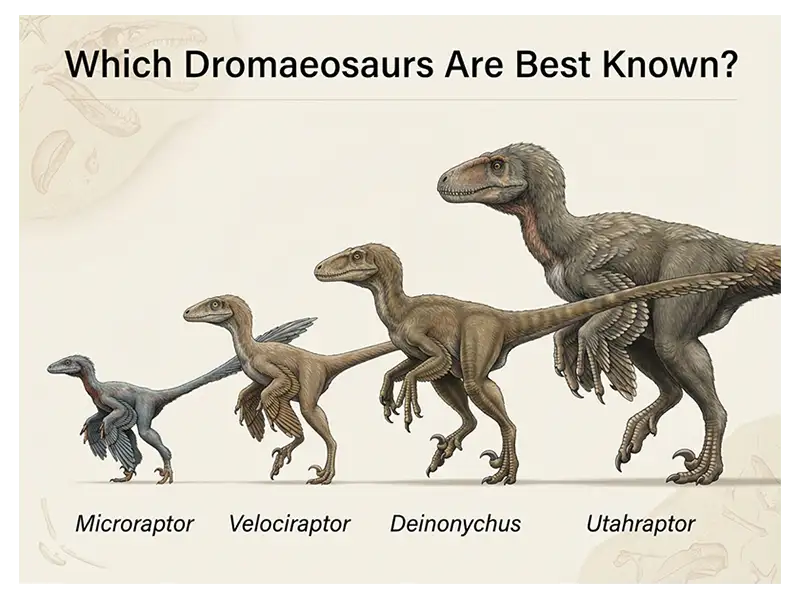
Several dromaeosaurs are especially important because their fossils reveal different aspects of the group's diversity. They range from small feathered forms to large terrestrial predators.
Velociraptor
Velociraptor was a relatively small dromaeosaur that lived in Asia during the Late Cretaceous. It had a long skull, sharp teeth, grasping hands, and an enlarged second-toe claw. Fossils provide evidence that it had feathers on its forelimbs. The real animal was much smaller than the large, human-sized creatures often shown in popular films. Its fossils are important for understanding dromaeosaur anatomy and the relationship between feathered dinosaurs and birds.
Deinonychus
Deinonychus lived in North America during the Early Cretaceous. It was larger than Velociraptor and had a powerful hind limb with a prominent sickle claw. Discoveries of Deinonychus helped change scientific ideas about dinosaur activity and movement. Its anatomy contributed to renewed interest in the possibility that some dinosaurs were active animals rather than slow, sluggish reptiles. Its hunting behavior is still debated, and its fossil associations do not conclusively demonstrate coordinated pack hunting.
Utahraptor
Utahraptor was a large dromaeosaur from North America. It lived during the Early Cretaceous and was much more heavily built than Velociraptor. Its size and powerful limbs show that dromaeosaurids were not all small predators. The discovery of Utahraptor expanded understanding of the family's size range. Like other dromaeosaurs, it possessed an enlarged claw on the second toe, but details of its behavior must be inferred from anatomy rather than assumed from its size.
Microraptor
Microraptor was a small dromaeosaur from Early Cretaceous deposits in China. It is especially significant because exceptionally preserved fossils show long feathers on its arms, legs, and tail. Its feather arrangement has led to extensive research into how early bird-related dinosaurs moved through the air.
Scientists have investigated whether Microraptor glided between elevated locations and how its four feathered limbs affected stability. It demonstrates that the evolutionary history of feathers and flight-related adaptations was more varied than a simple progression from ground-running dinosaurs to modern birds.
Other dromaeosaurids, including Dromaeosaurus, Saurornitholestes, and Balaur, add further evidence of the group's diversity. Their relationships and ecological roles help researchers reconstruct how dromaeosaurs evolved across different regions.
When and Where Did Dromaeosaurs Live?
Dromaeosaurids are known primarily from the Cretaceous Period, which lasted from about 145 million to 66 million years ago. Their fossils have been found in parts of Asia, North America, Europe, and other regions, although the quality and amount of evidence vary by location.
Important fossils from China preserve feathers and other delicate structures. North American discoveries include well-known genera such as Deinonychus and Utahraptor. Asian fossils include Velociraptor and Microraptor, each providing evidence of different body forms and lifestyles.
Their environments were diverse. Fossil-bearing deposits indicate that some lived in landscapes with rivers, lakes, forests, or floodplains. The exact habitat of an individual species depends on the geological setting in which its remains were found. The distribution of dromaeosaur fossils also helps scientists investigate how dinosaur groups spread and changed over time.
However, gaps in the fossil record make it difficult to identify the precise origin of the family or the full range of every species. The youngest known non-avian dromaeosaur fossils come from the Late Cretaceous. Like other non-avian dinosaurs, dromaeosaurids disappeared during the mass extinction at the end of that period, around 66 million years ago.
How Big Were Dromaeosaurs?
Dromaeosaur body size varied considerably. Some species were small, lightweight animals, while others were large predators with strong limbs and substantial bodies. There is no single size that represents the whole family.
Microraptor was small, generally estimated at around the size of a large crow or small chicken, depending on the specimen and measurement used. Velociraptor was larger but remained relatively small compared with its movie portrayal. Deinonychus was a more robust predator, while Utahraptor was among the largest known dromaeosaurids.
Size estimates come from the dimensions of fossil bones, comparisons with related animals, and reconstructions of body proportions. Many specimens are incomplete, so scientists must estimate missing parts. Different reconstruction methods can produce somewhat different results.
It is also important to distinguish body length from height and mass. A long tail can make a dinosaur's total length substantial without indicating a particularly tall or heavy body. Mass estimates are especially uncertain because soft tissues are rarely preserved.
These differences in size suggest that dromaeosaurs filled a variety of ecological roles. Smaller species may have targeted smaller prey or used different movement strategies, while larger species could have handled larger animals. Such interpretations must still be evaluated species by species.
What Do Dromaeosaur Fossils Reveal?
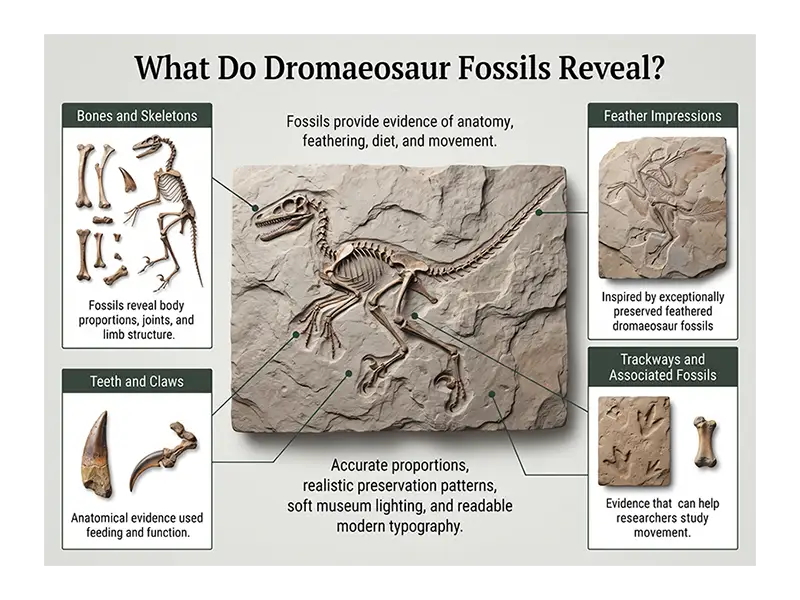
Dromaeosaur fossils provide evidence about anatomy, diet, growth, feathering, movement, and evolutionary relationships. Different types of fossils answer different questions, and the strength of a conclusion depends on the quality of the evidence.
Bones and skeletons reveal body proportions, joint structure, and muscle attachment areas. These features help researchers reconstruct how the animal moved and how its limbs functioned.
Teeth and jaws offer clues about feeding. Tooth shape, serrations, replacement patterns, and wear can help identify broad dietary habits. Bite marks and associated remains may provide additional evidence of feeding interactions.
Feather impressions and quill knobs are important for understanding feather evolution. Exceptional fossils preserve the outlines of feathers, while certain bone features show where large feathers attached. These discoveries connect dromaeosaurs with the wider evolutionary history of birds.
Trackways can provide information about how an animal placed its feet and moved across a surface. However, assigning a trackway to a particular species can be difficult unless the evidence is unusually clear.
Associated fossils may reveal ecological relationships. A predator found near potential prey can suggest an interaction, but the circumstances of burial must be considered before concluding that the predator killed the other animal.
Fossil interpretation involves comparing several lines of evidence. A single feature rarely proves a complex behavior on its own. New discoveries can change earlier conclusions, which is a normal part of scientific research.
How Were Dromaeosaurs Related to Birds?
Dromaeosaurs were close relatives of birds within the theropod dinosaurs. Both groups share many features, including aspects of the wrist, shoulder, hind limbs, and feathered body covering. These similarities reflect common ancestry rather than a coincidence.
Birds evolved from theropod dinosaurs, but dromaeosaurs are generally understood as close relatives of the bird lineage rather than as a group whose members were all direct ancestors of modern birds. Their precise relationships depend on the evolutionary tree supported by current evidence.
Feathered dromaeosaurs are particularly important to this research. Fossils of Microraptor show that elaborate feathers existed in non-bird theropods. Evidence of feathers in Velociraptor and other related dinosaurs further demonstrates that feathers were not exclusive to animals capable of modern powered flight.
The discovery of these features has helped scientists understand that several traits associated with birds appeared before the origin of modern birds. Feathers may initially have served functions such as insulation or display and were later adapted for different forms of movement in some lineages.
Dromaeosaurs therefore help illustrate that evolution does not proceed in a straight line toward a single final form. Related branches can share features, develop distinct adaptations, and follow different evolutionary paths.
How Did Dromaeosaurs Become Extinct?
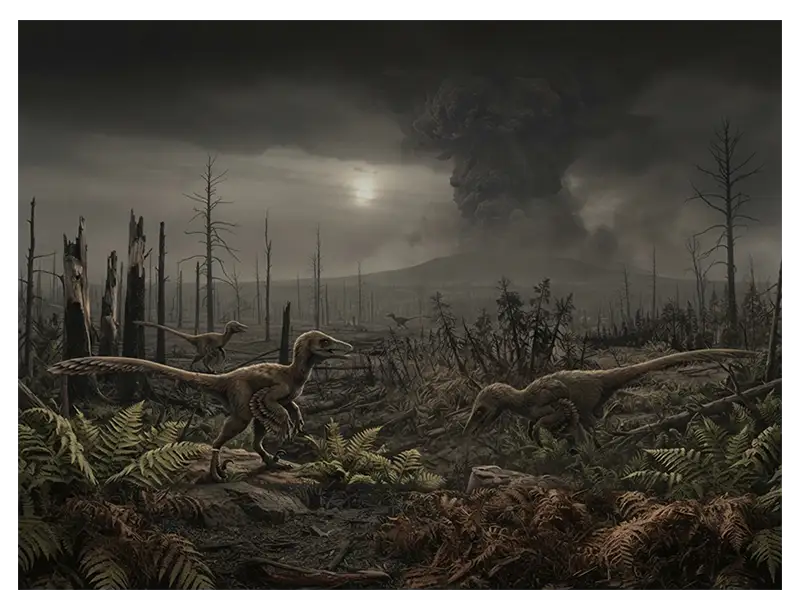
Non-avian dromaeosaurs disappeared during the mass extinction at the end of the Cretaceous, approximately 66 million years ago. This event eliminated all non-avian dinosaurs along with many other groups of organisms.
The extinction is strongly associated with the impact of a large asteroid near the present-day Yucatán Peninsula in Mexico. The impact caused widespread environmental disruption, including dust and aerosols entering the atmosphere, reduced sunlight, and major changes to food webs. Other environmental factors, including volcanic activity, were also part of the broader context of the Late Cretaceous world.
Dromaeosaurs depended on functioning ecosystems that supported their prey. Severe disruptions to plant productivity and food chains would have affected many terrestrial animals, including carnivorous dinosaurs.
There is no strong evidence that dromaeosaurs disappeared because their claws, feathers, or hunting strategies suddenly became ineffective. The end-Cretaceous event affected many unrelated groups, and extinction patterns are best understood through changes to the wider environment.
Birds survived the extinction and are the only living lineage of dinosaurs. They are not dromaeosaurs, but their shared ancestry with dromaeosaurs helps scientists understand the evolutionary history of feathered theropods.
Conclusion
Dromaeosaurs were a diverse family of theropod dinosaurs recognized for their grasping hands, long tails, sharp teeth, and enlarged toe claws. Fossils show that many species had feathers and that the family included both small, lightweight animals and much larger predators.
Their evolutionary relationship with birds makes them especially valuable for understanding how feathered dinosaurs developed and diversified. At the same time, questions about their hunting methods, social behavior, and the exact function of the sickle claw remain open to further research.
By combining evidence from bones, teeth, feathers, and geological context, scientists continue to build a clearer picture of how dromaeosaurs lived and evolved. They remain an important example of the diversity and complexity of dinosaur evolution.
Yes. Dromaeosaurs are theropod dinosaurs within the family Dromaeosauridae. They were part of the wider evolutionary group that also includes birds.
Dromaeosaurid is the standard term for a member of the family Dromaeosauridae. Dromaeosaur is commonly used as a shorter general term for a member of this group.
Feathers are directly preserved in several dromaeosaurids, including Microraptor. Quill knobs on Velociraptor forearm bones also support the presence of large feathers. The exact feather covering differed among species.
Utahraptor is one of the largest well-known dromaeosaurids. Estimates vary because fossil material is incomplete and body mass is difficult to calculate precisely.
Most dromaeosaurs were not adapted for powered flight like modern birds. Some, especially Microraptor, had long feathers that may have helped with gliding or controlled aerial movement.