
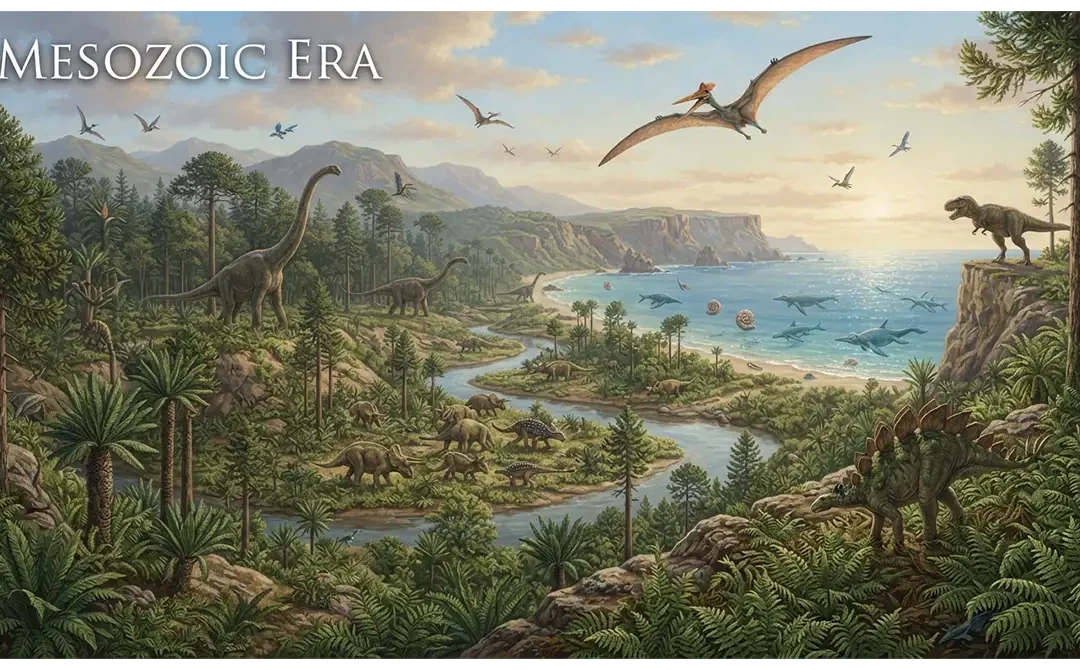
The Mesozoic Era was a long period of geological and biological change that shaped many of the ecosystems known from the fossil record. It included the Triassic, Jurassic, and Cretaceous periods and witnessed major changes in Earth's landscapes, oceans, climate, and living organisms.
During this era, dinosaurs became some of the most successful land animals, while marine reptiles occupied ocean ecosystems and pterosaurs ruled the skies. At the same time, early mammals and birds evolved, and many new groups of plants and animals appeared.
The Mesozoic was also marked by major changes to Earth's geography. Pangaea gradually broke apart, new oceans formed, and shifting continents created different environments around the world. Flowering plants became increasingly common during the Cretaceous, while changing climates and habitats influenced the evolution of many organisms.
The era ended with the Cretaceous–Paleogene (K–Pg) extinction, which eliminated non-avian dinosaurs and many other organisms, bringing the Mesozoic to a close and opening a new stage in Earth's biological history.
What Was the Mesozoic Era?
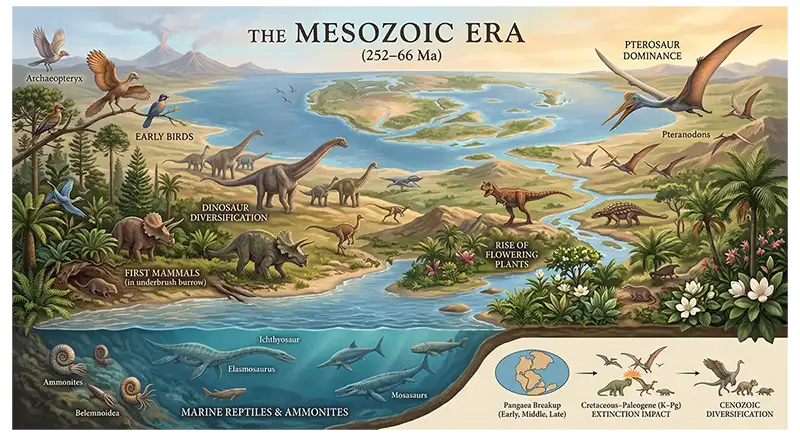
The Mesozoic Era was the middle era of the Phanerozoic Eon, lasting from about 252 to 66 million years ago. It followed the Paleozoic Era and came before the Cenozoic Era. The name Mesozoic means “middle life,” reflecting its position between two major stages of Earth's history. It was a time of major changes in both geology and biology.
During the Mesozoic, dinosaurs became widespread and highly diverse, while the first mammals and early birds evolved. Pterosaurs dominated the skies, marine reptiles occupied many ocean habitats, and ammonites were common in marine ecosystems. Plants also changed significantly, with flowering plants becoming increasingly important during the later part of the era.
Earth's geography changed just as dramatically. The supercontinent Pangaea gradually broke apart, creating new oceans, coastlines, and isolated landmasses. These geological changes influenced climate, habitats, and the distribution of organisms.
The Mesozoic ended about 66 million years ago with the Cretaceous–Paleogene (K–Pg) extinction, which eliminated non-avian dinosaurs and many other organisms. Birds survived as the only living dinosaur lineage, while mammals and other surviving groups later became increasingly diverse during the Cenozoic.
Overall, the Mesozoic was a major period of continental breakup, dinosaur diversification, evolutionary change, and ecosystem development that shaped the later history of life on Earth.
When Did the Mesozoic Era Begin and End?
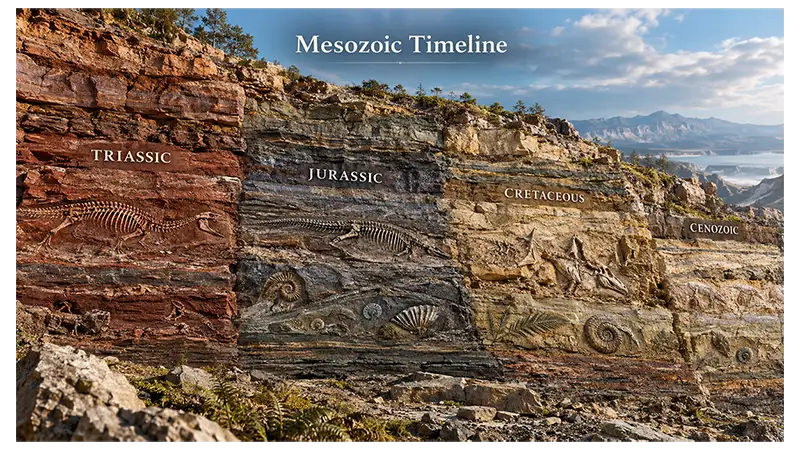
The Mesozoic Era lasted from approximately 252 million years ago to 66 million years ago, covering nearly 186 million years. It began after the Permian–Triassic mass extinction and ended with the Cretaceous–Paleogene extinction.
The Mesozoic is divided into three geological periods:
| Period | Approximate age | Major features |
|---|---|---|
| Triassic | 252–201 million years ago | Early dinosaurs, first mammals, recovery after the Permian extinction |
| Jurassic | 201–145 million years ago | Major dinosaur diversification, large sauropods, early birds |
| Cretaceous | 145–66 million years ago | Flowering plants spread, diverse dinosaurs, advanced birds and mammals |
These periods were not identical. Each had its own climate, geography, ecosystems, and evolutionary changes. The Triassic was the beginning of the Mesozoic, when ecosystems were recovering from the devastating Permian extinction. The Jurassic saw major expansion and diversification of dinosaurs, including enormous sauropods and large theropods.
The Cretaceous was the final and longest period of the Mesozoic. During this time, flowering plants became increasingly important and many new dinosaur groups evolved.
What Are the Three Periods of the Mesozoic Era?
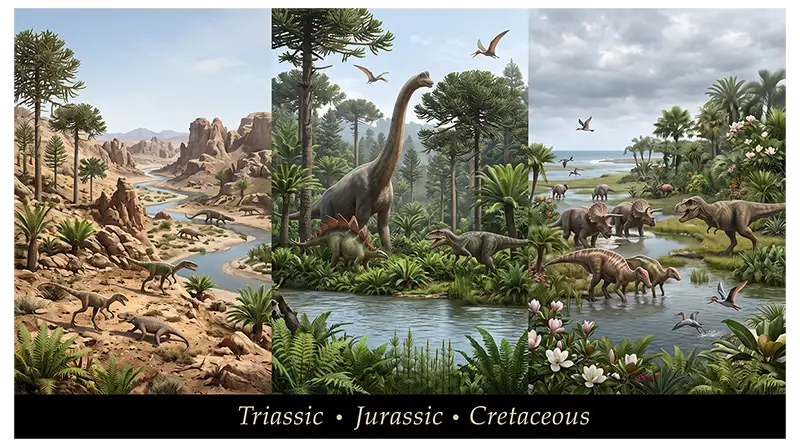
Triassic Period
The Triassic began about 252 million years ago. Earth was still recovering from the largest known mass extinction in its history. Many ecological communities had been severely disrupted, creating opportunities for surviving groups to expand. The earliest dinosaurs appeared during the Triassic. They were generally much smaller and less dominant than many of the famous dinosaurs that evolved later.
The first mammals also appeared during this period. They were small compared with many of the reptiles around them but represented an important new branch of animal evolution. The Triassic ended with another major extinction around 201 million years ago. This event removed several groups and helped create ecological opportunities for dinosaurs during the Jurassic.
Jurassic Period
The Jurassic began about 201 million years ago. Dinosaurs became extremely diverse during this period. Large sauropods such as Diplodocus and Brachiosaurus occupied herbivorous roles, while large theropods such as Allosaurus were important predators. Marine environments supported ammonites, marine reptiles, fish, and many other organisms.
The Jurassic also provides some of the most famous evidence for early bird evolution. Archaeopteryx, which lived around 150 million years ago, had both bird-like and non-avian theropod characteristics. Forests and other plant communities were dominated mainly by conifers, cycads, ferns, and related plants.
Cretaceous Period
The Cretaceous began about 145 million years ago and ended about 66 million years ago. It was a time of major evolutionary diversification. Flowering plants, or angiosperms, became increasingly widespread and changed many terrestrial ecosystems.
Dinosaurs included familiar groups such as tyrannosaurs, ceratopsians, hadrosaurs, ankylosaurs, and many types of smaller feathered dinosaurs. Birds became increasingly diverse, while mammals also developed new forms and ecological roles. The Cretaceous ended with the K–Pg extinction. Most non-avian dinosaurs disappeared, along with many other organisms.
What Was Earth Like During the Mesozoic Era?
Earth's geography changed greatly throughout the Mesozoic. At the beginning of the era, most major continental landmasses were joined together in the supercontinent Pangaea. Over time, Pangaea began to break apart. The breakup created new coastlines, seas, islands, and continental environments.
The Atlantic Ocean began forming as parts of the former supercontinent separated. North America moved away from Europe, while other continental blocks also changed their positions. These geological movements affected ecosystems because organisms became separated by oceans and new geographic barriers.
The Mesozoic also contained extensive shallow seas. These marine environments supported rich communities of fish, ammonites, marine reptiles, corals, and other organisms. On land, forests and other vegetation covered large areas. The exact appearance of these landscapes changed through time as climate, geography, and plant communities changed.
Mesozoic Earth was therefore a dynamic planet. Continents moved, oceans opened and closed, mountains developed, and ecosystems changed along with them.
How Did Pangaea Break Apart During the Mesozoic?
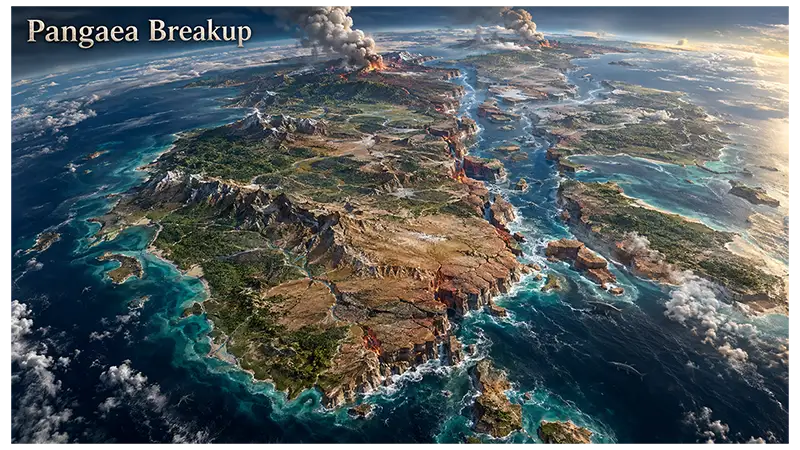
Pangaea was one of the most important geographical features at the beginning of the Mesozoic. It brought many landmasses together into a single enormous supercontinent. A huge ocean called Panthalassa surrounded much of it, while the developing Tethys Ocean occupied an important region along its eastern side.
Pangaea did not remain intact. During the Triassic and Jurassic, tectonic forces caused parts of the supercontinent to begin separating. Large fractures developed in Earth's crust, followed by volcanic activity and the formation of new oceanic crust. The breakup continued through the Jurassic and Cretaceous.
This process eventually separated major continental blocks and helped produce the broad arrangement of continents seen today. Continental breakup had important biological consequences. When populations became separated by newly forming oceans, they could evolve independently. New coastlines and islands also created additional habitats.
Plate tectonics therefore influenced Mesozoic life not only by changing the physical shape of Earth but also by changing how organisms were distributed.
What Was the Mesozoic Climate Like?
The Mesozoic climate was generally warmer than today's global climate, although conditions varied considerably between different periods and regions. Large permanent continental ice sheets were generally absent during much of the era. Warmer conditions allowed many ecosystems to exist at high latitudes.
Temperature and rainfall were not uniform across the planet. Some regions were dry, while others received more rainfall and supported dense vegetation.
Climate was influenced by several factors, including:
- Atmospheric carbon dioxide
- Volcanic activity
- Continental position
- Ocean circulation
- Sea level
- Solar energy
- Mountain building
Changing continental positions affected ocean currents and atmospheric circulation. As Pangaea broke apart, these changes also influenced regional climates. Sea levels were particularly high during parts of the Cretaceous. Shallow inland seas covered areas of some continents and created extensive marine habitats. Climate change through the Mesozoic affected plant distribution, animal habitats, ocean ecosystems, and evolutionary patterns.
What Animals Lived During the Mesozoic Era?
The Mesozoic contained an extraordinary variety of animals.
Dinosaurs
Dinosaurs were among the most important terrestrial vertebrates of the era. They included herbivorous groups such as sauropods, hadrosaurs, ceratopsians, and ankylosaurs, as well as carnivorous theropods. Their sizes ranged from small, bird-sized species to enormous sauropods that reached several tens of meters in length.
Pterosaurs
Pterosaurs were flying reptiles rather than dinosaurs. They appeared during the Triassic and became increasingly diverse during the Jurassic and Cretaceous. Some were small, while later forms included animals with very large wingspans.
Marine Reptiles
The oceans contained several groups of large reptiles. Ichthyosaurs had streamlined bodies adapted for swimming, while plesiosaurs and pliosaurs included many forms with different body shapes. Mosasaurs became major marine predators during the Cretaceous. These animals shared the oceans with fish, ammonites, sharks, turtles, and many smaller organisms.
Mammals
The first mammals evolved during the Triassic. Early Mesozoic mammals were generally small, but they developed a variety of feeding strategies and body forms. By the Cretaceous, mammals had become more diverse and occupied different ecological roles.
Birds
Birds evolved from theropod dinosaurs. Early avian dinosaurs had a mixture of ancestral and bird-like characteristics. Over time, their skeletons, wings, feathers, tails, and feeding structures changed. Modern birds are the surviving members of this dinosaur lineage.
Other Animals
Mesozoic ecosystems also contained turtles, crocodile relatives, lizards, snakes, insects, amphibians, and numerous invertebrates. The famous dinosaurs therefore existed within much larger communities of life.
How Did Life Evolve During the Mesozoic Era?
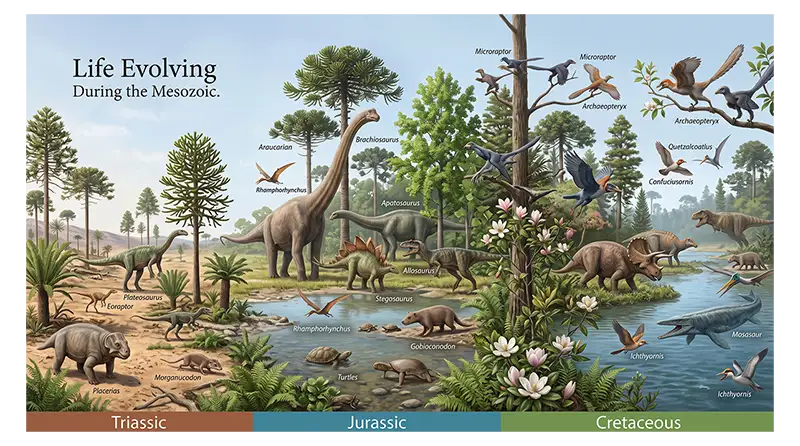
Evolution during the Mesozoic produced major changes across nearly every ecosystem. Dinosaurs diversified into many different body forms and ecological roles. Some became huge herbivores, while others evolved specialized feeding structures, defensive features, or predatory adaptations.
Feathers also became an important evolutionary feature among theropod dinosaurs. Although feathers were not originally developed solely for flight, they later became essential to the evolution of powered flight in birds. Mammals developed important changes in their teeth, jaws, hearing structures, and feeding strategies.
Birds gradually acquired features associated with modern avian anatomy. Plants changed as well. Early Mesozoic landscapes were dominated by groups such as conifers, cycads, ferns, and other seed-producing plants. During the Cretaceous, flowering plants became increasingly widespread.
This expansion changed terrestrial ecosystems because flowering plants created new food resources and habitats for insects and other animals. Insects also diversified alongside changing plant communities.
Evolution was therefore occurring at many levels simultaneously. Animals, plants, insects, microorganisms, oceans, and terrestrial environments all influenced one another.
How Did the Mesozoic Era End?
The Mesozoic Era ended approximately 66 million years ago with the Cretaceous–Paleogene extinction. The strongest evidence indicates that a large asteroid struck near the present-day Yucatán Peninsula of Mexico, creating the Chicxulub crater. The impact released enormous amounts of energy and sent dust, debris, and other material into the atmosphere.
The resulting environmental changes included reduced sunlight, cooling, disruption of photosynthesis, and major changes to food webs. Many organisms disappeared during this event.
The losses included:
- Non-avian dinosaurs
- Pterosaurs
- Ammonites
- Mosasaurs
- Several marine plankton groups
- Other terrestrial and marine organisms
However, the extinction did not eliminate all life. Birds survived as the only living dinosaur lineage. Mammals, crocodilians, turtles, amphibians, fish, insects, and many plants also survived. After the extinction, ecosystems gradually recovered during the early Cenozoic.
Surviving groups expanded into ecological roles that had been occupied by extinct Mesozoic organisms. The end of the Mesozoic was therefore both an extinction event and a major evolutionary transition.
What Fossils Reveal About the Mesozoic Era?
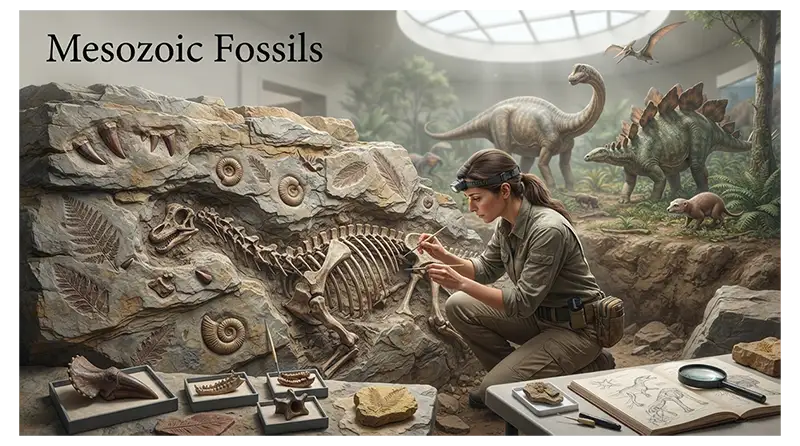
Fossils provide much of our knowledge about Mesozoic life and environments. Dinosaur bones and teeth reveal body structure, growth, feeding, and evolutionary relationships. Fossil footprints provide evidence of movement and behavior that may not be preserved in skeletons.
Plant fossils show how vegetation changed through time. Fossil leaves, wood, pollen, and seeds help scientists reconstruct ancient landscapes. Marine fossils are especially useful for understanding Mesozoic oceans. Ammonites, marine reptiles, fish, shells, corals, and microscopic organisms are preserved in many sedimentary rocks.
Some exceptionally preserved fossil sites also record soft tissues, feathers, skin impressions, or detailed body outlines. Fossils can also reveal changes across geological boundaries. By comparing fossil communities from rocks formed before and after the K–Pg boundary, scientists can identify which organisms disappeared and which lineages survived.
Fossils therefore do more than show what ancient organisms looked like. They provide evidence about evolution, extinction, environments, climate, geography, and changes in ecosystems.
Why Is the Mesozoic Era Important?
The Mesozoic Era is important because it records one of the most transformative periods in the history of life on Earth. During these nearly 186 million years, dinosaurs diversified, mammals appeared and evolved, birds emerged from theropod ancestors, flowering plants spread, and continents moved toward their modern arrangement.
The era also shows how geological and biological processes are connected. Plate tectonics changed continents and oceans. Climate influenced habitats. Changing plants affected animals. Evolution produced new ecological relationships. Mass extinctions then removed many established groups and created opportunities for survivors.
The Mesozoic is especially important for understanding dinosaur evolution and the origin of modern birds. It also provides evidence for how Earth's ecosystems respond to major environmental disturbances. The K–Pg extinction shows that a relatively sudden geological event can cause worldwide biological changes.
For paleontology, geology, and Earth science, the Mesozoic provides an enormous record of changing life and landscapes.
Conclusion
The Mesozoic Era was a long and dynamic chapter of Earth's history that included the Triassic, Jurassic, and Cretaceous periods. It began after the devastating Permian extinction and ended with the K–Pg extinction about 66 million years ago.
During this era, dinosaurs became major terrestrial animals, mammals and birds evolved, marine reptiles occupied ocean ecosystems, flowering plants spread, and Pangaea gradually broke apart.
The Mesozoic was therefore much more than the “Age of Dinosaurs.” It was a period of major changes in life, climate, oceans, continents, and ecosystems. Its fossils provide an important record of how Earth changed over millions of years and help scientists understand the evolutionary history that eventually led to the modern world.
The Mesozoic lasted from about 252 to 66 million years ago, covering nearly 186 million years.
The three periods are the Triassic, Jurassic, and Cretaceous.
Reptiles became highly diverse and occupied many major ecological roles on land, in the oceans, and in the air during this era.
No. Humans evolved much later, during the Cenozoic Era.
Conifers, cycads, ferns, and other seed-producing plants were important throughout the era. Flowering plants became increasingly common during the Cretaceous.