
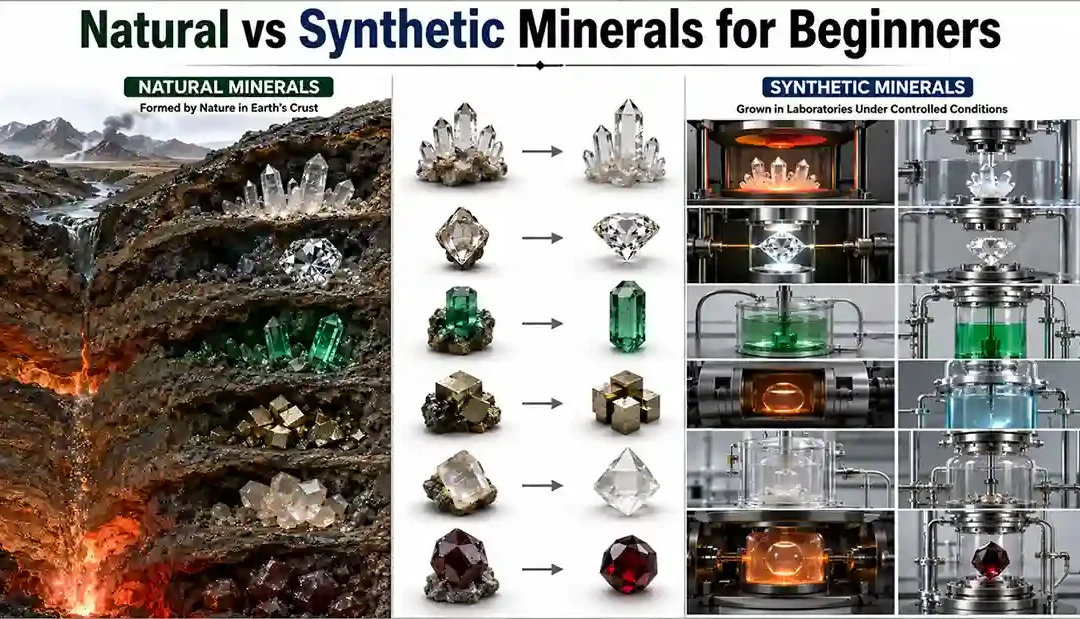
Minerals can form naturally through geological processes or be produced artificially under controlled laboratory conditions. Natural minerals develop over thousands to millions of years through processes such as magma crystallization, hydrothermal activity, sedimentation, metamorphism, and weathering. Synthetic minerals, on the other hand, are created by scientists using laboratory equipment that reproduces the pressure, temperature, and chemical conditions found in nature.
Although natural and synthetic minerals often have the same chemical composition, crystal structure, and physical properties, they differ in their origin and method of formation. Many synthetic minerals are manufactured for scientific research, industrial applications, electronics, optics, gemstones, and advanced technologies.
Understanding the differences between natural and synthetic minerals is important in mineralogy, crystallography, gemology, materials science, economic geology, and laboratory research.
This topic should be studied together with Experimental Mineralogy Explained, Crystal Chemistry Explained, and Mineralogy Explained.
What Are Natural Minerals?
Natural minerals are inorganic crystalline substances that form naturally through geological processes without human intervention.
To qualify as a natural mineral, a substance must:
- Form naturally
- Be inorganic
- Have a definite chemical composition
- Possess an ordered crystal structure
Examples include:
- Quartz
- Calcite
- Diamond
- Pyrite
- Feldspar
- Garnet
Natural minerals are found throughout Earth's crust and mantle.
What Are Synthetic Minerals?
Synthetic minerals are minerals produced artificially in laboratories or industrial facilities by recreating natural geological conditions.
Scientists carefully control:
- Temperature
- Pressure
- Chemical composition
- Growth time
The resulting crystals may be chemically and structurally identical to their natural counterparts.
How Natural Minerals Form
Natural minerals develop through several geological processes.
Major formation methods include:
- Magma crystallization
- Hydrothermal activity
- Sedimentary precipitation
- Metamorphism
- Weathering
- Biomineralization
These processes often require long geological timescales.
How Synthetic Minerals Are Produced
Synthetic minerals are manufactured using techniques such as:
- Hydrothermal crystal growth
- High-pressure high-temperature (HPHT) synthesis
- Chemical vapor deposition (CVD)
- Flux growth
- Melt growth
- Sol-gel methods
These methods can produce high-quality crystals in weeks or months.
Similarities Between Natural and Synthetic Minerals
Natural and synthetic minerals often share:
- Chemical composition
- Crystal structure
- Hardness
- Density
- Optical properties
- Crystal system
In many cases, laboratory tests are required to distinguish them.
Differences Between Natural and Synthetic Minerals
Key differences include:
- Origin
- Formation process
- Growth environment
- Growth rate
- Inclusions
- Trace elements
Natural minerals usually contain natural growth features, while synthetic minerals often display more uniform internal structures.
Common Natural and Synthetic Minerals
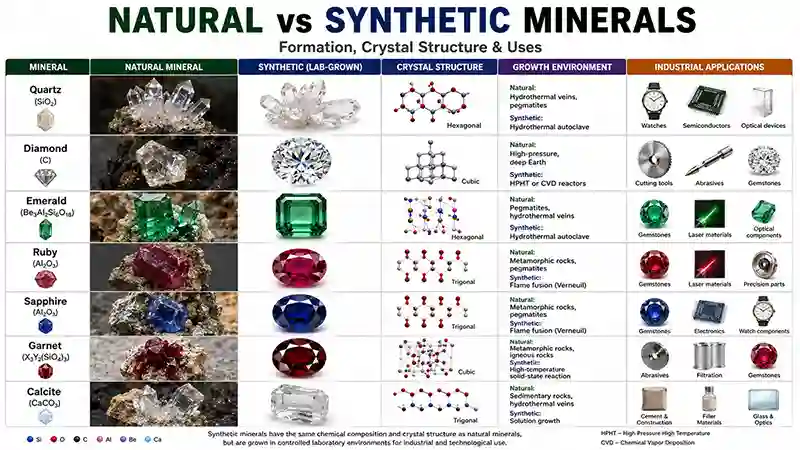
Quartz
Natural:
Forms in igneous, metamorphic, and sedimentary rocks.
Synthetic:
Produced hydrothermally for electronics and optical devices.
Diamond
Natural:
Forms deep within Earth's mantle under extreme pressure.
Synthetic:
Produced using HPHT and CVD methods.
Used in:
- Cutting tools
- Electronics
- Gemstones
Emerald
Natural:
Forms in hydrothermal veins and pegmatites.
Synthetic:
Produced using hydrothermal and flux-growth techniques.
Ruby and Sapphire
Natural:
Form in metamorphic and igneous rocks.
Synthetic:
Widely manufactured for:
- Jewelry
- Lasers
- Scientific instruments
Calcite
Natural:
Occurs in limestones, caves, and hydrothermal veins.
Synthetic:
Produced for industrial and scientific applications.
Garnet
Natural:
Common in metamorphic rocks.
Synthetic:
Used in abrasives and laser technology.
Accessory Synthetic Minerals
Other minerals that are commonly produced synthetically include:
- Spinel
- Corundum
- Fluorite
- Perovskite
- Yttrium Aluminum Garnet (YAG)
- Cubic Zirconia (synthetic crystal, not a natural mineral species)
These materials are widely used in industry, optics, electronics, and jewelry.
How Scientists Identify Synthetic Minerals
Scientists examine:
- Growth zoning
- Fluid inclusions
- Trace elements
- Crystal defects
- Isotope composition
- Growth patterns
Advanced laboratory techniques help distinguish synthetic crystals from natural ones.
Laboratory Investigation
Natural and synthetic minerals are analyzed using:
- Petrographic Microscopy
- X-Ray Diffraction (XRD)
- Electron Microprobe Analysis (EPMA)
- Scanning Electron Microscopy (SEM)
- Raman Spectroscopy
- Infrared Spectroscopy (FTIR)
- Cathodoluminescence
- Stable Isotope Analysis
These methods reveal subtle differences in growth history and composition.
Geological Importance
Studying natural and synthetic minerals helps geologists:
- Understand mineral formation
- Investigate crystal growth
- Interpret geological environments
- Improve mineral identification
- Study crystal chemistry
- Validate experimental models
Synthetic minerals often help explain natural geological processes.
Industrial Importance
Synthetic minerals are widely used in:
- Electronics
- Lasers
- Semiconductors
- Abrasives
- Medical devices
- Optical equipment
- Jewelry
- Scientific research
Natural minerals remain essential for mining and resource development.
Applications
The study of natural and synthetic minerals is important in:
- Mineralogy
- Gemology
- Materials Science
- Economic Geology
- Experimental Mineralogy
- Crystallography
- Electronics
- Planetary Science
Advantages of Studying Natural and Synthetic Minerals
Studying both types helps scientists:
- Understand crystal growth
- Improve synthetic crystal production
- Identify gemstones accurately
- Develop advanced industrial materials
- Reproduce geological processes
- Advance scientific research
Limitations
Comparing natural and synthetic minerals presents several challenges:
- Some synthetic minerals are nearly identical to natural crystals.
- Advanced laboratory analyses are often required for reliable identification.
- Trace elements and inclusions vary between samples.
- Manufacturing techniques continue to improve, making differentiation more difficult.
For comprehensive understanding, combine this topic with:
- Experimental Mineralogy Explained
- Crystal Growth in Minerals Explained
- Crystal Chemistry Explained
- Mineralogy Explained
- Atomic Structure of Minerals Explained
- X-Ray Diffraction in Mineralogy
- Electron Microprobe Analysis
- Optical Mineralogy Explained
Comparison Table
| Feature | Natural Minerals | Synthetic Minerals |
|---|---|---|
| Formation | Geological Processes | Laboratory Production |
| Time Required | Thousands to Millions of Years | Days to Months |
| Environment | Earth's Crust and Mantle | Controlled Laboratory |
| Crystal Structure | Natural | Same as Natural |
| Common Uses | Mining, Research, Gemstones | Industry, Research, Electronics, Gemstones |
Summary Table
| Feature | Natural vs Synthetic Minerals |
| Main Difference | Origin of Formation |
| Similarities | Chemistry, Crystal Structure, Physical Properties |
| Common Study Methods | XRD, SEM, EPMA, Raman, FTIR |
| Industrial Importance | Mining, Electronics, Gemology |
| Geological Importance | Understanding Mineral Formation |
Natural minerals form through geological processes without human intervention, while synthetic minerals are produced in laboratories by recreating natural conditions.
Many synthetic crystals have the same chemical composition and crystal structure as natural minerals, but because they are human-made, they are generally not classified as natural mineral species in mineralogy.
Yes. Many synthetic diamonds, quartz, emeralds, rubies, and sapphires are nearly identical to natural specimens and often require advanced laboratory testing for identification.
Synthetic minerals are manufactured for scientific research, electronics, lasers, industrial tools, optics, medicine, and jewelry.
Geologists use petrographic microscopy, X-ray diffraction (XRD), Raman spectroscopy, electron microprobe analysis (EPMA), scanning electron microscopy (SEM), cathodoluminescence, and isotope analysis to identify subtle differences in crystal growth and composition.
Final Thoughts
Natural and synthetic minerals may appear nearly identical, but their origins tell very different stories. Natural minerals preserve Earth's geological history, recording processes such as magma crystallization, metamorphism, hydrothermal activity, and sedimentation. Synthetic minerals, meanwhile, demonstrate humanity's ability to recreate these processes under carefully controlled laboratory conditions.
By comparing natural and laboratory-grown crystals, scientists gain deeper insights into crystal growth, mineral stability, and geological evolution while also developing advanced materials for technology, medicine, and industry. The study of natural versus synthetic minerals remains an important connection between mineralogy, crystallography, experimental geology, and modern materials science.
Continue Learning
Continue exploring mineral formation and crystal science with these related guides: