
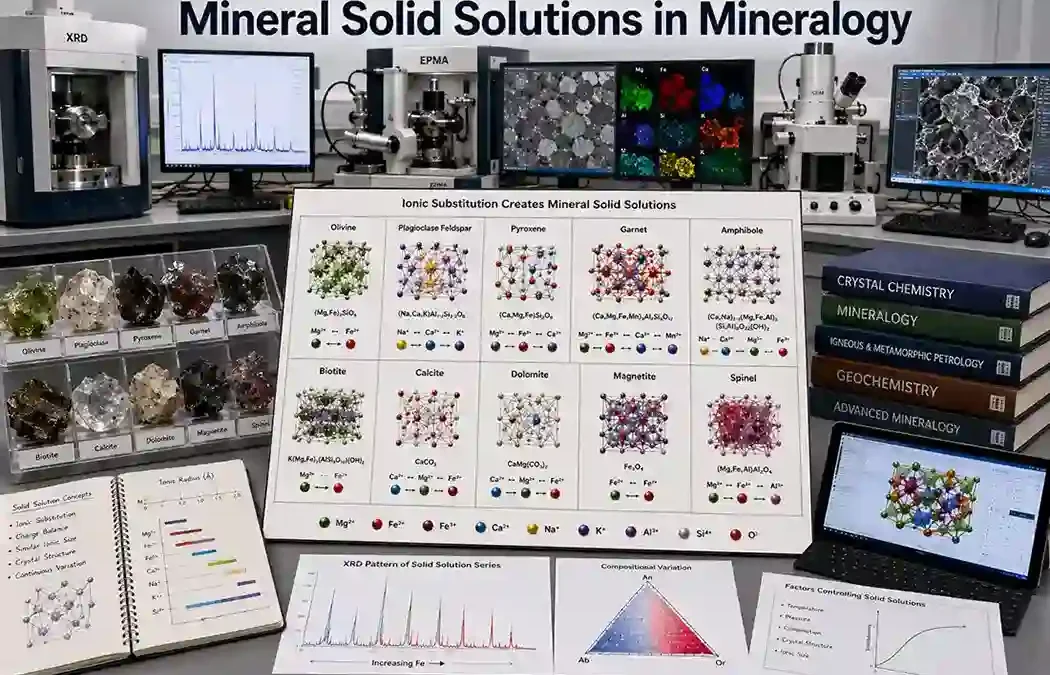
Mineral solid solutions are one of the most important concepts in mineralogy and crystal chemistry. A solid solution occurs when atoms or ions of one chemical element replace those of another within a mineral's crystal structure without changing the overall crystal lattice. This process, known as ionic substitution, allows minerals to vary in chemical composition while maintaining the same basic crystal structure.
Many common rock-forming minerals—including olivine, plagioclase feldspar, pyroxene, amphibole, garnet, biotite, and calcite—exist as solid solution series rather than having a single fixed composition. Understanding mineral solid solutions helps geologists interpret magma evolution, metamorphic conditions, mineral stability, and the chemical history of rocks.
This topic should be studied together with Crystal Chemistry Explained, Atomic Structure of Minerals Explained, Mineral Polymorphism Explained, and Mineral Chemistry Analysis.
What Are Mineral Solid Solutions?
A mineral solid solution is a mineral whose chemical composition varies because one ion substitutes for another within its crystal structure.
Solid solutions have:
- The same crystal structure
- Variable chemical composition
- Ionic substitution
- Stable crystal lattice
- Continuous or partial compositional variation
The mineral remains a single crystal despite changes in chemistry.
How Do Solid Solutions Form?
Solid solutions develop when ions of similar size and electrical charge replace one another during crystal growth.
The process generally involves:
- Crystallization from magma or fluids.
- Similar ions becoming available.
- One ion replacing another in the crystal lattice.
- Crystal growth continuing without changing the overall structure.
This substitution creates minerals with variable compositions.
Conditions Required for Solid Solutions
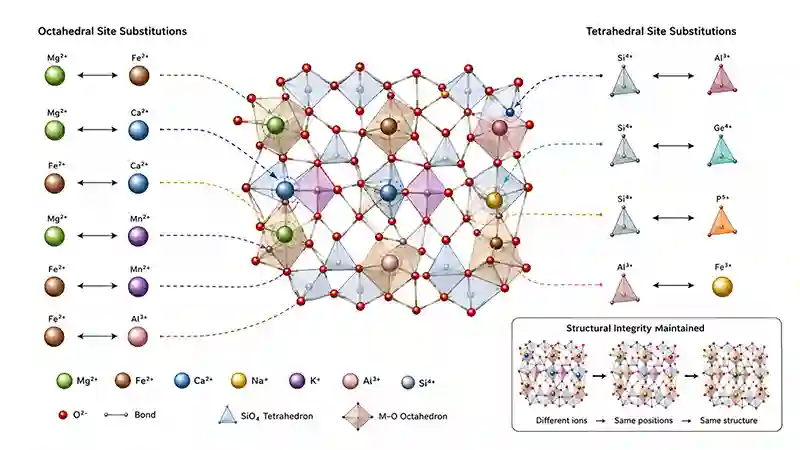
Solid solutions occur most easily when substituting ions have:
- Similar ionic radii
- Similar electrical charges
- Similar chemical behavior
- Compatible crystal sites
These conditions follow Goldschmidt's Rules of Ionic Substitution.
Types of Mineral Solid Solutions
Complete Solid Solution
Substitution occurs across the entire compositional range.
Characteristics:
- Continuous substitution
- Single mineral series
- Same crystal structure
Example:
- Olivine (Forsterite–Fayalite)
Partial Solid Solution
Only limited substitution occurs.
Beyond certain compositions, separate minerals form.
Example:
- Potassium feldspar and plagioclase
Coupled Substitution
Two ions substitute simultaneously to maintain electrical neutrality.
Example:
Na⁺ + Si⁴⁺ ↔ Ca²⁺ + Al³⁺
This is common in feldspars.
Interstitial Solid Solution
Small ions occupy empty spaces within the crystal lattice. This type is relatively uncommon in rock-forming minerals.
Goldschmidt's Rules
Victor Goldschmidt proposed several rules governing ionic substitution.
Substitution depends primarily on:
- Ionic size
- Electrical charge
- Temperature
- Crystal structure
The closer two ions match, the more easily substitution occurs.
Common Solid Solution Series
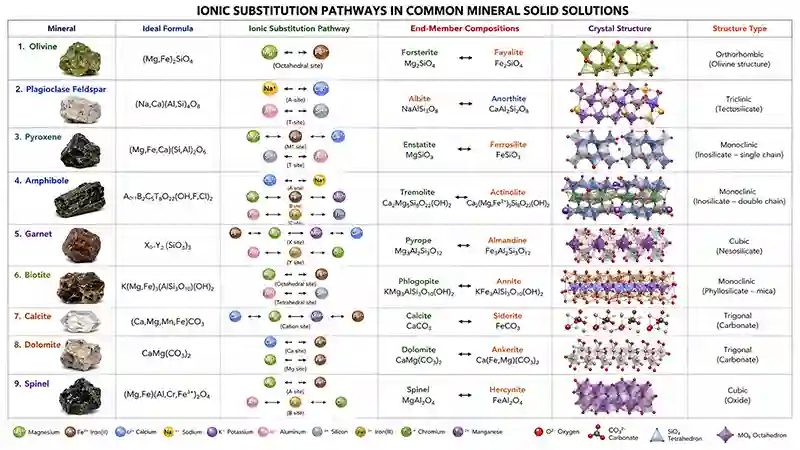
Olivine Series
End members:
- Forsterite (Mg₂SiO₄)
- Fayalite (Fe₂SiO₄)
Magnesium and iron substitute freely.
Plagioclase Feldspar Series
End members:
- Albite (NaAlSi₃O₈)
- Anorthite (CaAl₂Si₂O₈)
Coupled substitution produces continuous variation.
Pyroxene Series
Common substitutions include:
- Magnesium
- Iron
- Calcium
Pyroxenes display complex solid solution relationships.
Amphibole Series
Amphiboles contain extensive substitution involving:
- Calcium
- Sodium
- Magnesium
- Iron
- Aluminum
This results in numerous amphibole varieties.
Garnet Series
Common end members include:
- Pyrope
- Almandine
- Grossular
- Spessartine
Extensive substitution creates a wide range of compositions.
Biotite Series
Iron and magnesium substitute continuously within biotite.
Calcite–Dolomite System
Calcium and magnesium may substitute under certain conditions.
However, complete substitution does not occur because of structural limitations.
Spinel Group
Spinel minerals commonly contain substitution involving:
- Magnesium
- Iron
- Aluminum
- Chromium
These substitutions produce numerous spinel varieties.
End Members
Most solid solution series are described by their end-member compositions.
Examples include:
| Mineral Series | End Member 1 | End Member 2 |
|---|---|---|
| Olivine | Forsterite | Fayalite |
| Plagioclase | Albite | Anorthite |
| Garnet | Pyrope | Almandine |
| Orthopyroxene | Enstatite | Ferrosilite |
Intermediate compositions occur between the end members.
Factors Affecting Solid Solutions
Several factors influence ionic substitution.
These include:
- Temperature
- Pressure
- Crystal structure
- Ionic radius
- Electrical charge
- Availability of elements
- Cooling rate
Higher temperatures generally allow greater substitution.
Geological Importance
Mineral solid solutions help geologists:
- Estimate crystallization temperatures
- Interpret magma evolution
- Determine metamorphic conditions
- Understand mineral stability
- Classify rock-forming minerals
- Reconstruct geological history
They are fundamental to petrology and mineral chemistry.
Laboratory Investigation
Solid solutions are investigated using:
- X-Ray Diffraction (XRD)
- Electron Microprobe Analysis (EPMA)
- Scanning Electron Microscopy (SEM)
- Transmission Electron Microscopy (TEM)
- X-Ray Fluorescence (XRF)
- Raman Spectroscopy
- ICP-MS
- Crystal chemistry software
These techniques determine chemical composition and substitution patterns.
Applications
Mineral solid solutions are important in:
- Mineralogy
- Crystal Chemistry
- Petrology
- Geochemistry
- Economic Geology
- Materials Science
- Planetary Geology
- Environmental Geology
Advantages of Studying Mineral Solid Solutions
Studying mineral solid solutions helps scientists:
- Explain mineral composition variations
- Interpret crystallization history
- Predict mineral stability
- Understand magma differentiation
- Classify rock-forming minerals
- Improve mineral exploration
Limitations
Studying mineral solid solutions has several limitations:
- Some substitutions occur only at high temperatures or pressures.
- Not all ions can substitute because of differences in size or charge.
- Complex minerals may contain multiple overlapping substitution mechanisms.
- Accurate determination usually requires laboratory analyses rather than hand-specimen observation.
For comprehensive understanding, combine this topic with:
- Crystal Chemistry Explained
- Atomic Structure of Minerals Explained
- Mineral Polymorphism Explained
- Mineral Chemistry Analysis
- X-Ray Diffraction in Mineralogy
- Electron Microprobe Analysis
- Petrographic Microscopy
- Mineralogy Explained
Comparison Table
| Solid Solution Type | Description | Example |
| Complete | Continuous substitution | Olivine |
| Partial | Limited substitution | Feldspars |
| Coupled | Two ions substitute together | Plagioclase |
| Interstitial | Small ions occupy vacant sites | Some synthetic minerals |
Summary Table
| Feature | Mineral Solid Solutions |
| Definition | Variable Mineral Composition with Same Crystal Structure |
| Main Mechanism | Ionic Substitution |
| Key Controls | Ionic Radius, Charge, Temperature |
| Common Study Methods | XRD, EPMA, SEM, Raman |
| Geological Importance | Mineral Chemistry, Petrology, Magmatic Evolution |
A mineral solid solution is a mineral in which one type of ion replaces another within the crystal structure while preserving the same overall crystal lattice.
Ionic substitution is the replacement of one ion by another with similar size and charge, allowing minerals to vary in chemical composition without changing their crystal structure.
Common examples include olivine, plagioclase feldspar, pyroxene, amphibole, garnet, biotite, and spinel.
They help geologists understand magma evolution, metamorphism, mineral stability, crystallization history, and the chemical evolution of rocks.
Geologists investigate solid solutions using X-ray diffraction (XRD), electron microprobe analysis (EPMA), scanning electron microscopy (SEM), transmission electron microscopy (TEM), Raman spectroscopy, X-ray fluorescence (XRF), and geochemical analyses.
Final Thoughts
Mineral solid solutions explain why many minerals do not have a single fixed chemical composition but instead exist as continuous or partial compositional series. Through ionic substitution, minerals maintain their crystal structures while accommodating different elements, making them valuable indicators of geological conditions and mineral-forming processes.
By combining crystal chemistry, mineralogy, petrology, and advanced analytical techniques, geologists can use solid solutions to interpret crystallization histories, metamorphic environments, and magma evolution. Mineral solid solutions remain a fundamental concept in mineralogy, geochemistry, petrology, and materials science.
Continue Learning
Continue exploring crystal chemistry and mineral structures with these related guides: