
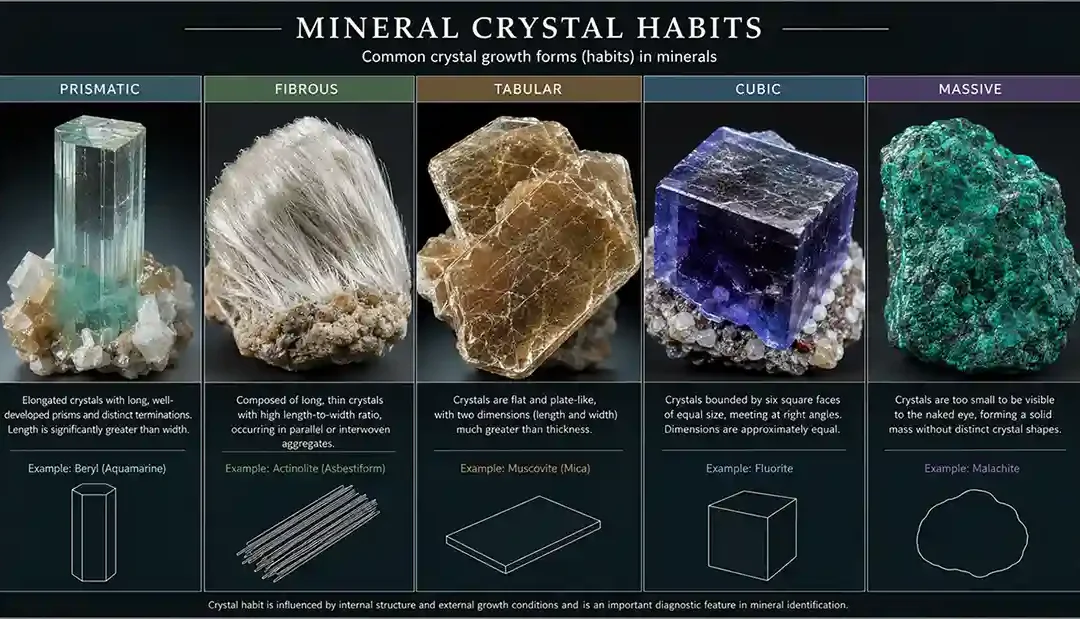
Mineral habit describes the typical external shape or growth form of a mineral crystal. Even when minerals share the same chemical composition, they may grow in different shapes depending on environmental conditions.
Crystal habit helps geologists:
- identify minerals
- understand crystal growth
- interpret geological environments
- study mineral formation processes
Some minerals form beautiful geometric crystals, while others appear massive, fibrous, or needle-like.
Mineral habit is closely related to:
- crystal structure
- temperature
- pressure
- growth space
Learn more → crystal structure in minerals
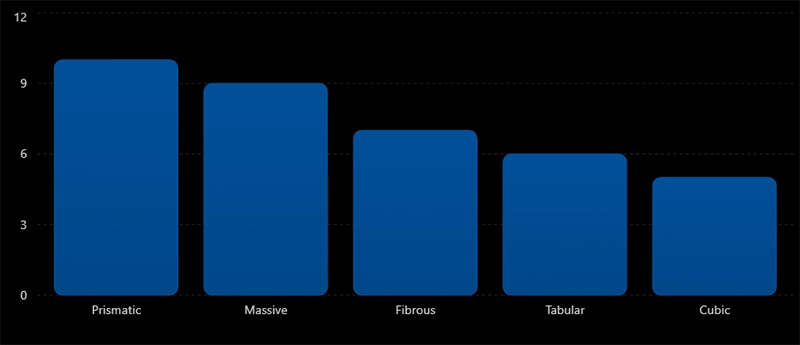
Common Mineral Habits
Common Mineral Habits
Typical crystal growth forms observed in minerals.
What Is Mineral Habit?
Mineral habit is the visible external shape of a mineral. It describes how mineral crystals grow in nature.
Crystal habit may include:
- long crystals
- flat crystals
- needle-like forms
- blocky shapes
- irregular masses
Habit is influenced by crystal structure and growth conditions.
Why Mineral Habit Matters
Mineral habit helps geologists:
- identify unknown minerals
- distinguish similar minerals
- understand crystal growth environments
Some minerals have very distinctive habits that make identification easier.
Example
Quartz commonly forms prismatic hexagonal crystals.
Prismatic Habit
Prismatic minerals grow as long column-like crystals
Common Examples
- Quartz
- Tourmaline
These crystals often have:
- elongated shapes
- well-developed crystal faces
- pointed terminations
Prismatic habit is very common in silicate minerals.
Cubic Habit
Cubic habit produces cube-shaped crystals.
Common Examples
- Halite
- Pyrite
- Galena
This habit forms because of:
- symmetrical atomic arrangement
- cubic crystal systems
Learn more → mineral classification system
Fibrous Habit
Fibrous minerals contain thin thread-like crystals
Common Examples
- Chrysotile
- Gypsum (satin spar)
Fibrous minerals often appear:
- silky
- flexible
- hair-like
This habit develops from rapid directional crystal growth.
Tabular Habit
Tabular minerals grow as flat plate-like crystals.
Common Examples
- Barite
- Feldspar varieties
Tabular crystals are usually:
- wider than thick
- flattened
- layered in appearance
Massive Habit
Massive habit occurs when crystals grow together without distinct crystal faces.
Common Examples
- Hematite
- Magnetite
- Some quartz deposits
Massive minerals often appear:
- compact
- granular
- irregular
Acicular Habit
Acicular minerals form needle-like crystals
Common Examples
- Rutile
- Natrolite
These crystals are:
- thin
- sharp
- elongated
Acicular habit often forms during rapid crystal growth.
Mineral Habit Examples
| Mineral Habit | Typical Appearance |
|---|---|
| Prismatic | Long crystal columns |
| Cubic | Cube-shaped crystals |
| Fibrous | Hair-like strands |
| Tabular | Flat plates |
| Massive | Irregular masses |
Crystal habit is one of the most useful visual identification features.
Mineral Habit and Crystal Structure
Crystal habit is controlled partly by crystal structure
The internal atomic arrangement influences:
- growth direction
- symmetry
- crystal faces
However, environmental conditions also affect final crystal shape.
Learn more → crystal structure in minerals
Environmental Factors Affecting Mineral Habit
Mineral habit can change depending on:
- temperature
- pressure
- available space
- growth speed
- chemical environment
Example
Slow crystal growth in open cavities often produces large, well-formed crystals.
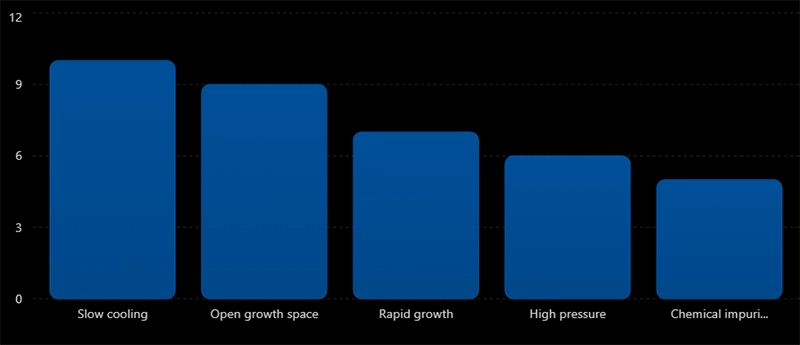
Crystal Growth Conditions and Habit
Crystal Growth Conditions and Mineral Habit
Different geological conditions influence crystal growth forms.
Mineral Habit in Geology and Mining
Mineral habit helps geologists:
- recognize ore minerals
- identify gemstones
- study hydrothermal systems
- classify mineral deposits
Habit analysis is important in:
- mineralogy
- petrology
- economic geology
It is the typical external shape or growth form of a mineral crystal.
Crystal structure and environmental growth conditions.
Habit is the visible shape, while structure is the internal atomic arrangement.
Quartz often forms prismatic crystals.
Final Thoughts
Mineral habit is one of the most important visual features used in mineral identification and geological analysis. From cubic and prismatic crystals to fibrous and massive growth forms, mineral habits reveal how crystals formed and grew within Earth’s geological environments.
Understanding mineral habits helps scientists identify minerals, interpret crystal growth conditions, and study Earth’s geological history.