
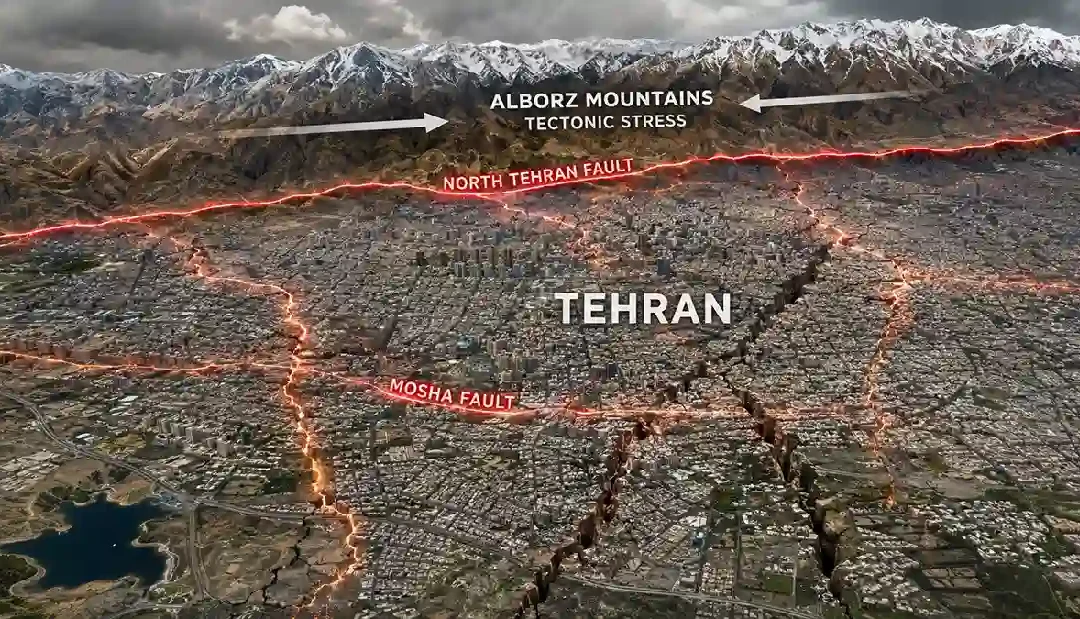
Tehran is one of the most earthquake-risk cities in the Middle East. The Iranian capital sits beside several major active faults at the southern edge of the Alborz Mountains. That means millions of people live directly near active seismic zones.
Iran itself is located in a collision region where tectonic plates continue pushing against each other.
If you’re new to earthquakes, begin here → what is an earthquake
Tehran Seismic Zones
| Zone | Risk Level | Main Cause |
|---|---|---|
| North Tehran Fault | Extremely High | Active fault movement |
| Mosha Fault | Extremely High | Strike-slip faulting |
| Rey Fault Zone | High | Urban crustal stress |
| Alborz Mountain Front | Very High | Compression tectonics |
| Southern Tehran Basin | High | Ground amplification |
Tehran is surrounded by multiple active fault systems. To understand how faults work → fault lines
Why Do Earthquakes Happen in Tehran?
Tehran lies within the collision zone between the Arabian Plate and Eurasian Plate.
Here’s the simple explanation:
- The Arabian Plate moves northward
- It collides with Eurasia
- The crust compresses and fractures
- Stress builds along active faults
- Earthquakes occur when faults suddenly rupture
Iran is considered one of the world’s most earthquake-active regions because of this tectonic collision.
Learn more → causes of earthquakes
Four Major Earthquake Systems Affecting Tehran
North Tehran Fault (Main Urban Threat)
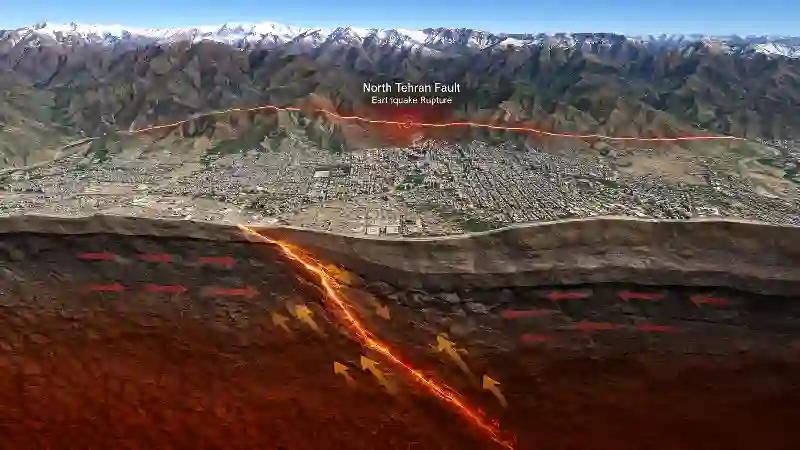
The North Tehran Fault is one of the city’s most important seismic threats.
- Runs along the southern Alborz Mountains
- Major active fault system
- Associated with historical earthquakes
Researchers identify it as a major active structure affecting Tehran.
Explore earthquake types
Mosha Fault System
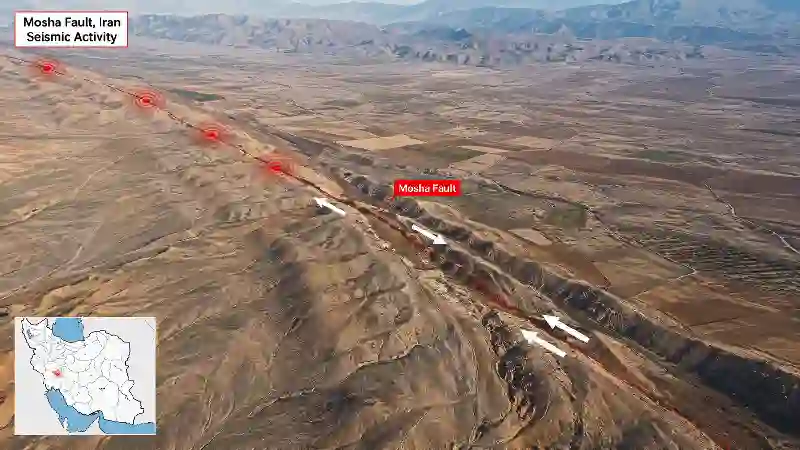
The Mosha Fault lies northeast of Tehran.
- Highly active tectonic structure
- Connected to regional deformation
- Considered one of Tehran’s major seismic sources
Alborz Mountain Compression
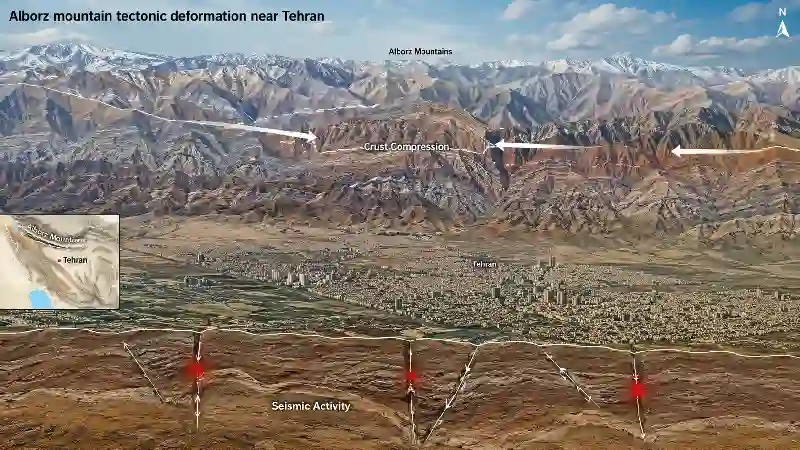
The Alborz Mountains are still tectonically active.
- Crustal shortening continues
- Mountain uplift creates stress
- Fault systems remain active near Tehran
Tehran Basin Amplification Effect
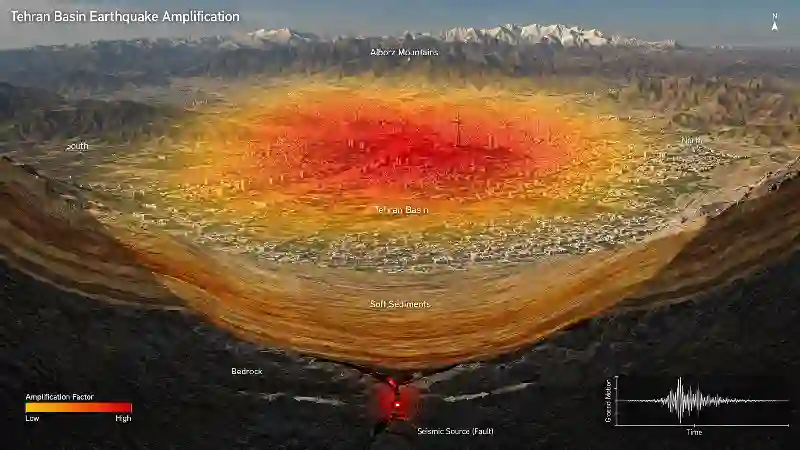
Parts of Tehran may amplify earthquake shaking.
- Dense urban construction
- Sediment-filled basin areas
- Increased shaking potential during earthquakes
Some studies identify southeastern Tehran as especially vulnerable because of dense infrastructure and local conditions.
Recent Earthquake Activity Around Tehran
Tehran regularly experiences small earthquakes and regional seismic activity.
Recent studies continue to warn about stress accumulation near Tehran fault systems.
Patterns include:
- Small earthquakes near active faults
- Ongoing tectonic deformation
- Seismic activity along Alborz structures
Scientists monitor the region closely because large earthquakes remain possible.
Historical Earthquakes Affecting Tehran
Tehran and surrounding regions have experienced destructive earthquakes historically.
- 1830 Damghan Earthquake
Major historical regional earthquake. - 1962 Buin-Zahra Earthquake (M7.1)
A devastating earthquake west of Tehran. - Historical Tehran Fault Activity
Multiple active fault systems show evidence of past major earthquakes.
Understand magnitude vs impact
Tehran vs Other Earthquake Regions
Tehran has a unique seismic profile.
- Tehran → continental collision + active faults
- Istanbul → transform fault system
- Tokyo → subduction zone earthquakes
- California → transform faults like the San Andreas Fault
Tehran’s earthquakes are mainly driven by continental compression.
Can Earthquakes in Tehran Be Predicted?
No — earthquakes cannot be predicted precisely.
Scientists can:
- monitor active faults
- track seismic activity
- study tectonic deformation
But exact timing remains uncertain.
Learn more → Can earthquakes be predicted
Because it sits near several active faults within a tectonic collision zone.
Major movement along the North Tehran Fault or nearby systems.
Small earthquakes occur regularly across the region.
Yes — scientists consider the city at high seismic risk.
Final Thoughts
Tehran is one of the world’s major cities located beside multiple active fault systems.
With tectonic compression continuing across Iran and major faults surrounding the capital, seismic risk remains an important concern for the region.
Understanding Tehran earthquakes helps explain how continental collision zones create powerful and complex seismic activity.