
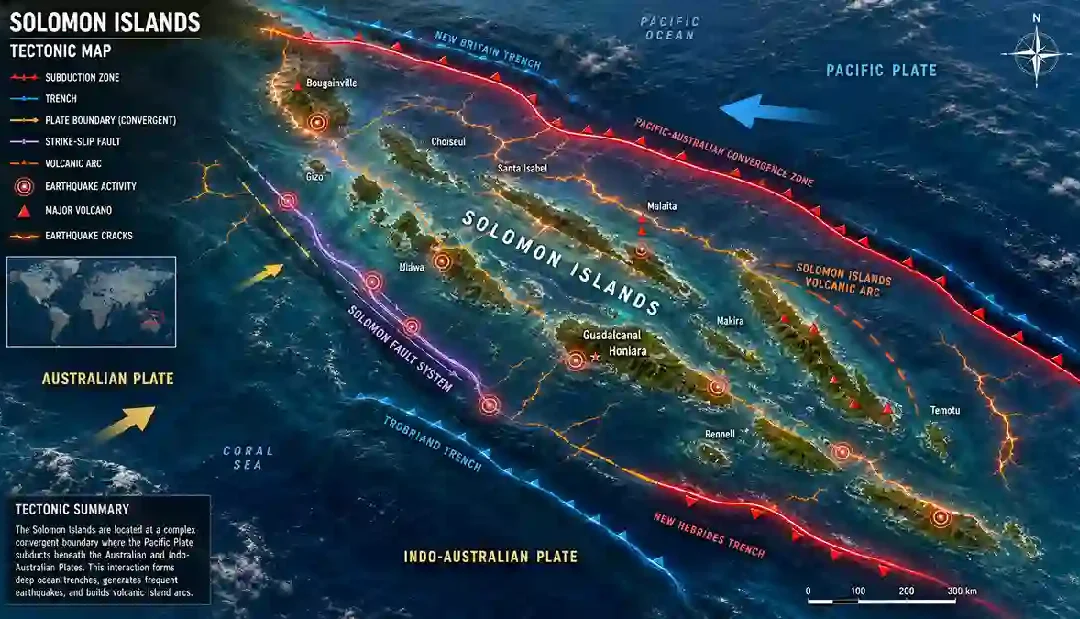
The Solomon Islands may be small, but they sit in one of the most active earthquake regions on Earth. Located deep within the Pacific Ring of Fire, this island chain experiences frequent and sometimes very powerful earthquakes.
The reason is simple:
Multiple tectonic plates are constantly colliding and sliding beneath each other here. This creates intense seismic activity beneath both land and ocean.
If you’re new to earthquakes, begin here → what is an earthquake
Solomon Islands Seismic Regions
| Region | Risk Level | Main Cause |
|---|---|---|
| Northern Islands | Extremely High | Subduction zone |
| Southern Islands | Very High | Plate interaction |
| Offshore Trench Zones | Extremely High | Oceanic subduction |
| Volcanic Island Arc | Very High | Magma + tectonic stress |
| Western Solomon Islands | High | Complex fault systems |
The Solomon Islands experience some of the most powerful earthquakes in the Pacific.
To understand how tectonic stress builds → fault lines
Why Do Earthquakes Happen in the Solomon Islands?
The Solomon Islands lie at a complex tectonic boundary involving several oceanic plates.
Here’s the simple explanation:
- Oceanic plates move toward each other
- One plate dives beneath another (subduction)
- Massive stress builds underground
- Faults rupture suddenly
- Earthquakes release that energy
This process produces frequent and sometimes very strong earthquakes.
Learn more → causes of earthquakes
Four Powerful Earthquake Systems in the Solomon Islands
Subduction Zone Megathrust Earthquakes
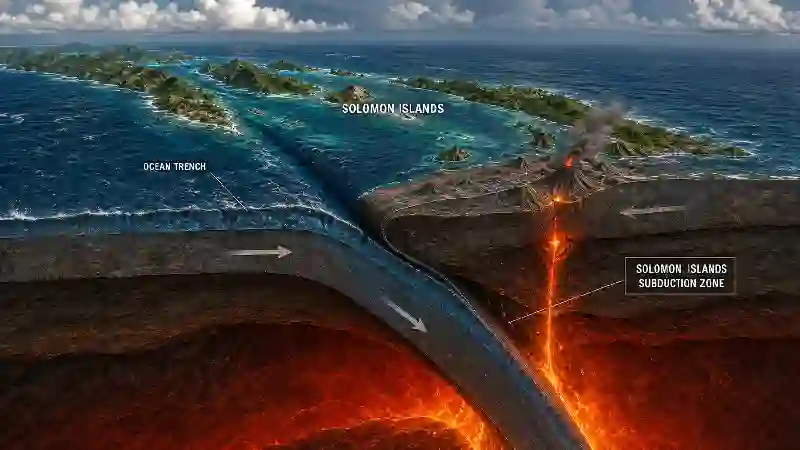
Subduction zones produce the strongest earthquakes in the Solomon Islands.
- Plates collide and one sinks beneath another
- Large earthquakes (M7–M8+) are possible
- Tsunami risk is high
Explore earthquake types
Volcanic Arc Earthquakes
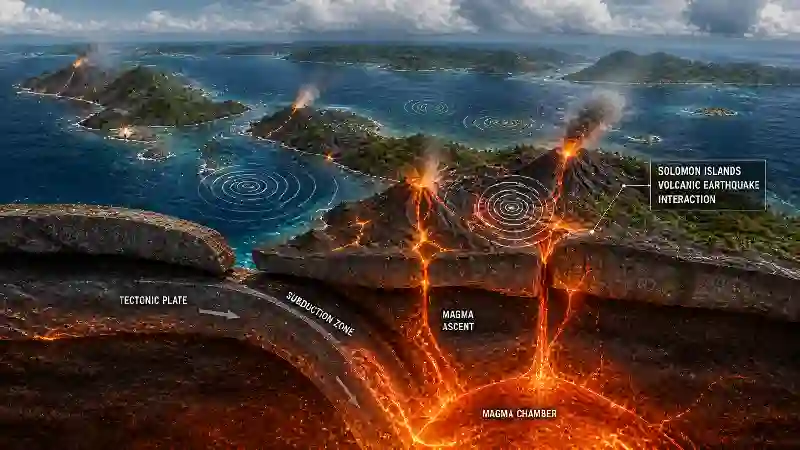
The Solomon Islands are part of a volcanic island arc.
- Magma movement creates earthquakes
- Volcanic activity is common
- Earthquake swarms often occur near volcanoes
Shallow Crustal Fault Earthquakes
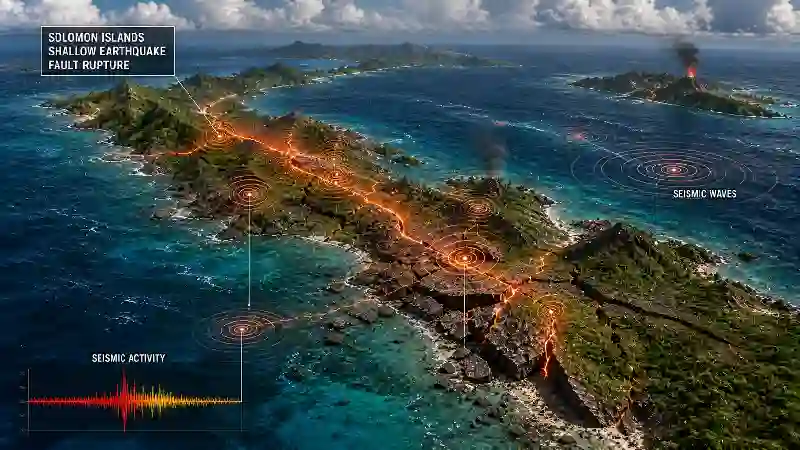
Some earthquakes occur within the crust itself.
- Shallow depth
- Strong local shaking
- Higher damage potential
These earthquakes can be especially dangerous for island communities.
Complex Plate Boundary Interaction
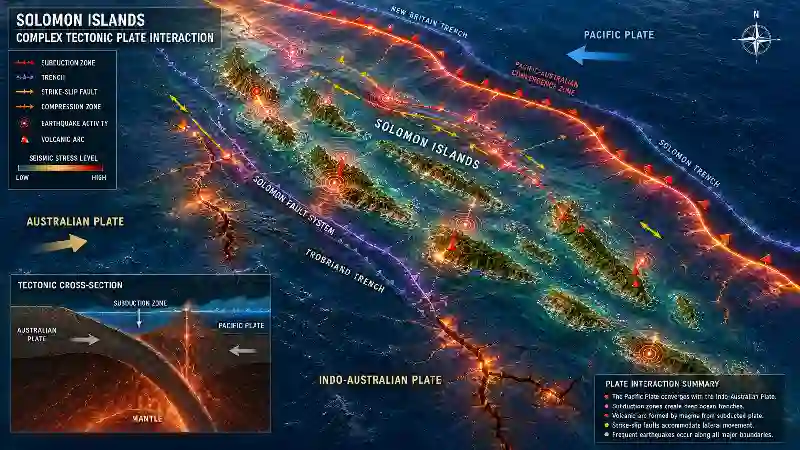
The Solomon Islands lie at a complex plate junction.
- Multiple plates interact simultaneously
- Fault systems overlap
- Earthquake patterns are unpredictable
Recent Earthquake Activity in the Solomon Islands
The Solomon Islands experience frequent seismic activity.
Recent patterns show:
- Regular strong offshore earthquakes
- Frequent earthquake swarms
- Occasional major seismic events
Many earthquakes are strong enough to be widely felt across the islands.
Notable Earthquakes in the Solomon Islands
The region has experienced several powerful earthquakes.
- 2007 Solomon Islands Earthquake (M8.1)
A major earthquake that triggered a tsunami. - 2013 Santa Cruz Earthquake (M8.0)
A powerful subduction earthquake. - Recent M7+ Earthquakes
Strong earthquakes continue to occur regularly.
Understand magnitude vs impact
Solomon Islands vs Other Earthquake Regions
The Solomon Islands are among the most active seismic regions globally.
- Solomon Islands → subduction + volcanic + complex plate interaction
- Papua New Guinea → similar tectonic complexity
- Japan → multi-plate boundary earthquakes
- California → transform faults like the San Andreas Fault
Few regions experience such frequent powerful earthquakes.
Can Earthquakes in the Solomon Islands Be Predicted?
No — earthquakes cannot be predicted precisely.
Scientists can:
- monitor seismic activity
- track tectonic movement
- observe volcanic systems
But exact timing remains uncertain.
Learn more → Can earthquakes be predicted
Because they lie on active tectonic plate boundaries.
Yes — earthquakes occur frequently, including strong ones.
Yes — especially large offshore subduction earthquakes.
Yes — many are connected to volcanic activity.
Final Thoughts
The Solomon Islands are one of the most seismically active places on Earth. With subduction zones, volcanic systems, and multiple plate interactions all working together, the region experiences powerful and frequent earthquakes.
Understanding this region helps explain how some of Earth’s strongest tectonic forces operate beneath the ocean.