
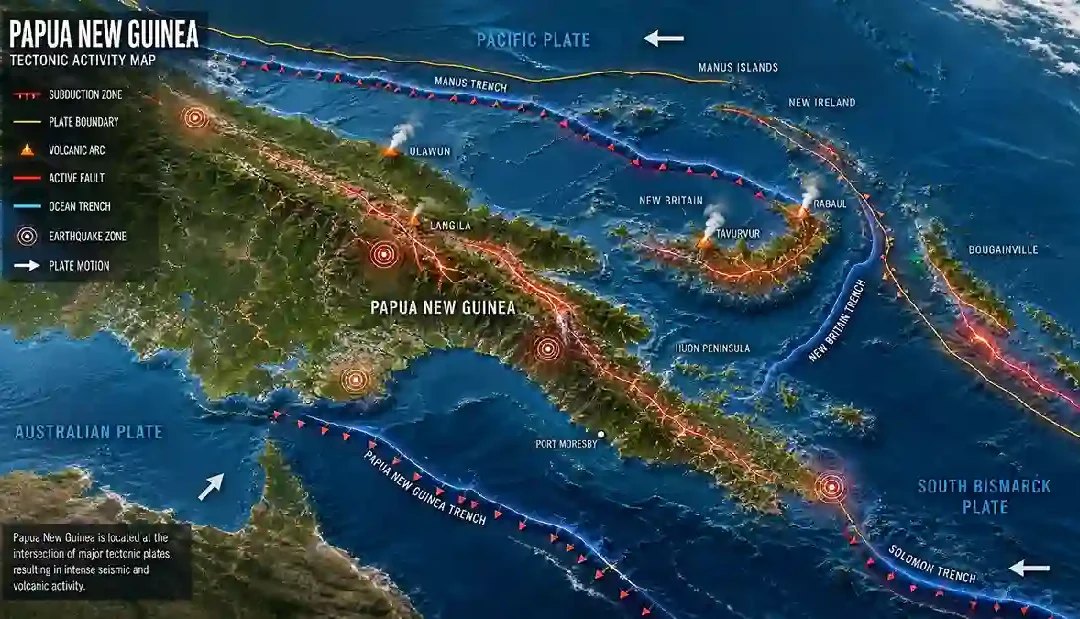
Papua New Guinea is one of the most seismically active places on Earth. The country lies directly on the Pacific Ring of Fire, where multiple tectonic plates collide, slide, and dive beneath each other.
This intense geological activity creates:
- powerful earthquakes
- frequent seismic events
- active volcanoes
- tsunami risks
In simple terms, Papua New Guinea sits on one of the most complex tectonic zones in the world.
If you’re new to earthquakes, begin here → what is an earthquake
Papua New Guinea’s Main Seismic Regions
| Region | Risk Level | Main Cause |
|---|---|---|
| Northern Coast | Extremely High | Subduction zones |
| New Guinea Highlands | Very High | Crustal deformation |
| New Britain & New Ireland | Very High | Volcanic arc activity |
| Solomon Sea Region | Extremely High | Plate interaction |
| Southern PNG | Moderate | Distributed stress |
Papua New Guinea experiences some of the strongest earthquakes in the Pacific region.
To understand how tectonic stress builds → fault lines
Why Do Earthquakes Happen in Papua New Guinea?
Papua New Guinea sits at the intersection of several tectonic plates, including parts of the Pacific Plate and surrounding smaller plates.
Here’s the simple explanation:
- Oceanic plates move and collide
- Some plates are forced beneath others (subduction)
- Fault systems accumulate enormous stress
- Earthquakes occur when that stress is released
This creates frequent and sometimes very powerful earthquakes.
Learn more → causes of earthquakes
Papua New Guinea’s Four Powerful Earthquake Systems
Subduction Zone Earthquakes (Most Powerful Events)
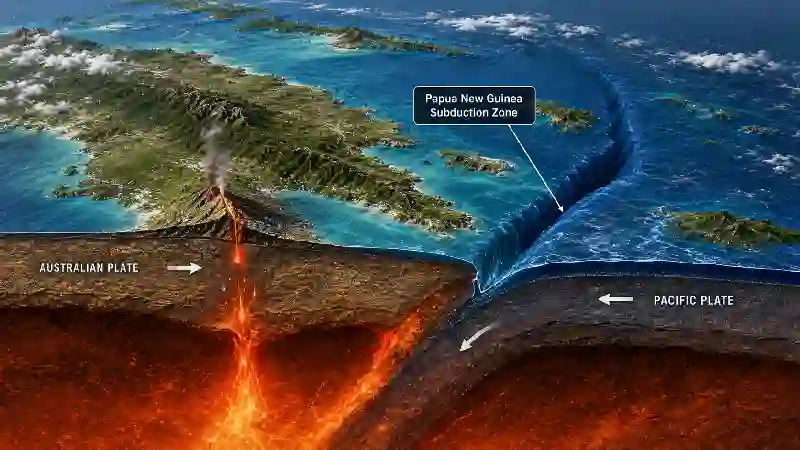
Subduction zones produce Papua New Guinea’s strongest earthquakes.
- Plates dive beneath each other
- Massive stress builds over time
- Large earthquakes (M7+) can occur
- Tsunami risk is high
Explore earthquake types
Volcanic Arc Earthquakes
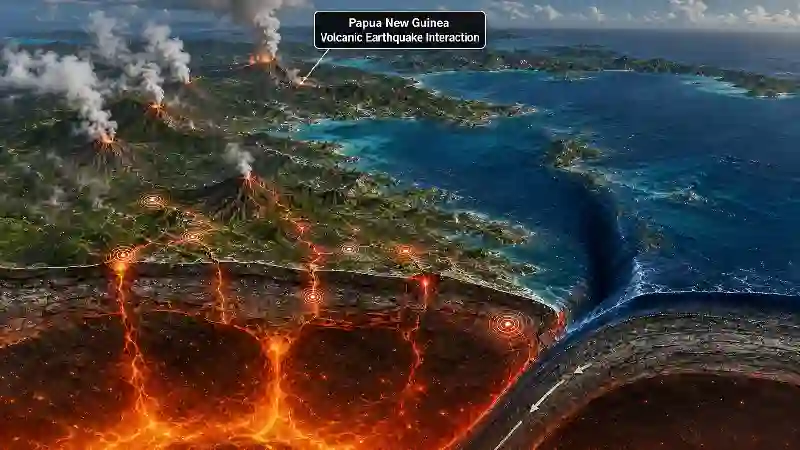
Papua New Guinea is also a highly volcanic region.
- Magma movement beneath the surface
- Frequent earthquake swarms
- Strong link between volcanoes and seismic activity
Crustal Deformation in the Highlands
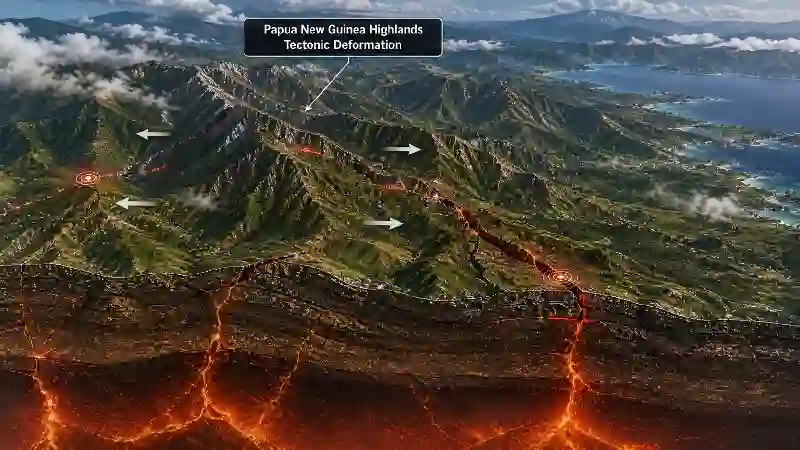
The central highlands experience intense crustal deformation.
- Mountain-building processes
- Fault systems under stress
- Moderate to strong inland earthquakes
Complex Plate Boundary Interactions
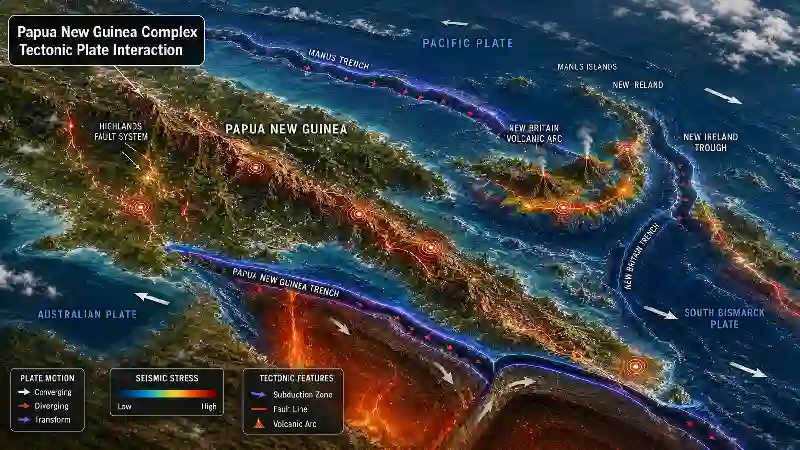
Papua New Guinea is located at a complex plate junction.
- Multiple plates interacting
- Fault systems overlap
- Earthquake behavior is highly complex
Recent Earthquake Activity in Papua New Guinea
Papua New Guinea experiences frequent seismic activity.
Recent patterns show:
- Regular strong offshore earthquakes
- Volcanic-related seismic swarms
- Inland earthquakes in mountainous regions
Many earthquakes are strong enough to be felt widely.
Notable Earthquakes in Papua New Guinea
Papua New Guinea has experienced several major earthquakes.
- 2018 PNG Earthquake (M7.5)
A powerful inland earthquake affecting the highlands. - 2000 New Ireland Earthquake (M8.0)
A major subduction earthquake. - 1998 Papua New Guinea Earthquake & Tsunami
A devastating offshore event.
Understand magnitude vs impact
Papua New Guinea vs Other Earthquake Regions
Papua New Guinea is among the most active seismic regions globally.
- Papua New Guinea → subduction + volcanic + complex plate interaction
- Indonesia → similar high seismic activity
- Japan → multi-plate boundary earthquakes
- California → transform faults like the San Andreas Fault
Few regions combine so many earthquake systems in one place.
Can Earthquakes in Papua New Guinea Be Predicted?
No — earthquakes cannot be predicted precisely.
Scientists can:
- monitor seismic activity
- track tectonic plate movement
- observe volcanic systems
But exact timing remains uncertain.
Learn more → Can earthquakes be predicted
Because it lies on multiple active tectonic plate boundaries.
Yes — earthquakes occur frequently, including strong ones.
Yes — especially from offshore subduction earthquakes.
Yes — many earthquakes are connected to volcanic activity.
Final Thoughts
Papua New Guinea is one of the most geologically dynamic places on Earth. With multiple tectonic plates interacting, active volcanoes, and deep ocean trenches nearby, the region experiences some of the world’s most powerful and complex earthquakes.
Understanding this region helps explain how Earth’s most extreme tectonic forces operate.