
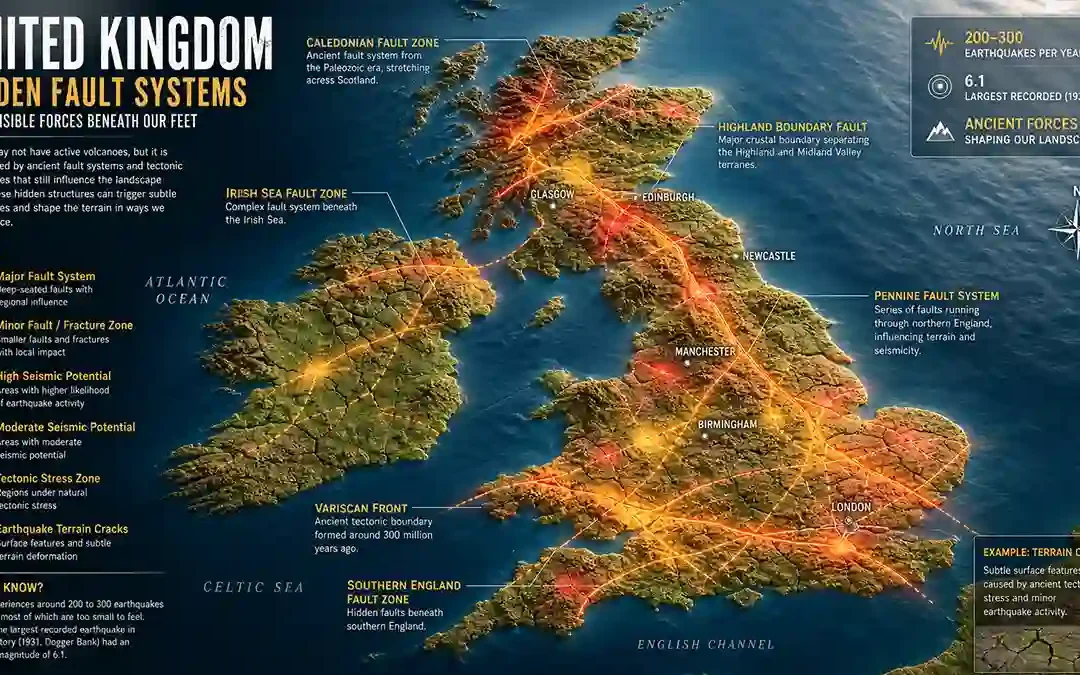
The United Kingdom is not known for major earthquakes. But the ground beneath Britain is not completely still. Every year, the UK experiences small earthquakes caused by ancient fault systems that continue to reactivate under slow tectonic pressure.
Most are minor — but some are strong enough to be felt across cities and towns.
If you’re new to earthquakes, begin here → what is an earthquake
UK Earthquake Regions (Quick Overview)
| Region | Risk Level | Main Cause |
|---|---|---|
| Western Scotland | Moderate | Ancient fault reactivation |
| Wales & Western England | Moderate | Crustal stress |
| Northern England | Low–Moderate | Hidden fault systems |
| Southern England | Low | Stable crust |
| Offshore North Sea | Moderate | Seafloor fault activity |
Most UK earthquakes are linked to older geological structures rather than active plate boundaries. To understand how tectonic stress builds → fault lines
Why Do Earthquakes Happen in the UK?
The UK lies far from major tectonic plate boundaries.
So why do earthquakes still happen?
Here’s the simplified explanation:
- Ancient faults remain deep underground
- Stress slowly spreads across the Eurasian Plate
- Old fault zones reactivate occasionally
- Small earthquakes occur when rocks suddenly shift
This is known as intraplate seismic activity.
Learn more → causes of earthquakes
The UK’s Four Main Seismic Areas
Scotland (Britain’s Most Active Region)
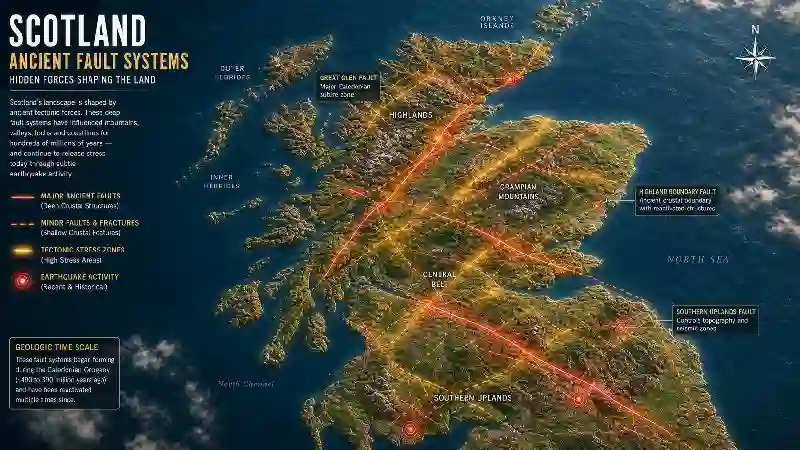
Scotland experiences some of the UK’s most noticeable earthquakes.
- Ancient faults remain active
- Small earthquakes occur regularly
- Most activity is minor but measurable
Explore earthquake types
Wales & Western Britain
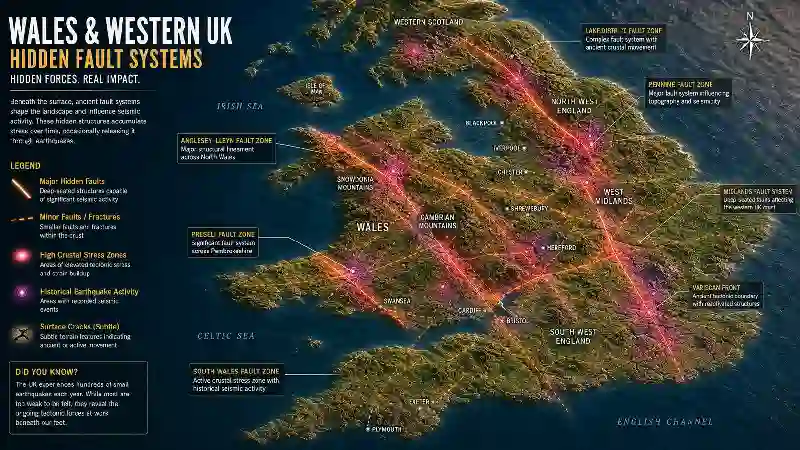
Western parts of the UK also experience occasional earthquakes.
- Fault systems beneath older rock formations
- Small shallow earthquakes
- Activity sometimes felt locally
Offshore North Sea Earthquakes
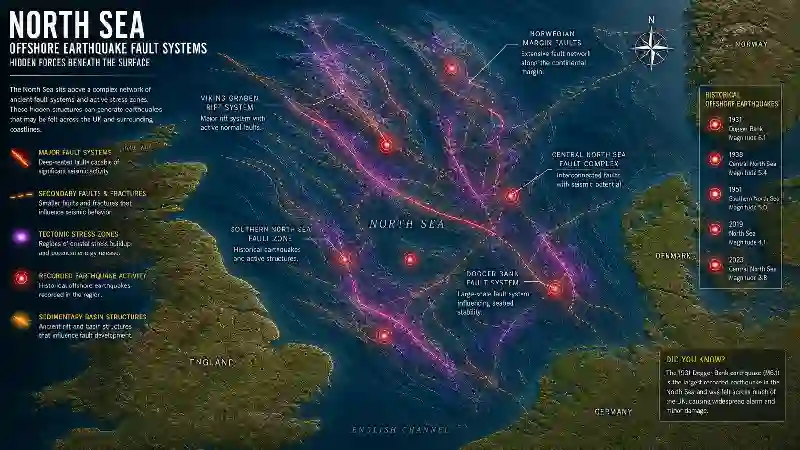
Some earthquakes occur beneath the North Sea.
- Offshore fault movement
- Small to moderate seismic activity
- Usually weak but detectable
Southern England (Low Seismic Activity)
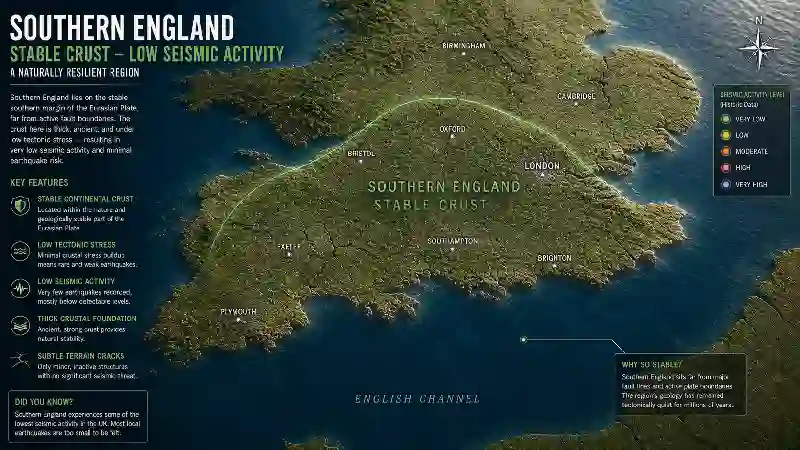
Southern England is relatively stable.
- Very low tectonic stress
- Rare earthquakes
- Mostly minor seismic events
Recent Earthquake Activity in the UK
The UK experiences hundreds of small earthquakes each year.
Recent patterns show:
- Minor earthquakes in Scotland and Wales
- Occasional offshore events
- Small shallow earthquakes felt by residents
Most earthquakes are too weak to cause damage.
Notable Earthquakes in UK History
Although uncommon, the UK has experienced stronger earthquakes in the past.
- 1931 Dogger Bank Earthquake (M6.1)
The strongest recorded earthquake affecting the UK. - 2008 Lincolnshire Earthquake (M5.2)
Felt across much of England. - 1884 Colchester Earthquake
One of England’s most damaging historical earthquakes.
Understand magnitude vs impact
UK vs Other Earthquake Regions
The UK’s earthquakes are very different from those in active tectonic zones.
- UK → ancient fault reactivation inside a stable plate
- Germany → similar intraplate seismic activity
- Iceland → tectonic spreading + volcanoes
- California → transform faults like the San Andreas Fault
UK earthquakes are usually weaker but still scientifically important.
Can Earthquakes in the UK Be Predicted?
No — earthquakes cannot be predicted precisely.
Scientists can:
- monitor seismic activity
- map ancient faults
- estimate long-term risk
But exact timing remains uncertain.
Learn more → Can earthquakes be predicted
Yes — small earthquakes occur every year.
Scotland and western Britain.
Most are minor and cause little damage.
Because ancient faults inside the Eurasian Plate still reactivate under stress.
Final Thoughts
The UK may seem geologically quiet, but ancient fault systems beneath Britain still produce occasional earthquakes. Although most are small, they provide important clues about how tectonic stress continues to affect even relatively stable regions.
Understanding UK earthquakes helps show that seismic activity is not limited to famous fault lines or major tectonic boundaries.