
Ornithischians were a diverse group of plant-eating dinosaurs that included famous animals such as Triceratops, Stegosaurus, Ankylosaurus, and Iguanodon. They lived across much of the world during the Mesozoic Era and developed an extraordinary range of body forms, from small, agile runners to heavily armored giants.
Their skulls, teeth, hips, and limbs reveal how different species adapted to feeding, movement, and survival in ancient environments. Although their name means “bird-hipped reptiles,” ornithischians were not the ancestors of modern birds. Understanding this group helps paleontologists reconstruct dinosaur diversity, evolutionary relationships, and the ecosystems that existed millions of years ago.
What Are Ornithischians?
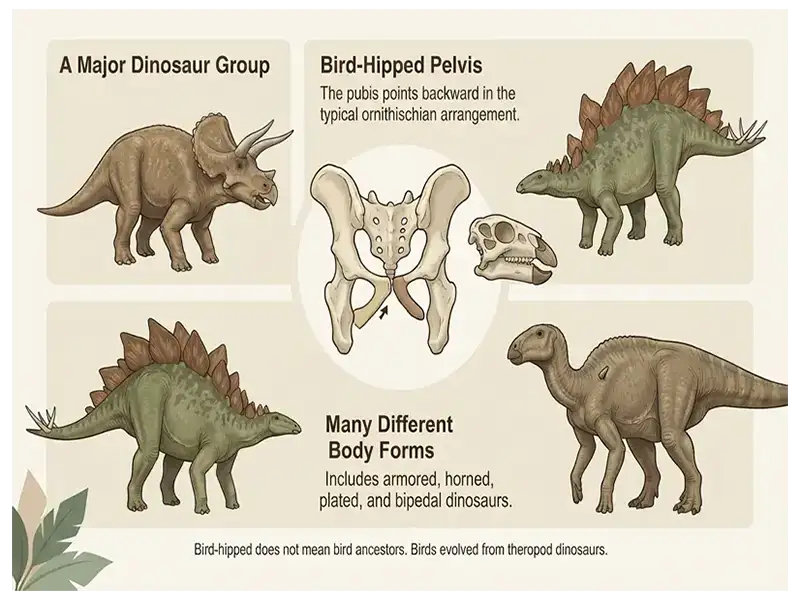
Ornithischians are a major group of dinosaurs traditionally known for their distinctive pelvic structure and predominantly herbivorous diets. Their name comes from Greek words meaning “bird-hipped,” referring to the arrangement of certain pelvic bones. This feature distinguishes them from saurischian dinosaurs, the other major traditional dinosaur group.
The group includes several familiar dinosaur lineages with very different appearances. Some developed large body crests, others carried plates or defensive armor, and some possessed elaborate horns and frills. Despite these differences, their shared evolutionary history and anatomical features allow scientists to study them as a related group.
Ornithischians first appeared during the Triassic–Jurassic transition or early Jurassic, depending on how the earliest disputed fossils are interpreted. They subsequently diversified throughout the Jurassic and Cretaceous periods. Their fossils have been discovered on every continent, including Antarctica, demonstrating their extensive geographical distribution.
The group is especially important because its members developed numerous adaptations for feeding on vegetation. Changes in tooth shape, jaw movement, skull structure, and body size enabled different species to exploit different plant resources. These adaptations helped ornithischians occupy a wide range of ecological roles.
One important distinction is that ornithischians were dinosaurs, but they were not the dinosaur lineage from which birds evolved. Modern birds descended from theropod dinosaurs within Saurischia. The similarity implied by the name “bird-hipped” describes pelvic anatomy, not direct ancestry.
What Are the Main Characteristics of Ornithischians?
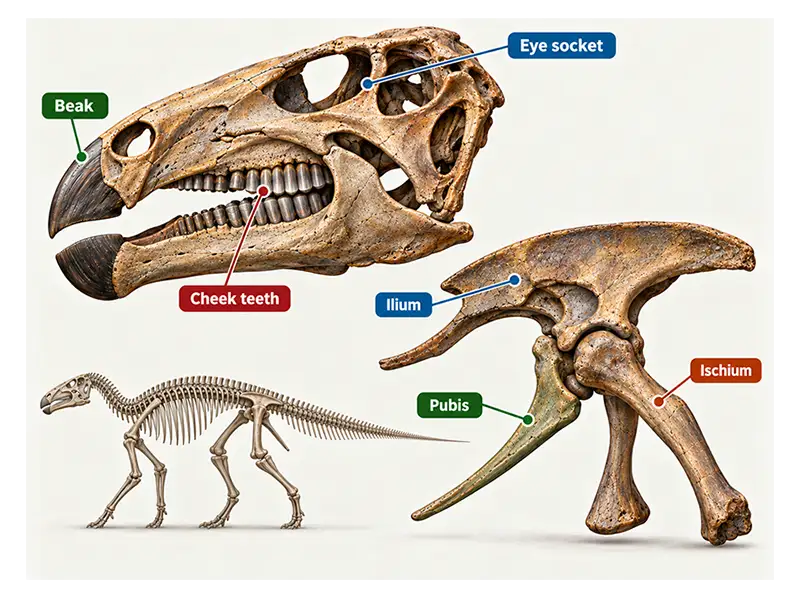
Ornithischians shared several anatomical features, although the details varied considerably between lineages. Their most useful identifying traits include pelvic structure, specialized jaws and teeth, and a range of adaptations associated with plant eating.
Distinctive pelvic structure
The defining feature behind the traditional name Ornithischia is a bird-like arrangement of the pubis, one of the bones forming the pelvis. In typical ornithischians, the pubis extends backward, broadly parallel to the ischium. This differs from the ancestral pelvic arrangement seen in many other dinosaurs.
The pelvic structure changed during evolution and should not be treated as the only feature needed to identify a fossil. Paleontologists examine several anatomical characteristics together when determining whether a dinosaur belongs to this group.
Beaks and specialized teeth
Many ornithischians possessed a keratin-covered beak at the front of the jaws. This structure helped them crop or bite vegetation. Behind the beak, many species had rows of teeth adapted to cutting, crushing, or grinding plant material.
Their teeth were not identical across the group. Some had relatively simple leaf-shaped teeth, while others developed broad grinding surfaces and complex arrangements that processed vegetation efficiently. These differences provide clues about feeding behavior and dietary specialization.
Diverse body shapes
Ornithischians ranged from small, lightly built animals to massive quadrupeds. Their body proportions reflected different ways of moving and feeding. Long hind limbs suited some species to bipedal locomotion, whereas broad bodies and sturdy limbs supported quadrupedal animals.
Other lineages evolved distinctive defensive structures, including bony plates, spikes, knobs, and horns. These features may have served several functions, such as protection, display, or species recognition, although the purpose of individual structures is not always certain.
Predominantly herbivorous biology
Most ornithischians were adapted to eating plants. Their jaws and teeth indicate that vegetation formed the principal part of their diet, but the plants consumed and the methods of processing them differed between species.
Herbivory also influenced their wider anatomy. A large digestive system could accommodate substantial quantities of plant material, while changes in posture and body proportions helped animals reach food at different heights or travel through their habitats.
These shared characteristics establish a broad anatomical foundation. However, the diversity of ornithischian bodies means that no single external feature accurately describes every member of the group.
How Are Ornithischians Classified?
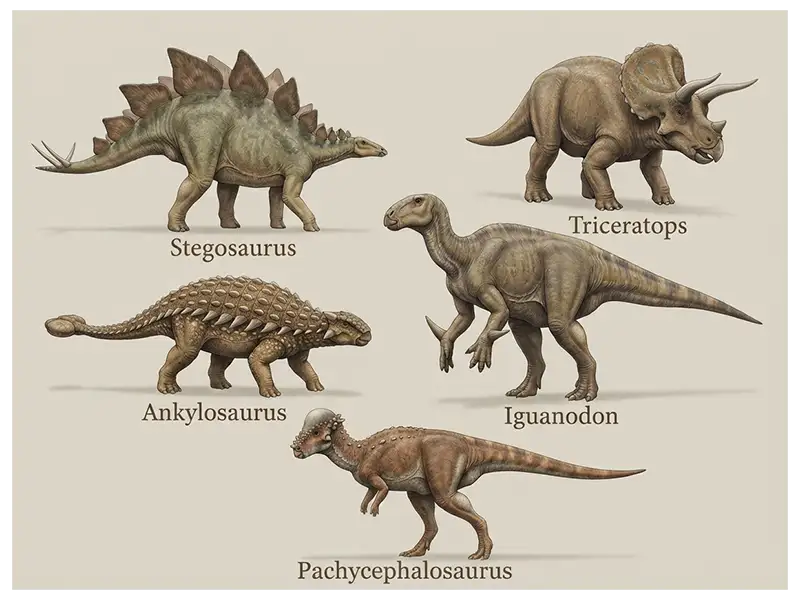
Ornithischians are classified using shared anatomical features and evidence of common ancestry. Paleontologists compare fossils from different species to determine which characteristics were inherited from shared ancestors and which evolved independently.
The traditional classification recognizes several major branches, including Thyreophora, Ornithopoda, and Marginocephalia. These groups contain many of the best-known ornithischian dinosaurs. Smaller early lineages and the precise relationships among some groups remain subjects of scientific investigation.
Thyreophora: Armored dinosaurs
Thyreophorans were characterized by bony structures embedded in or associated with the skin. Their most recognizable members include stegosaurs and ankylosaurs, which developed different forms of body armor.
Stegosaurs, such as Stegosaurus, carried rows of large plates or spikes along the back and tail. Ankylosaurs, including Ankylosaurus, generally had extensive bony armor covering parts of the body. Some ankylosaurs also possessed a heavy tail club.
These structures differed in arrangement and likely function. Their development illustrates how related dinosaurs could evolve different defensive or display adaptations.
Ornithopoda: Diverse plant-eating dinosaurs
Ornithopods included many bipedal and quadrupedal herbivores, from relatively small forms to large, highly specialized plant eaters. Familiar examples include Iguanodon and the hadrosaurs, commonly called duck-billed dinosaurs.
Their skulls and teeth became particularly well suited to processing vegetation. In many hadrosaurs, numerous tightly packed teeth formed dental batteries that continually replaced worn surfaces. This adaptation allowed them to grind tough plant material effectively.
Ornithopods occupied a wide variety of environments and became especially diverse during the Cretaceous. Their fossils are found on several continents, providing evidence of widespread evolutionary success.
Marginocephalia: Horned and thick-skulled dinosaurs
Marginocephalia traditionally includes two distinctive lineages: Pachycephalosauria and Ceratopsia.
Pachycephalosaurs, such as Pachycephalosaurus, are known for their thickened skull roofs. Scientists have proposed several possible functions for these structures, including display and combat, but the behavior of individual species remains debated.
Ceratopsians included horned dinosaurs such as Triceratops. Many developed expanded skull frills and facial horns, although early members of the lineage could be much smaller and lacked the dramatic ornamentation seen in later forms.
Other early ornithischian lineages
Early ornithischian diversity included small-bodied dinosaurs such as heterodontosaurids, which often had different tooth types within the same jaw. Some early forms combined a beaked front portion of the mouth with distinctive cheek teeth, illustrating that the group experimented with several feeding strategies early in its history.
The exact position of some early dinosaurs and the relationships among major branches have changed in published evolutionary analyses. For this reason, classification is best understood as a scientific model that is refined as new fossils and analytical methods become available.
What Did Ornithischians Eat?
Ornithischians were predominantly herbivores, but their diets varied according to body size, jaw mechanics, tooth structure, and the plants available in their habitats. Rather than feeding in one uniform way, different lineages developed specialized methods for gathering and processing vegetation.
Cropping plants with beaks
Many ornithischians had a beak at the front of the mouth. A keratinous covering formed the cutting surface, which could help remove leaves, shoots, and other plant material. The shape and size of the beak varied between species, reflecting differences in feeding habits.
Some dinosaurs likely selected relatively soft vegetation, while others could handle tougher plant parts. Fossil teeth and jaw structures help researchers infer these differences, although they do not always reveal the exact plants consumed.
Grinding and processing vegetation
In many ornithischians, the teeth behind the beak played a major role in breaking down food. Some species had leaf-shaped teeth suited to cutting vegetation. Others possessed broad, closely packed teeth that formed extensive grinding surfaces.
Hadrosaurs provide a particularly clear example. Their dental batteries contained numerous replacement teeth, allowing worn teeth to be replaced throughout life. The arrangement supported efficient processing of plant material and contributed to their success in a range of environments.
Different feeding heights and strategies
Body proportions influenced which plants an animal could reach. Long-necked or large-bodied species could potentially feed on vegetation beyond the reach of smaller dinosaurs, while compact animals may have concentrated on plants close to the ground. These patterns depended on anatomy and habitat rather than a single rule applying to every group.
Scientists reconstruct ancient diets by combining evidence from tooth wear, jaw movement, fossilized gut contents when available, and the vegetation known from the same deposits. Coprolites—fossilized feces—can sometimes provide additional evidence of consumed plant material.
Although plants formed the main diet of ornithischians, researchers should avoid assigning a precise menu to a species without supporting evidence. The fossil record often reveals how food was processed more clearly than exactly which plant species were eaten.
How Did Ornithischians Move?
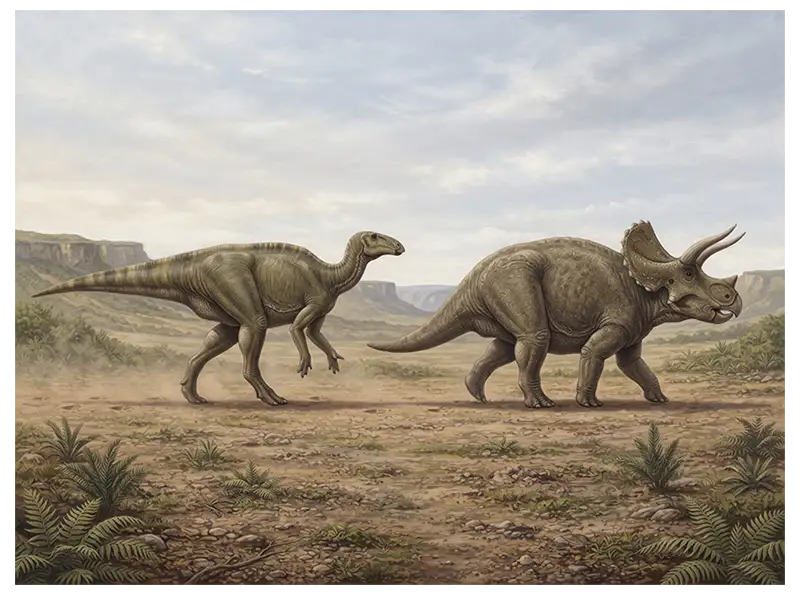
Ornithischians evolved several forms of locomotion. Some primarily walked on two hind limbs, while others moved on all four legs. Their movement patterns depended on body proportions, limb strength, body mass, and the demands of their environment.
Bipedal locomotion
Many smaller ornithischians and several ornithopod lineages were capable of moving on their hind limbs. In bipedal animals, the hind limbs supported the body and generated forward motion, while the forelimbs served different functions depending on the species.
Longer hind limbs and relatively light bodies may have helped some species move quickly. However, body proportions alone do not establish maximum speed. Scientists also examine joint structure, muscle attachment sites, trackways, and computer models to estimate locomotor ability.
Quadrupedal locomotion
Large-bodied ornithischians often relied on all four limbs for support. Ceratopsians and many armored dinosaurs had robust bodies that were supported by strong limbs. Some ornithopods also shifted toward predominantly quadrupedal movement as they became larger.
The forelimbs of quadrupedal species had to bear a substantial proportion of body weight. Their bones, joints, and limb posture provide evidence of how that load was distributed.
Trackways and movement evidence
Fossil footprints preserve information that skeletons alone cannot provide. Trackway spacing, footprint shape, and the relative positions of forefoot and hindfoot impressions can help researchers infer gait and direction of travel.
Trackways may also record groups moving through the same area, although footprints made close together do not automatically prove that the animals traveled as a social group. Interpreting behavior requires careful consideration of the geological setting and other evidence.
Armor, horns, and large body size could affect how particular dinosaurs moved, but these features did not necessarily make an animal slow. Movement estimates remain hypotheses informed by anatomy and fossil traces rather than direct observations.
Where and When Did Ornithischians Live?
Ornithischians lived during the Mesozoic Era, which extended from approximately 252 to 66 million years ago. Their history spans much of the Jurassic and Cretaceous periods, with their early origins reaching back toward the Triassic–Jurassic transition.
Their fossils have been found on every continent. This broad distribution reflects the diversification of dinosaur populations across changing landmasses and environments over millions of years.
Jurassic environments
During the Jurassic, many ornithischian lineages diversified in landscapes containing forests, floodplains, and open areas with varied vegetation. Stegosaurs became prominent in several Jurassic ecosystems, while early ornithopods and other lineages occupied different ecological roles.
The continents were arranged differently from today, and changing geography influenced the distribution of animal populations. Fossils from different regions help researchers compare how ornithischian communities developed under different environmental conditions.
Cretaceous environments
Ornithischians reached considerable diversity during the Cretaceous. Hadrosaurs, ceratopsians, ankylosaurs, and other groups occupied ecosystems in Asia, North America, Europe, South America, and other regions.
Some famous dinosaurs are known from particular geographic areas. Triceratops and many other late Cretaceous dinosaurs are associated with western North America, while diverse hadrosaurs and ceratopsians are known from Asia. These patterns reflect the fossil record and do not mean each group was necessarily restricted to a single modern continent.
Habitats and environmental change
Ornithischians lived in a variety of terrestrial environments, including floodplains, woodland settings, and regions with seasonal climates. Their specific habitat preferences differed by species and changed as climates, vegetation, and geography evolved.
Paleontologists reconstruct these environments by studying the rock layers that contain dinosaur fossils, together with fossil plants, pollen, sediment structures, and other animals. This evidence helps establish whether a dinosaur lived near rivers, in a wooded landscape, or in another ancient setting.
Fossil distribution is also influenced by preservation and discovery. A region with few known ornithischian fossils may have supported these animals in the past, even if suitable deposits have not yet been found or explored.
How Did Ornithischians Evolve?
Ornithischian evolution was a branching process in which different lineages developed new anatomical features and occupied different ecological roles. Their history is not a simple sequence in which one familiar dinosaur transformed directly into another.
The earliest stages of ornithischian evolution remain difficult to reconstruct because early dinosaur fossils are often incomplete, and the relationships among some early species are disputed. Nevertheless, the available evidence shows that ornithischians became an increasingly diverse component of terrestrial ecosystems during the Jurassic and Cretaceous periods.
Early origins and diversification
The earliest known ornithischians were generally much smaller and less heavily built than many later members of the group. Their fossils provide evidence of early adaptations in the jaws, teeth, and skeleton that distinguish ornithischians from other dinosaurs.
As lineages diversified, different groups developed specialized traits. Some evolved extensive armor, others developed more efficient dental systems, and several lineages acquired elaborate skull structures. These changes occurred at different times rather than appearing together in one ancestral species.
Evolution of feeding adaptations
The evolution of beaks, tooth replacement systems, and more complex chewing surfaces was important in the history of ornithischians. Different lineages developed different ways of gathering and processing vegetation.
In some ornithopods, increasingly complex dental arrangements improved the grinding of plant material. Ceratopsians developed distinctive beaks and, in many later forms, elaborate skulls. Armored dinosaurs followed a different evolutionary path, combining herbivorous feeding adaptations with protective body structures.
These differences suggest that ornithischian diversification involved both changes in food processing and adaptations to different ecological opportunities.
Changes in body size and defense
Body size varied considerably throughout ornithischian history. Some lineages remained relatively small, while others evolved massive bodies. Large size may have reduced vulnerability to certain predators, but it also required substantial food resources and influenced movement.
Defensive structures evolved independently in several lineages. Bony plates, spikes, armor, horns, and enlarged skull features could have contributed to defense, display, or interactions between individuals. Their exact functions must be evaluated separately because superficially similar structures do not necessarily have identical purposes.
How scientists reconstruct their ancestry
Paleontologists compare anatomical features across fossils and construct evolutionary trees, known as phylogenies. These trees represent hypotheses about common ancestry and the order in which evolutionary changes occurred.
New fossil discoveries can alter these relationships, especially when early species are represented by only a few bones. Researchers also use geological ages and anatomical comparisons to test whether a proposed evolutionary sequence is consistent with the fossil record. The result is a continually refined understanding of ornithischian history rather than a fixed family tree that can never change.
What Are the Most Famous Ornithischian Dinosaurs?
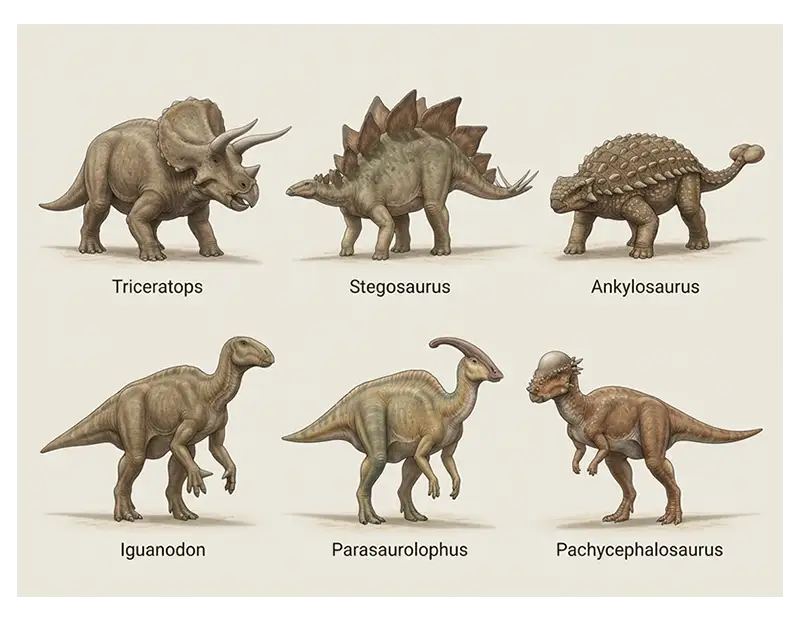
Several ornithischians are especially well known because of their distinctive anatomy, abundant fossils, or importance in popular accounts of dinosaur life. They represent different branches of the group and illustrate its remarkable variety.
1. Triceratops
Late Cretaceous: Ceratopsia
Triceratops was a large, four-legged herbivore recognized by its three prominent facial horns and broad bony frill. Its powerful skull made it one of the most distinctive ceratopsians. Fossils from western North America provide extensive evidence of its anatomy and growth.
2. Stegosaurus
Late Jurassic: Thyreophora
This large herbivore carried two rows of plates along its back and sharp spikes at the end of its tail. The exact roles of its plates remain debated, with display and thermoregulatory functions among the hypotheses studied by researchers.
3. Ankylosaurus
Late Cretaceous : Thyreophora
Ankylosaurus had extensive body armor, a broad body, and a large bony tail club. Its low profile and protective structures distinguish it from the plated stegosaurs, even though both belonged to the broader armored-dinosaur lineage.
4. Iguanodon
Early Cretaceous: Ornithopoda
Iguanodon was a large herbivore known for its distinctive thumb spikes and strong jaws. Its fossils played an important role in the early scientific recognition of dinosaurs, and its anatomy helps illustrate the diversity of iguanodontian ornithopods.
5. Parasaurolophus
Late Cretaceous: Hadrosauridae
This duck-billed dinosaur had a long, backward-curving crest extending from its skull. The crest's internal passages have been studied as possible sound-producing structures, and communication is one important hypothesis for its function.
6. Pachycephalosaurus
Late Cretaceous: Pachycephalosauria
Pachycephalosaurus is famous for its thick, domed skull roof. The structure has inspired hypotheses about display and physical competition, although the extent to which individuals used their heads in forceful combat remains uncertain.
These examples are not a complete list of ornithischian diversity. Many other genera reveal different combinations of size, feeding adaptations, defensive structures, and geographic distribution. Each should be understood within its own evolutionary context rather than treated as a representative of every ornithischian.
What Do Ornithischian Fossils Reveal?
Fossils preserve evidence of ornithischian anatomy, development, movement, and interactions with ancient environments. By combining different types of evidence, paleontologists can reconstruct aspects of dinosaur biology that are not visible from a single skeleton.
Bones and skulls
Fossil skeletons provide information about body proportions, posture, muscle attachment sites, and the arrangement of joints. Skull fossils are particularly valuable because they preserve beaks, teeth, horns, crests, and other structures associated with feeding or display.
Comparisons between juvenile and adult specimens can reveal how a dinosaur changed during growth. Differences in bone texture, proportions, and the development of skull structures may indicate changes in maturity, although age estimates require careful interpretation.
Teeth and feeding evidence
Teeth preserve wear patterns that can help researchers infer how an animal processed food. Microscopic scratches and other surface features may indicate repeated contact with particular types of vegetation or abrasive particles.
Occasionally, fossilized stomach contents or coprolites provide more direct evidence of diet. Such finds are uncommon, however, and the absence of preserved food does not mean scientists cannot investigate feeding habits through other anatomical evidence.
Footprints and trackways
Trackways record the movement of dinosaurs across ancient sediment. They may reveal walking direction, approximate stride length, and whether an animal was moving on two legs or four.
Some trackways contain several sets of footprints close together. These can prompt hypotheses about group movement, but researchers must consider whether the tracks were made at the same time and whether the animals actually traveled together.
Eggs, nests, and juvenile remains
Eggs and nesting sites provide evidence of reproduction, while juvenile skeletons help researchers understand growth and development. In some dinosaur groups, fossil nests and clusters of young animals have been used to investigate whether adults stayed near their offspring.
Such interpretations vary in strength. A nest containing several eggs does not, by itself, prove parental care, and young animals found together may have gathered for several possible reasons.
Geological context
The rock surrounding a fossil is often as important as the fossil itself. Sediment type, associated plants, other animal remains, and the age of the rock help scientists reconstruct the environment in which the dinosaur lived.
By combining anatomy with geological evidence, researchers can distinguish observations directly supported by fossils from interpretations that remain tentative. This approach makes dinosaur reconstructions more reliable and allows new discoveries to refine earlier conclusions.
How Did Ornithischians Reproduce and Raise Their Young?
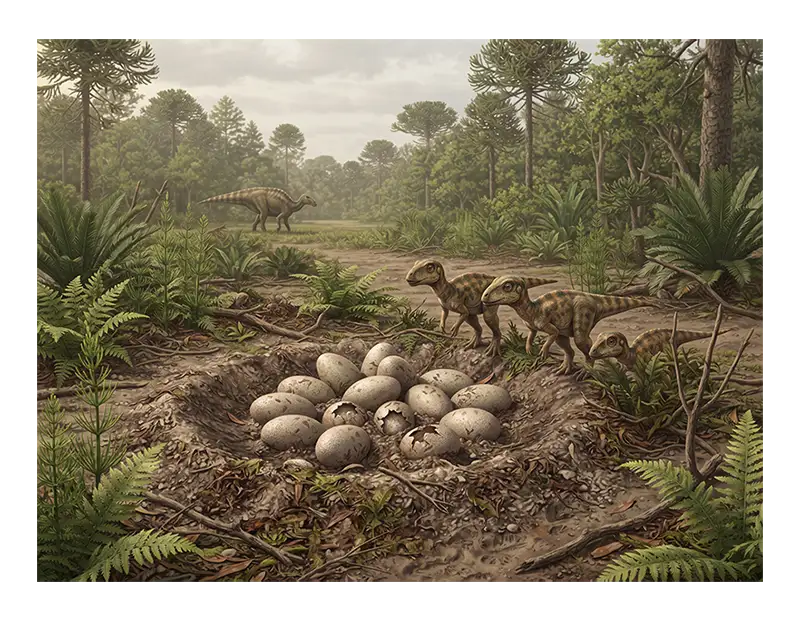
Like other dinosaurs, ornithischians reproduced by laying eggs. Fossil eggs, nests, embryos, and juvenile skeletons provide evidence of their reproductive biology, although the details are better understood for some groups than for others.
Eggs and nesting sites
Fossilized eggs preserve information about eggshell structure, shape, and, in favorable cases, the position of embryos. Their arrangement in a nest can help researchers investigate how eggs were laid and whether a nest was constructed in a particular pattern.
However, eggs are not always easy to assign to a specific dinosaur species. Egg classification may be based on shell structure and other characteristics, and the animal that laid an egg is not necessarily identifiable from the egg alone.
Growth and development
Juvenile fossils show that ornithischians changed substantially as they matured. Their limb proportions, skulls, teeth, and defensive structures could develop at different rates. In some species, features that are highly distinctive in adults were less developed in young individuals.
Bone histology—the study of microscopic bone structure—can provide information about growth patterns. Researchers may examine growth marks and tissue organization to estimate changes in growth rate, although these methods do not always yield a precise age for an individual.
Parental care and social behavior
Some dinosaur fossil sites preserve nests, eggs, and young animals in arrangements that suggest possible parental care. Evidence from other dinosaur groups can also help scientists formulate hypotheses about the range of reproductive behaviors that may have existed among dinosaurs.
For ornithischians, the evidence is not equally strong across all lineages. A particular nesting site may support an interpretation of adult attendance or repeated nesting activity, but it should not be taken as proof that every ornithischian cared for its young in the same way.
The most reliable conclusions come from multiple lines of evidence, including nest structure, juvenile remains, adult fossils, and the geological setting.
What Role Did Ornithischians Play in Ancient Ecosystems?
Ornithischians were important herbivores in many Mesozoic ecosystems. By consuming vegetation and serving as prey for predators, they formed part of the ecological networks that supported diverse communities of terrestrial animals.
Influencing vegetation
Large plant-eating dinosaurs could remove substantial quantities of vegetation. Their feeding may have affected which plants were consumed, how vegetation regenerated, and how plant communities were structured. The effects would have depended on the species present, their population sizes, and local environmental conditions.
Smaller herbivores likely used different food resources from larger animals, while differences in body size and feeding anatomy may have reduced competition among some species. Such ecological separation is plausible in many communities, but the exact relationships must be reconstructed from fossil evidence.
Supporting food webs
Ornithischians provided potential food for carnivorous dinosaurs and other predators. Their eggs and young animals may also have been vulnerable to a range of predators and scavengers.
Fossil evidence such as tooth marks on bones can reveal interactions between animals, though it may be difficult to determine whether a bite occurred during hunting or after death. Predator-prey relationships are therefore reconstructed by combining several kinds of evidence rather than relying on body size alone.
Contributing to nutrient cycling
As herbivores consumed plants and moved through their habitats, they would have redistributed nutrients through waste and the breakdown of organic material after death. These processes are fundamental to ecosystems, although the precise contribution of individual ornithischian species is difficult to quantify from fossils.
Their abundance and diversity also provide a way to study environmental change. Shifts in the types of herbivorous dinosaurs preserved in successive rock layers may reflect changes in climate, vegetation, geography, or other ecological conditions.
Ornithischians were therefore more than a collection of unusual prehistoric animals. They were active components of Mesozoic ecosystems, and their fossils help scientists investigate how ancient food webs and habitats functioned.
Why Did Non-Avian Ornithischians Become Extinct?
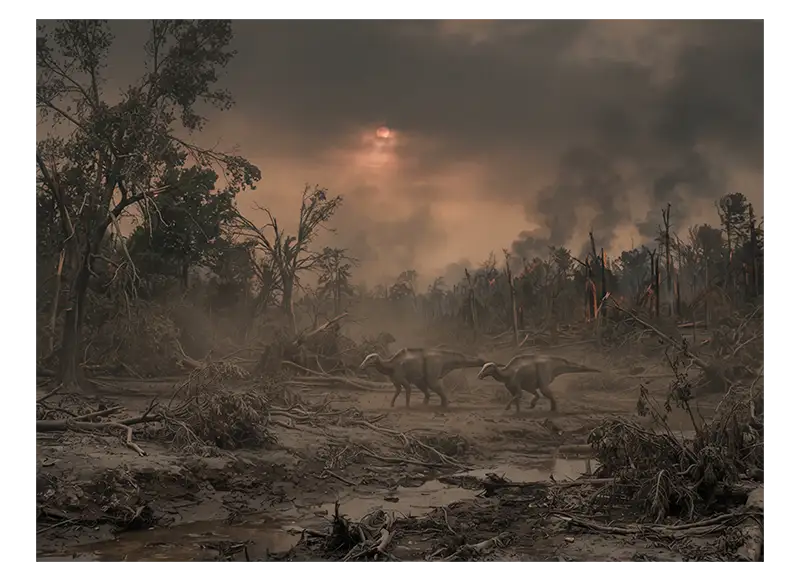
Non-avian ornithischians disappeared during the end-Cretaceous mass extinction approximately 66 million years ago. This event eliminated all known non-avian dinosaurs, along with many other groups of organisms, and marked the end of the Mesozoic Era.
The leading explanation for this extinction is the impact of a large asteroid near the present-day Yucatán Peninsula in Mexico. The resulting environmental disruption affected ecosystems around the world and caused the collapse of many food sources.
The Chicxulub impact
The Chicxulub impact released enormous energy and ejected material into the atmosphere. Dust, soot, and aerosols reduced the amount of sunlight reaching Earth's surface, while fires and other environmental disturbances contributed to the crisis.
Reduced sunlight disrupted photosynthesis, affecting plants and other primary producers. These changes had consequences throughout food webs, including for large herbivores that depended on vegetation.
Because ornithischians relied predominantly on plant material, disruptions to terrestrial food supplies would have placed severe pressure on their populations. The precise effects varied across habitats and species, and the fossil record does not preserve every stage of the extinction equally well.
Environmental consequences
The impact was followed by major changes in climate and ecosystems. Many organisms could not survive the rapid disruption, and numerous terrestrial and marine lineages disappeared.
Non-avian ornithischians did not survive this event. Their extinction was part of a broader biological crisis rather than the result of one anatomical limitation shared by every member of the group.
Did any dinosaurs survive?
Yes. Birds survived the end-Cretaceous extinction and are the living descendants of theropod dinosaurs. They belong to the saurischian lineage, not Ornithischia.
This distinction is important because the phrase “all dinosaurs went extinct” is scientifically incomplete. All known non-avian dinosaurs disappeared, but avian dinosaurs survived and subsequently diversified.
Conclusion
Ornithischians were one of the major branches of dinosaur diversity, encompassing an extraordinary range of herbivorous animals. Their specialized teeth, varied locomotion, defensive structures, and distinctive skulls demonstrate how different lineages adapted to life in Mesozoic environments. Fossils of stegosaurs, ornithopods, ceratopsians, and other groups provide evidence of their evolutionary relationships and ecological roles.
Although all known non-avian ornithischians disappeared during the end-Cretaceous mass extinction, their remains continue to help paleontologists understand dinosaur biology and the development of ancient ecosystems. Studying Ornithischia therefore offers a broader view of how dinosaurs diversified, interacted with their environments, and responded to major changes in Earth's history.
Ornithischia means “bird-hipped,” referring to the characteristic backward orientation of the pubis in the traditional ornithischian pelvic arrangement. The name describes anatomy rather than ancestry.
Well-known examples include Triceratops, Stegosaurus, Ankylosaurus, Iguanodon, and Parasaurolophus. They represent different branches of Ornithischia.
Ornithischians were predominantly herbivorous, and their teeth and jaws show adaptations for consuming plant material. Claims about unusual or non-plant diets should be supported by specific fossil evidence rather than generalized across the group.
No. Modern birds evolved from theropod dinosaurs within Saurischia. Ornithischians and bird ancestors were both dinosaurs, but they belonged to different evolutionary lineages.
Their history extended from the early part of the Mesozoic dinosaur radiation through the end of the Cretaceous. The earliest origins remain uncertain because the identity and relationships of some early fossils are debated.