
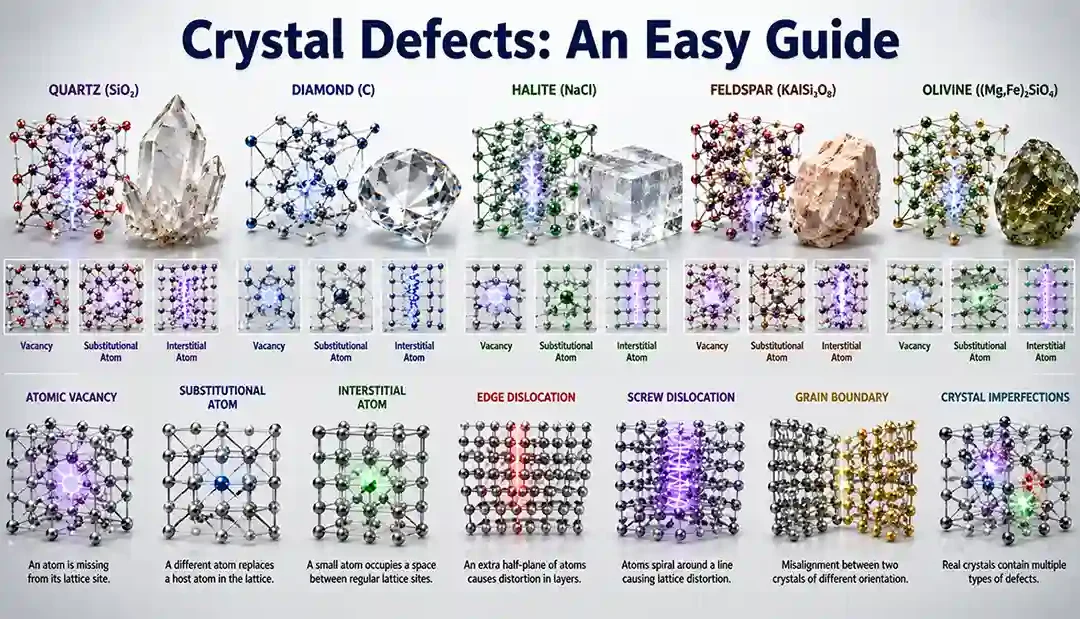
Although minerals are often described as perfectly ordered crystals, no natural crystal is completely flawless. Nearly all minerals contain crystal defects, which are irregularities or imperfections in the otherwise orderly arrangement of atoms within a crystal lattice. These defects may involve missing atoms, extra atoms, displaced atoms, dislocations, grain boundaries, or tiny inclusions.
Crystal defects develop naturally during crystal growth, cooling, deformation, metamorphism, weathering, and radiation exposure. While they may appear insignificant at the atomic scale, they strongly influence a mineral's hardness, color, electrical conductivity, magnetic behavior, diffusion, strength, and chemical stability.
Understanding crystal defects is fundamental to mineralogy, crystallography, crystal chemistry, materials science, petrology, and geochemistry.
This topic should be studied together with Crystal Chemistry Explained, Atomic Structure of Minerals Explained, Crystal Structure of Minerals, and Mineral Solid Solutions Explained.
What Are Crystal Defects?
Crystal defects are imperfections in the regular arrangement of atoms or ions within a crystal.
These imperfections may involve:
- Missing atoms
- Extra atoms
- Misplaced atoms
- Crystal dislocations
- Grain boundaries
- Internal fractures
Even high-quality natural crystals contain millions of microscopic defects.
Why Do Crystal Defects Form?
Crystal defects develop because crystals rarely grow under perfectly stable conditions.
Common causes include:
- Rapid crystal growth
- Cooling of magma
- High pressure
- Deformation
- Metamorphism
- Radiation damage
- Chemical substitution
- Mechanical stress
Natural geological processes continuously create and modify crystal defects.
Importance of Crystal Defects
Crystal defects influence many mineral properties, including:
- Hardness
- Cleavage
- Color
- Density
- Electrical conductivity
- Magnetism
- Diffusion
- Chemical reactivity
Many valuable gemstones owe their colors to crystal defects and trace-element substitutions.
Types of Crystal Defects
Point Defects
Point defects involve one or a few atomic positions.
Common examples include:
Vacancy
A normal atomic position is empty because an atom is missing.
Interstitial Defect
An extra atom occupies a space between normal lattice positions.
Substitutional Defect
One atom replaces another.
Example:
Iron replacing magnesium in olivine.
This process is closely related to mineral solid solutions.
Line Defects (Dislocations)
Line defects occur along rows of atoms.
Major types include:
- Edge dislocation
- Screw dislocation
Dislocations strongly influence crystal deformation.
Surface Defects
Surface defects occur where crystal orientation changes.
Examples:
- Grain boundaries
- Twin boundaries
- Crystal surfaces
These affect crystal growth and strength.
Volume Defects
Volume defects involve larger regions.
Examples include:
- Fluid inclusions
- Mineral inclusions
- Microfractures
- Cavities
These are common in natural minerals.
Point Defects in Minerals
Point defects are the most common crystal imperfections.
They influence:
- Diffusion
- Ionic mobility
- Color
- Electrical conductivity
Many point defects form during crystal growth.
Dislocations
Dislocations allow crystals to deform without breaking immediately.
They are important during:
- Mountain building
- Metamorphism
- Fault movement
- Plastic deformation
Most naturally deformed minerals contain abundant dislocations.
Crystal Defects in Common Minerals
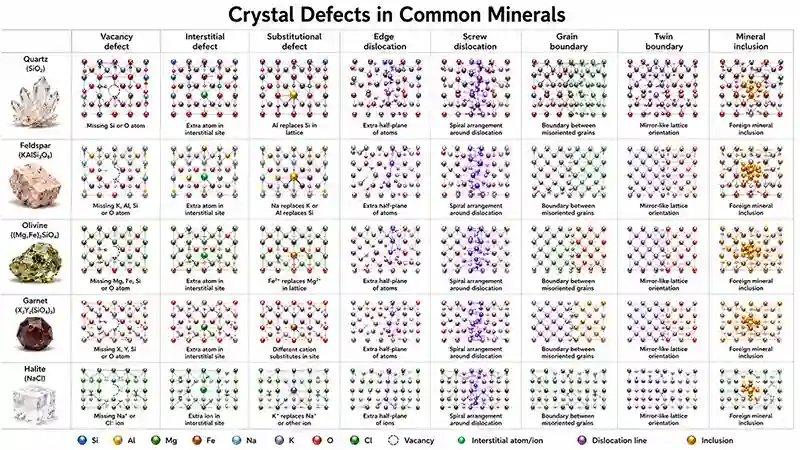
Quartz
Common defects include:
- Aluminum substitution
- Fluid inclusions
- Radiation defects
These contribute to the colors of smoky quartz and amethyst.
Feldspar
Frequently contains:
- Twinning
- Sodium-potassium substitution
- Dislocations
Olivine
Often develops:
- Iron-magnesium substitution
- Crystal dislocations
- Deformation features
Garnet
May contain:
- Growth zoning
- Trace-element substitutions
- Mineral inclusions
Diamond
Defects involving nitrogen and boron influence color and electrical properties.
Halite
Vacancies and ionic substitutions commonly occur during crystal growth.
Calcite
Calcite commonly contains:
- Magnesium substitution
- Twinning
- Deformation lamellae
Magnetite
Iron vacancies and mixed oxidation states influence magnetic behavior.
Effects of Crystal Defects
Crystal defects affect numerous mineral properties.
| Property | Influence of Crystal Defects |
|---|---|
| Color | Trace elements and vacancies |
| Hardness | Dislocations |
| Conductivity | Ionic movement |
| Magnetism | Iron defects |
| Diffusion | Vacancy migration |
| Strength | Grain boundaries |
Even tiny defects can produce significant changes.
Crystal Defects and Gemstones
Many gemstone colors result from crystal defects.
Examples include:
- Amethyst
- Smoky Quartz
- Blue Diamond
- Ruby
- Sapphire
Color centers often develop through radiation or trace-element substitution.
Geological Importance
Crystal defects help geologists:
- Study mineral growth
- Interpret metamorphism
- Understand deformation
- Investigate diffusion
- Analyze crystal stability
- Reconstruct geological history
They provide important information about mineral formation and evolution.
Laboratory Investigation
Crystal defects are investigated using:
- Transmission Electron Microscopy (TEM)
- Scanning Electron Microscopy (SEM)
- X-Ray Diffraction (XRD)
- Electron Microprobe Analysis (EPMA)
- Raman Spectroscopy
- Cathodoluminescence Microscopy
- Electron Backscatter Diffraction (EBSD)
These techniques reveal defects at microscopic and atomic scales.
Applications
Crystal defect studies are important in:
- Mineralogy
- Crystallography
- Crystal Chemistry
- Materials Science
- Petrology
- Geochemistry
- Engineering Geology
- Gemology
Advantages of Studying Crystal Defects
Studying crystal defects helps scientists:
- Explain mineral properties
- Understand deformation
- Predict diffusion behavior
- Improve gemstone analysis
- Develop advanced materials
- Interpret geological processes
Limitations
Studying crystal defects presents several challenges:
- Most defects are too small to observe with optical microscopes.
- Different defect types may produce similar effects on mineral properties.
- High-resolution instruments are required to identify many atomic-scale defects.
- Geological processes may overprint or modify earlier defects over time.
For comprehensive understanding, combine this topic with:
- Crystal Chemistry Explained
- Atomic Structure of Minerals Explained
- Crystal Structure of Minerals
- Mineral Solid Solutions Explained
- Mineral Polymorphism Explained
- X-Ray Diffraction in Mineralogy
- Electron Microprobe Analysis
- Optical Mineralogy Explained
Comparison Table
| Crystal Defect | Description | Common Example |
| Vacancy | Missing atom | Halite |
| Interstitial | Extra atom between lattice sites | Quartz |
| Substitutional | One atom replaces another | Olivine |
| Edge Dislocation | Extra atomic plane | Quartz |
| Screw Dislocation | Spiral lattice distortion | Feldspar |
| Grain Boundary | Boundary between crystals | Granite |
Summary Table
| Feature | Crystal Defects |
| Definition | Imperfections in Crystal Lattices |
| Main Types | Point, Line, Surface, Volume |
| Major Causes | Crystal Growth, Deformation, Cooling, Radiation |
| Common Study Methods | TEM, SEM, XRD, EBSD, EPMA |
| Geological Importance | Mineral Properties and Crystal Evolution |
Crystal defects are imperfections in the regular arrangement of atoms or ions within a crystal lattice. They include vacancies, substitutions, dislocations, grain boundaries, and inclusions.
Crystal defects develop during crystal growth, cooling, deformation, metamorphism, radiation exposure, and chemical substitution because natural crystals rarely form under perfectly stable conditions.
The four main categories are point defects, line defects (dislocations), surface defects, and volume defects.
They influence color, hardness, electrical conductivity, magnetic properties, deformation, diffusion, chemical stability, and crystal growth.
Geologists investigate crystal defects using transmission electron microscopy (TEM), scanning electron microscopy (SEM), X-ray diffraction (XRD), electron microprobe analysis (EPMA), Raman spectroscopy, cathodoluminescence microscopy, and electron backscatter diffraction (EBSD).
Final Thoughts
Crystal defects are a natural part of every mineral crystal and play a critical role in determining how minerals behave. From atomic vacancies and ionic substitutions to dislocations and grain boundaries, these microscopic imperfections influence physical properties, deformation, chemical reactions, and even the colors of gemstones. Far from being flaws, crystal defects provide valuable clues about crystal growth, geological history, and the environments in which minerals formed.
By combining crystallography, crystal chemistry, mineralogy, and advanced analytical techniques, geologists can investigate crystal defects to better understand mineral evolution, metamorphism, deformation, and resource formation. Crystal defects remain a key concept in mineralogy, materials science, petrology, and geochemistry.
Continue Learning
Continue exploring mineral structures with these related guides: