
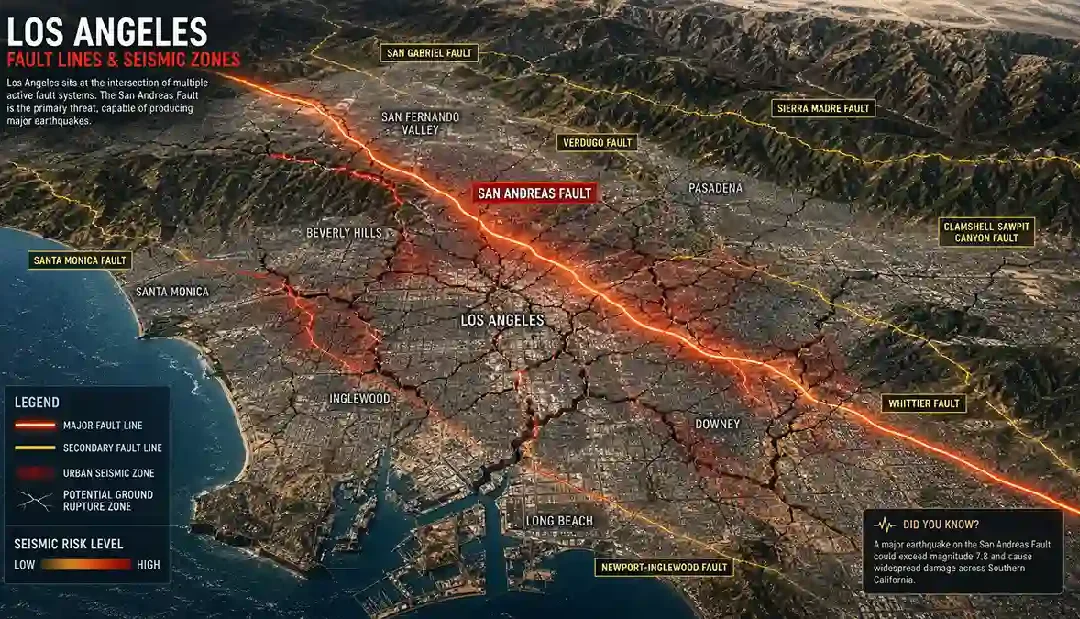
Los Angeles is one of the most earthquake-prone cities in the United States. The reason is simple, it sits on a network of active fault lines, including the famous San Andreas Fault.
Unlike regions where plates collide or separate, Los Angeles experiences earthquakes because tectonic plates slide past each other. This creates constant stress beneath the ground — and occasional sudden movement.
If you’re new to earthquakes, begin here → what is an earthquake
Los Angeles Seismic Zones
| Zone | Risk Level | Main Cause |
|---|---|---|
| San Andreas Fault | Extremely High | Plate sliding (transform fault) |
| San Jacinto Fault | Very High | Active fault movement |
| Newport–Inglewood Fault | High | Urban fault zone |
| Hollywood Fault | Moderate–High | Local crustal stress |
| Offshore Fault Systems | High | Coastal seismic activity |
Los Angeles sits in one of the most complex fault systems in the world. To understand how faults work → fault lines
Why Do Earthquakes Happen in Los Angeles?
Los Angeles lies along a transform plate boundary between two major tectonic plates.
Here’s the simple explanation:
- The Pacific Plate moves northwest
- The North American Plate moves southeast
- The plates grind past each other
- Stress builds along faults
- Earthquakes occur when the plates suddenly slip
This type of movement is known as a strike-slip (transform) fault system.
Learn more → causes of earthquakes
Four Major Earthquake Systems in Los Angeles
San Andreas Fault (The Main Threat)
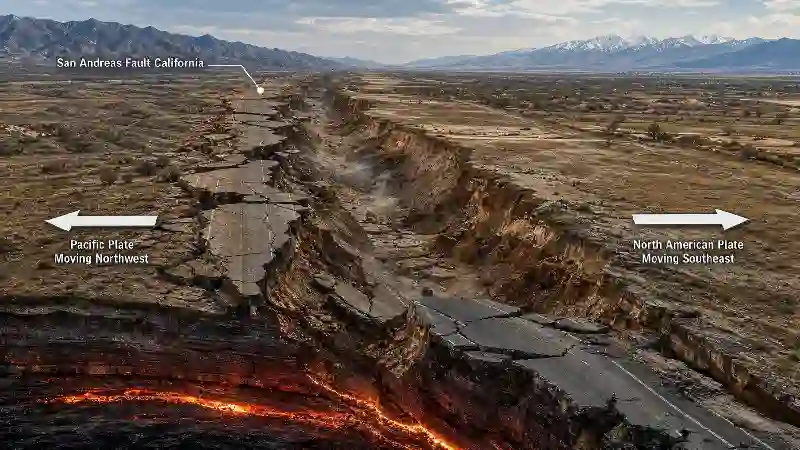
The San Andreas Fault is the most important fault affecting Los Angeles.
- A major plate boundary
- Capable of very large earthquakes (M7+)
- Builds stress over long periods
Explore earthquake types
San Jacinto Fault (Highly Active System)
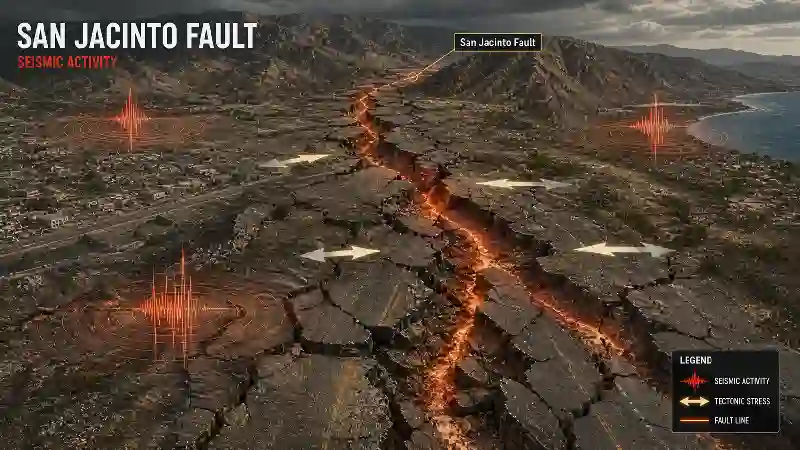
The San Jacinto Fault is one of the most active faults in Southern California.
- Frequent smaller earthquakes
- Rapid stress accumulation
- Considered a major seismic threat
Urban Faults (Hidden Beneath the City)
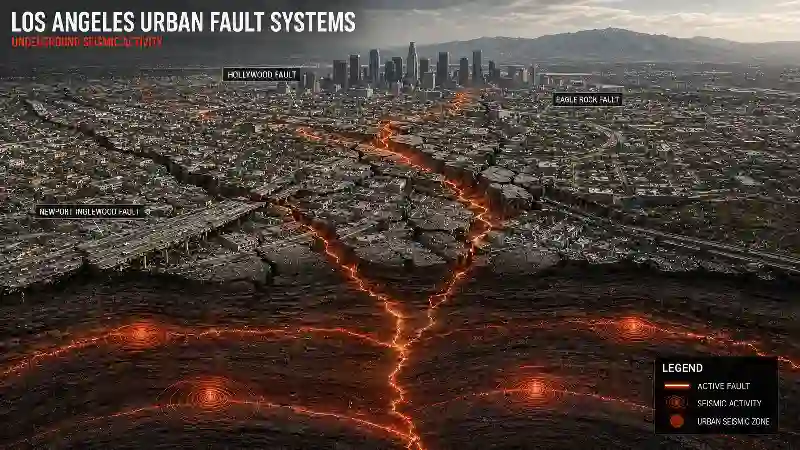
Los Angeles has several faults running directly beneath urban areas.
- Newport–Inglewood Fault
- Hollywood Fault
- Other hidden structures
These faults can produce strong local shaking.
Offshore Fault Systems
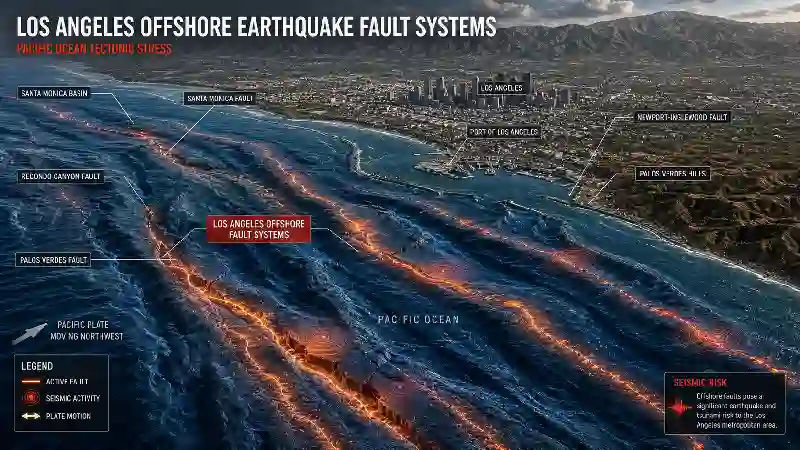
Some earthquakes occur offshore near Los Angeles.
- Coastal fault systems
- Possible tsunami risk (rare but possible)
- Linked to broader tectonic movement
Recent Earthquake Activity in Los Angeles
Los Angeles experiences earthquakes regularly.
Recent patterns show:
- Frequent small earthquakes across Southern California
- Occasional moderate earthquakes
- Continuous tectonic stress buildup
Most earthquakes are small, but larger ones are expected over time.
Notable Earthquakes in Los Angeles
Los Angeles has experienced several major earthquakes.
- 1994 Northridge Earthquake (M6.7)
A powerful urban earthquake causing major damage. - 1971 San Fernando Earthquake (M6.6)
Significant structural impact across LA. - 1857 Fort Tejon Earthquake (M7.9)
One of California’s largest earthquakes.
Understand magnitude vs impact
Los Angeles vs Other Earthquake Regions
Los Angeles is different from many global earthquake zones.
- Los Angeles → transform fault (sliding plates)
- Japan → subduction zone earthquakes
- Chile → plate collision earthquakes
- Iceland → tectonic spreading
LA’s earthquakes come from horizontal plate movement rather than vertical collision.
Can Earthquakes in Los Angeles Be Predicted?
No — earthquakes cannot be predicted precisely.
Scientists can:
- monitor fault movement
- measure stress buildup
- estimate long-term risk
But exact timing remains unknown.
Learn more → Can earthquakes be predicted
Because it sits on active transform faults between tectonic plates.
A major rupture along the San Andreas Fault.
Yes — small earthquakes occur frequently.
Yes — scientists expect a large earthquake in the future, but timing is uncertain.
Final Thoughts
Los Angeles is one of the most studied earthquake regions in the world. With multiple active fault systems, ongoing tectonic movement, and dense urban development, the city sits on constantly shifting ground.
Understanding Los Angeles earthquakes helps explain how transform plate boundaries work — and why seismic risk remains a constant part of life in Southern California.