
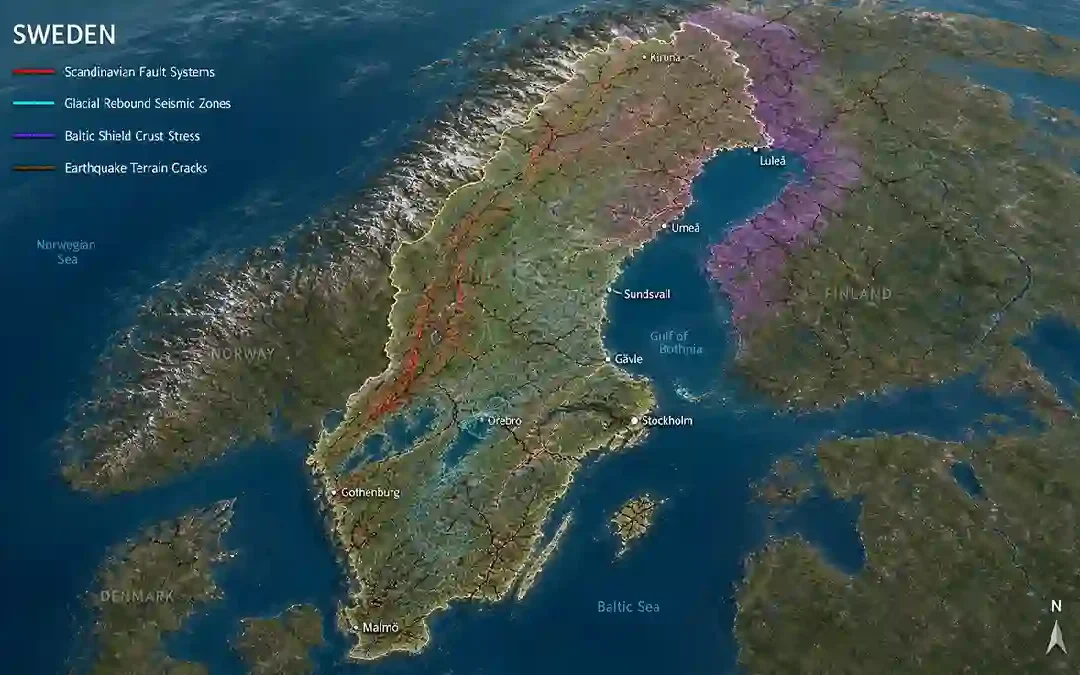
Sweden is often considered one of Europe’s most geologically stable countries. Yet earthquakes still happen here every year.
Most are small, but they reveal something important: The Scandinavian crust is still adjusting after the Ice Age.
Unlike countries near active plate boundaries, Sweden’s earthquakes are linked to ancient geological processes buried deep beneath the surface.
If you’re new to earthquakes, begin here → what is an earthquake
Sweden’s Main Seismic Regions
| Region | Risk Level | Main Cause |
|---|---|---|
| Northern Sweden | Moderate | Glacial rebound |
| Gulf of Bothnia Region | Moderate | Crust adjustment |
| Western Sweden | Low–Moderate | Ancient fault reactivation |
| Southern Sweden | Low | Stable crust |
| Baltic Sea Region | Moderate | Offshore stress zones |
Sweden’s earthquakes are mostly intraplate events rather than plate-boundary earthquakes
To understand how tectonic stress forms → fault lines
Why Do Earthquakes Happen in Sweden?
Sweden’s earthquakes are mainly caused by post-glacial rebound.
Here’s the simplified process:
- Massive ice sheets once covered Scandinavia
- The weight pushed the crust downward
- After the ice melted, the land slowly began rising again
- Stress built along ancient faults
- Small earthquakes continue as the crust adjusts
This slow rebound is still happening today.
Learn more → causes of earthquakes
Sweden’s Four Distinct Earthquake Systems (Unique Insight)
Glacial Rebound Zones (Sweden’s Main Seismic Source)
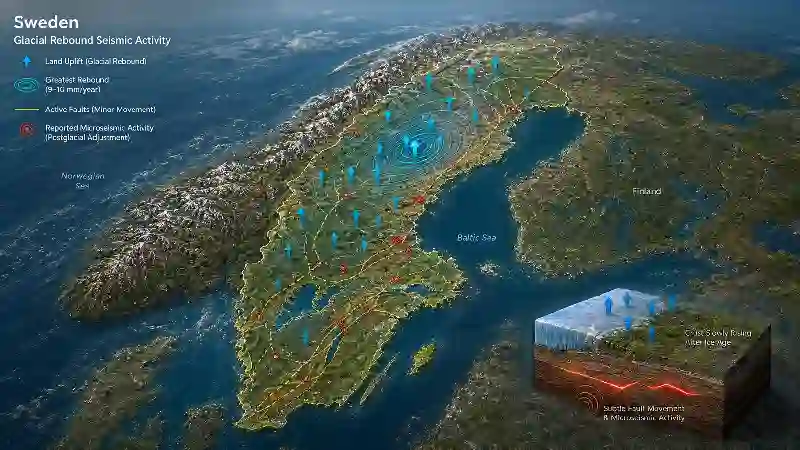
Northern Sweden continues to rise slowly after the Ice Age.
- Crustal uplift still ongoing
- Ancient faults reactivate occasionally
- Small earthquakes occur across the region
This is one of the clearest examples of glacial rebound earthquakes in Europe.
Explore earthquake types
Gulf of Bothnia Seismic Activity
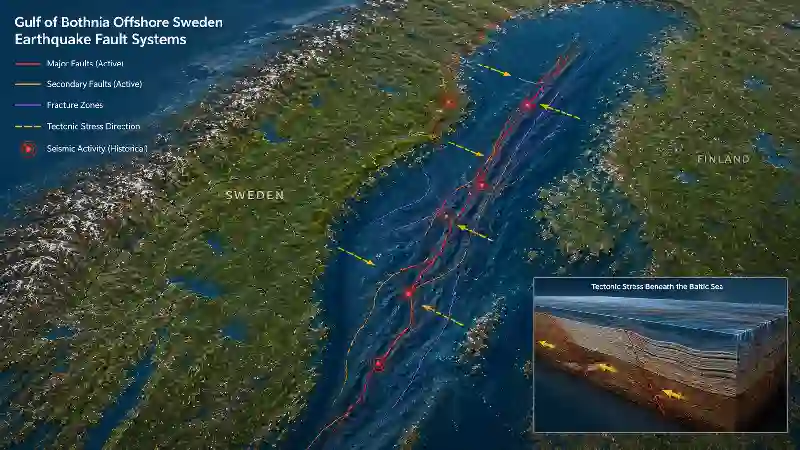
The Gulf of Bothnia region experiences measurable seismic activity.
- Offshore crust adjustment
- Small fault movements
- Ongoing post-glacial stress release
Western Sweden Fault Systems
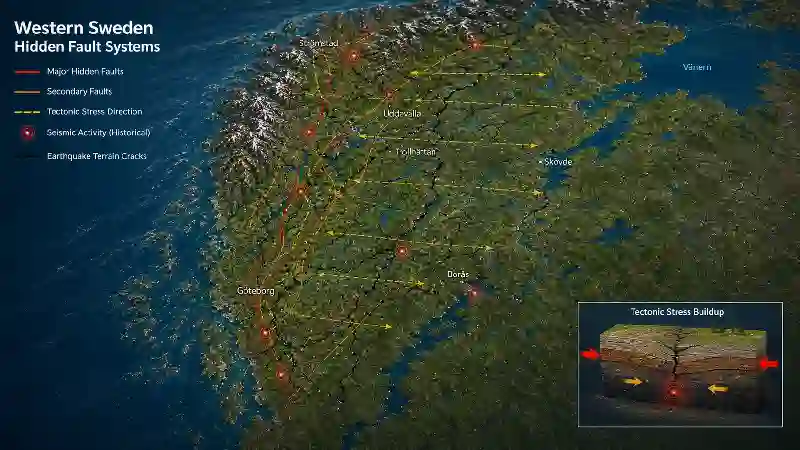
Western Sweden contains older fault structures beneath the crust.
- Ancient fault reactivation
- Mild earthquakes occasionally felt
- Most seismic activity remains weak
The Baltic Shield (Stable but Not Silent)
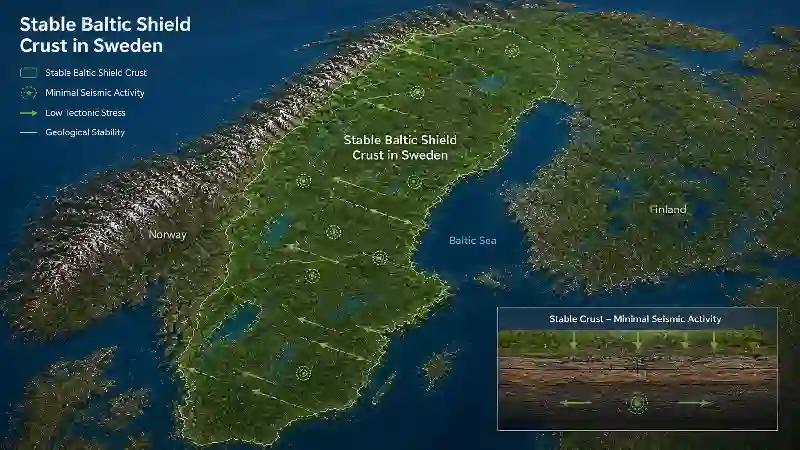
Sweden sits on the ancient Baltic Shield.
- Extremely old continental crust
- Very low tectonic movement
- Earthquakes are usually weak and infrequent
Recent Earthquake Activity in Sweden
Sweden experiences small earthquakes throughout the year.
Recent patterns show:
- Minor earthquakes in northern Sweden
- Offshore activity in the Baltic region
- Small intraplate earthquakes linked to crust adjustment
Most earthquakes are too weak to cause damage.
Notable Earthquakes in Sweden
Sweden rarely experiences strong earthquakes, but several events are historically important.
- 1904 Oslofjord Earthquake
Felt strongly across Sweden and Norway. - 1986 Skellefteå Earthquake
A notable northern Sweden earthquake. - Recent Northern Sweden Tremors
Small earthquakes continue to occur regularly.
Understand magnitude vs impact
Sweden vs Other Earthquake Regions
Sweden’s seismic activity is very different from active tectonic regions.
- Sweden → glacial rebound + ancient fault activity
- Norway → similar Scandinavian crust adjustment
- Iceland → volcanic + tectonic spreading
- California → transform faults like the San Andreas Fault
Sweden’s earthquakes are shaped more by Earth’s geological past than present-day plate collisions.
Can Earthquakes in Sweden Be Predicted?
No — earthquakes cannot be predicted precisely.
Scientists can:
- monitor seismic activity
- track crustal uplift
- study ancient fault systems
But exact timing remains uncertain.
Learn more → Can earthquakes be predicted
Mostly because the crust is still adjusting after the Ice Age.
Small earthquakes occur regularly, but strong earthquakes are rare.
Northern Sweden and regions near the Gulf of Bothnia.
No — most earthquakes are intraplate events linked to ancient faults.
Final Thoughts
Sweden’s earthquakes may be small, but they reveal an important geological story. Long after the glaciers disappeared, the Scandinavian crust is still slowly adjusting — and that movement continues to create stress beneath the surface.
Sweden is a reminder that earthquakes are not only caused by dramatic plate collisions. Sometimes, Earth’s ancient history is enough to keep the ground moving.