
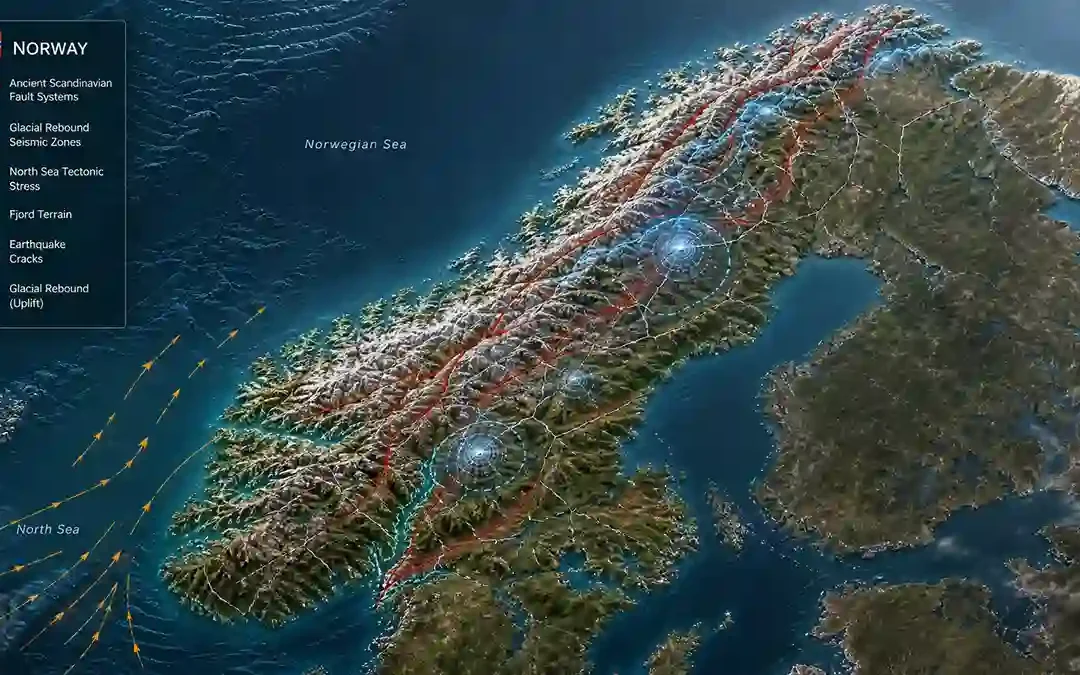
Norway is not located near a major tectonic plate boundary. Yet earthquakes still happen here.
The reason is surprisingly connected to something ancient: the Ice Age.
Thousands of years ago, massive glaciers covered Scandinavia. When those glaciers melted, the land slowly began rising again — and it’s still adjusting today. That slow movement continues to create stress deep underground.
If you’re new to earthquakes, begin here → what is an earthquake
Norway’s Main Seismic Regions
| Region | Risk Level | Main Cause |
|---|---|---|
| Western Norway | Moderate | Glacial rebound + ancient faults |
| Northern Norway | Moderate | Crustal adjustment |
| North Sea Region | Moderate | Offshore tectonic stress |
| Southern Norway | Low | Stable crust |
| Eastern Norway | Low–Moderate | Older fault systems |
Norway’s earthquakes are mostly caused by ancient crustal stress rather than active plate collisions.
To understand how faults form → fault lines
Why Do Earthquakes Happen in Norway?
Norway’s earthquakes are mainly linked to a process called glacial rebound.
Here’s the simplified explanation:
- Massive glaciers once covered Scandinavia
- The ice pushed down the Earth’s crust
- After the glaciers melted, the crust slowly rose upward
- Stress built along ancient faults
- Earthquakes occur when the crust adjusts suddenly
This process is still happening today.
Learn more → causes of earthquakes
Norway’s Four Unique Earthquake Systems (Most Distinctive Insight)
Glacial Rebound Earthquakes (Norway’s Unique Feature)
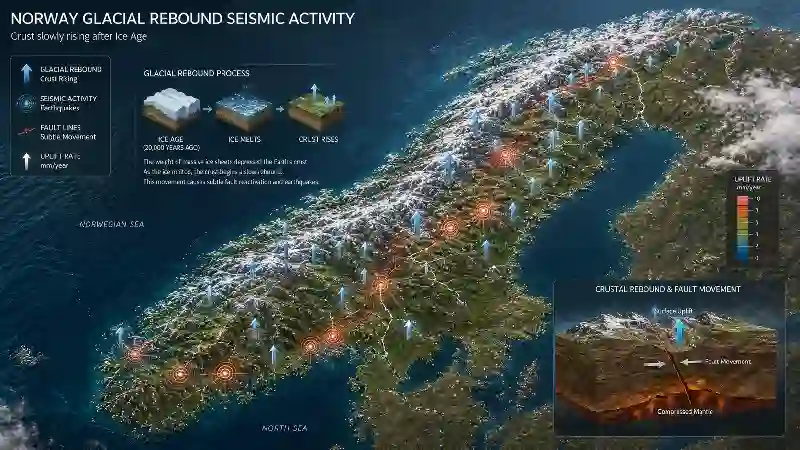
Norway’s seismic activity is strongly influenced by post-glacial adjustment.
- The crust is still rising slowly
- Ancient faults reactivate under pressure
- Small earthquakes continue across Scandinavia
Few regions in the world experience this type of long-term seismic adjustment so clearly.
Explore earthquake types
North Sea Offshore Earthquakes
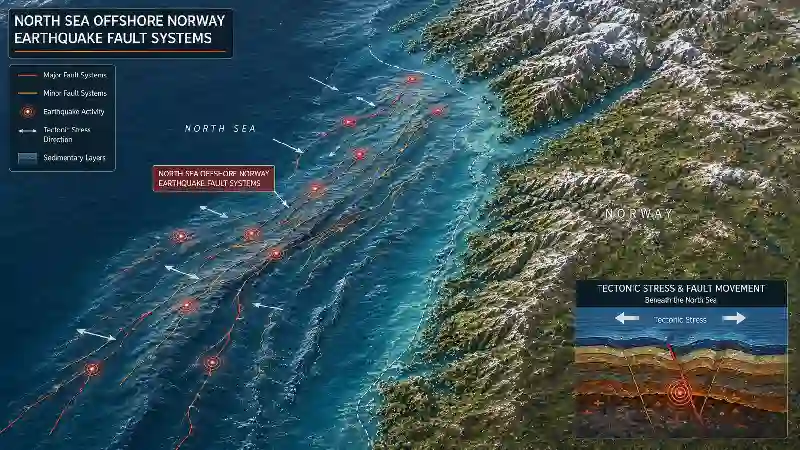
The North Sea region also experiences tectonic stress.
- Offshore fault systems
- Moderate seismic activity
- Ancient crustal structures remain active
This activity is linked to older tectonic processes beneath northern Europe.
Western Fjord Regions (Hidden Fault Activity)
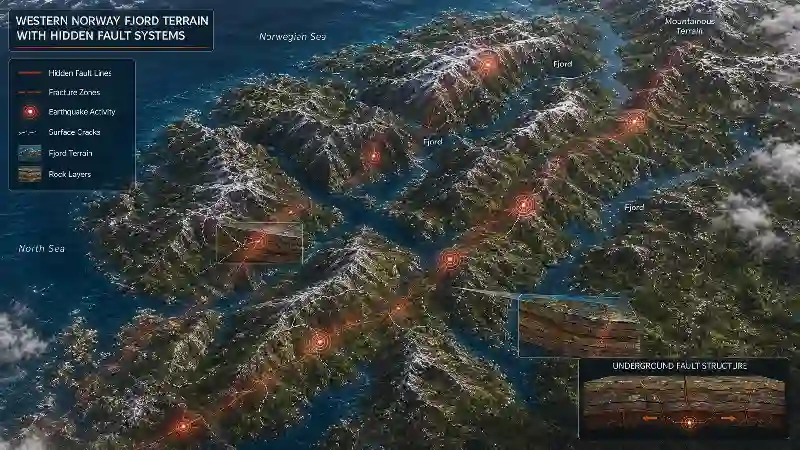
Western Norway contains older fault systems beneath mountainous fjord landscapes.
- Ancient crust fractures remain weak points
- Small earthquakes occur occasionally
- Stress concentrates beneath rugged terrain
Stable Interior Scandinavia
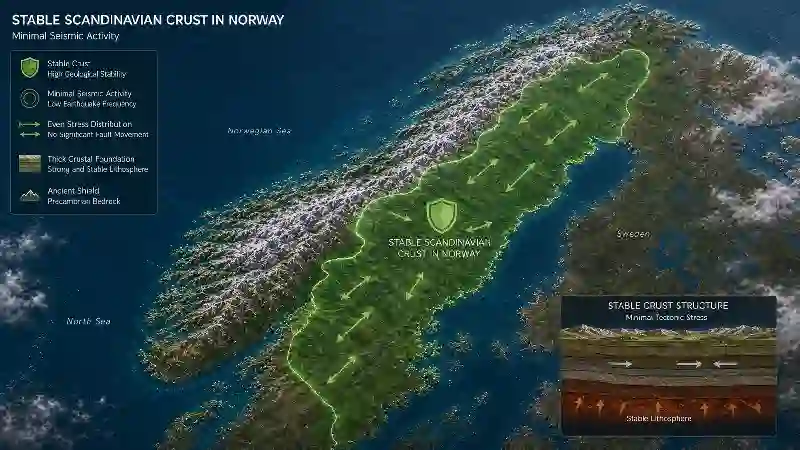
Large parts of Norway remain relatively stable.
- Very low seismic activity
- Ancient continental crust
- Earthquakes are generally weak and infrequent
Recent Earthquake Activity in Norway
Norway experiences small earthquakes regularly.
Recent patterns show:
- Offshore seismic activity in the North Sea
- Small earthquakes in western Norway
- Ongoing crustal adjustment across Scandinavia
Most earthquakes are minor and rarely cause damage.
Notable Earthquakes in Norway
Although Norway rarely experiences major earthquakes, some events have been significant.
- 1819 Lurøy Earthquake
One of Norway’s strongest historical earthquakes. - 1904 Oslofjord Earthquake (M5.4)
A notable earthquake affecting southeastern Norway. - Recent North Sea Earthquakes
Small offshore earthquakes detected regularly.
Understand magnitude vs impact
Norway vs Other Earthquake Regions
Norway’s earthquakes are very different from most major seismic zones.
- Norway → glacial rebound + ancient fault reactivation
- Iceland → volcanic and tectonic spreading
- Germany → intraplate fault activity
- California → transform faults like the San Andreas Fault
Norway’s seismic activity is shaped more by Earth’s ancient history than modern plate collisions.
Can Earthquakes in Norway Be Predicted?
No — earthquakes cannot be predicted precisely.
Scientists can:
- monitor seismic activity
- study crustal uplift
- map ancient fault systems
But exact timing remains uncertain.
Learn more → Can earthquakes be predicted
Mostly because the crust is still adjusting after the Ice Age.
Small earthquakes occur regularly, but strong earthquakes are rare.
Western Norway and offshore North Sea regions.
No — most earthquakes are intraplate events linked to ancient faults.
Final Thoughts
Norway’s earthquakes tell a very different geological story from places like Japan or Chile. Instead of active plate collisions, Norway’s seismic activity is tied to ancient glaciers, crustal rebound, and old fault systems hidden beneath the Scandinavian landscape.
That makes Norway one of the best examples of how Earth’s past can continue shaping seismic activity thousands of years later.