
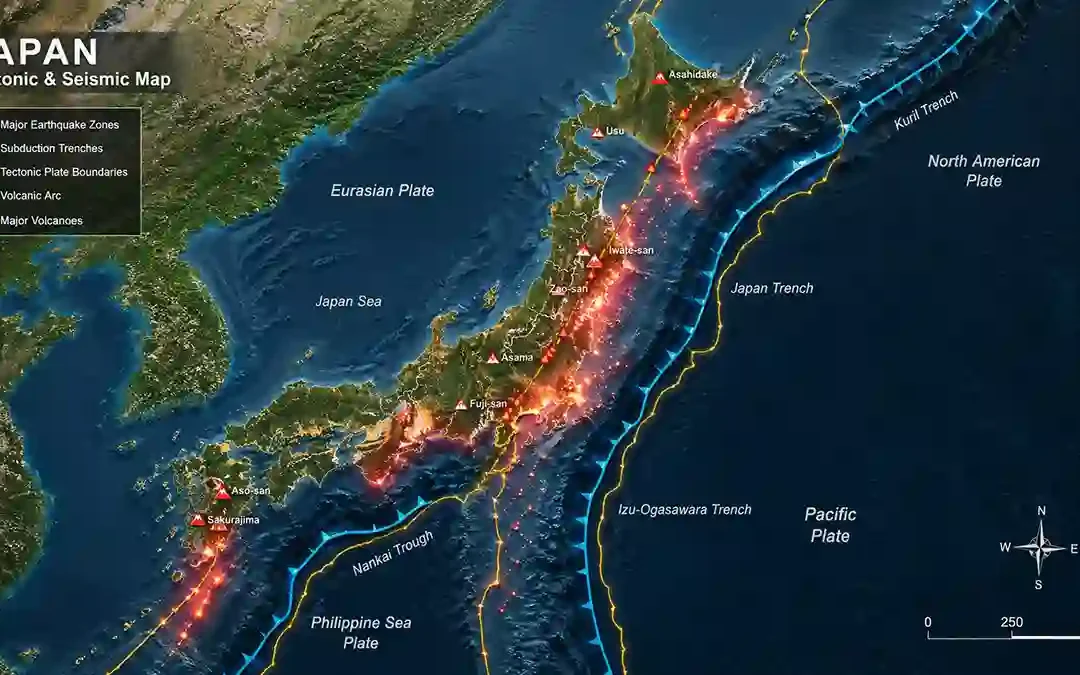
Japan is often described as one of the most earthquake-prone countries in the world. But what many people don’t realize is this:
Different parts of Japan experience earthquakes for completely different reasons. Some regions are controlled by deep ocean trenches. Others are shaped by inland faults or volcanic activity. That’s why earthquake behavior changes dramatically across the country.
If you’re new to earthquakes, begin here → what is an earthquake
Japan’s Main Earthquake Regions (Quick Overview)
| Region | Risk Level | Main Cause |
|---|---|---|
| Northeastern Japan | Extremely High | Japan Trench subduction |
| Central Japan | Very High | Complex plate interaction |
| Southwestern Japan | Very High | Nankai Trough subduction |
| Kyushu Region | High | Volcanic + tectonic activity |
| Hokkaido | Very High | Pacific Plate movement |
Japan sits where multiple tectonic plates meet at the same time. To understand how tectonic stress forms → fault lines
Why Does Japan Have So Many Earthquakes?
Japan lies directly on the Pacific Ring of Fire and sits near several tectonic plate boundaries.
The main plates involved are:
- Pacific Plate
- Philippine Sea Plate
- Eurasian Plate
- North American Plate
These plates constantly move, collide, and slide beneath one another. That creates one of the most active seismic systems on Earth.
Learn more → causes of earthquakes
Japan’s Five Major Earthquake Regions
Northeastern Japan (Japan Trench Zone)
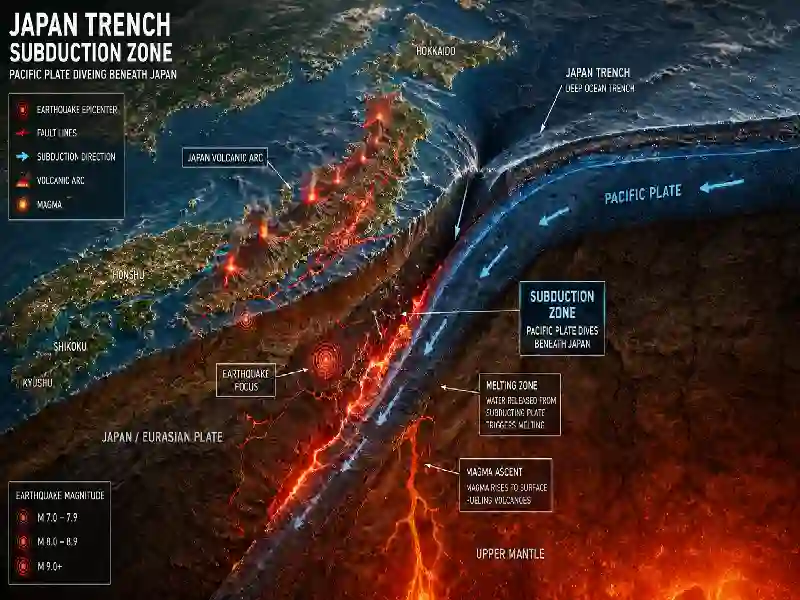
Northeastern Japan faces the Pacific Ocean and the Japan Trench.
- Pacific Plate dives beneath Japan
- Produces massive megathrust earthquakes
- High tsunami risk
This region experienced the 2011 Tōhoku Earthquake (M9.0).
Explore earthquake types
Central Japan (Complex Fault Interaction)
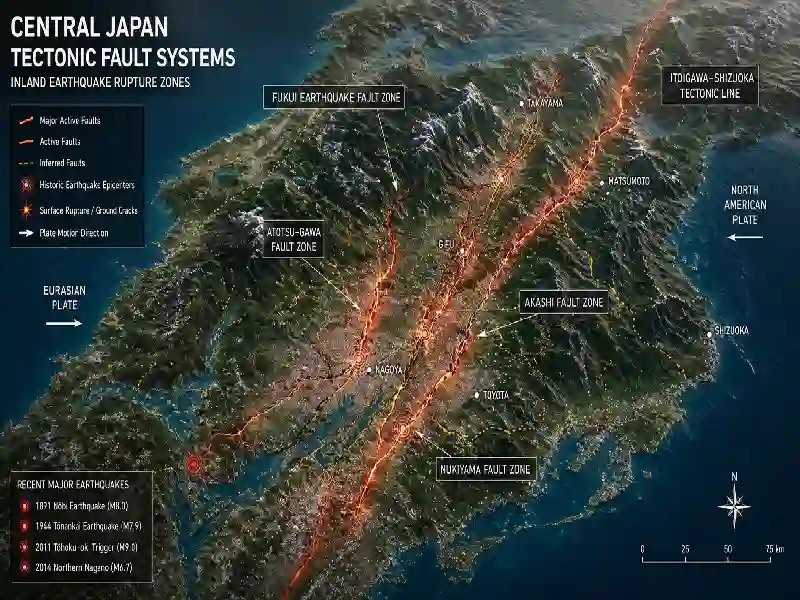
Central Japan is geologically complicated.
- Multiple plates interact nearby
- Inland faults are active
- Earthquakes can occur far from the coast
This region includes areas near Tokyo and the Japanese Alps.
Southwestern Japan (Nankai Trough)
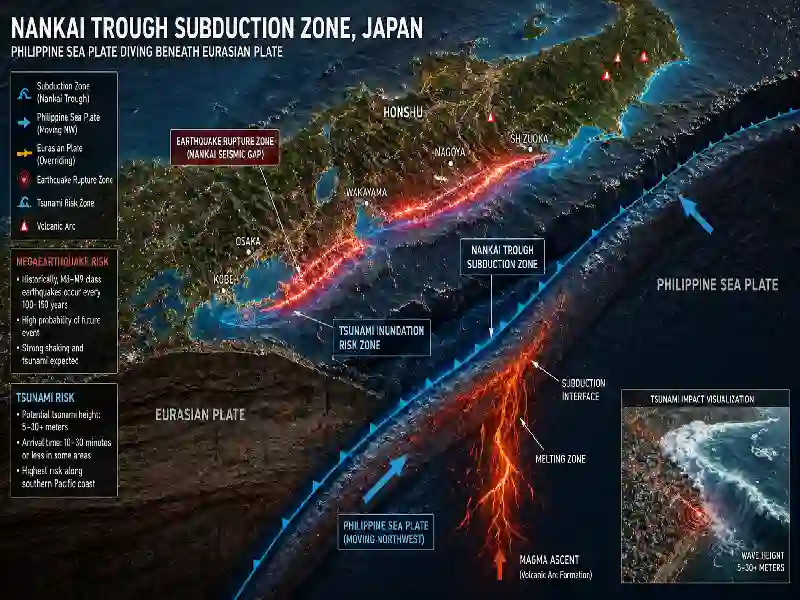
The Nankai Trough is one of Japan’s most closely monitored seismic zones.
- Philippine Sea Plate subduction
- History of repeated major earthquakes
- Potential for future megathrust events
Scientists closely monitor this region due to its long earthquake cycle.
Kyushu & Southern Japan (Volcanic Earthquakes)
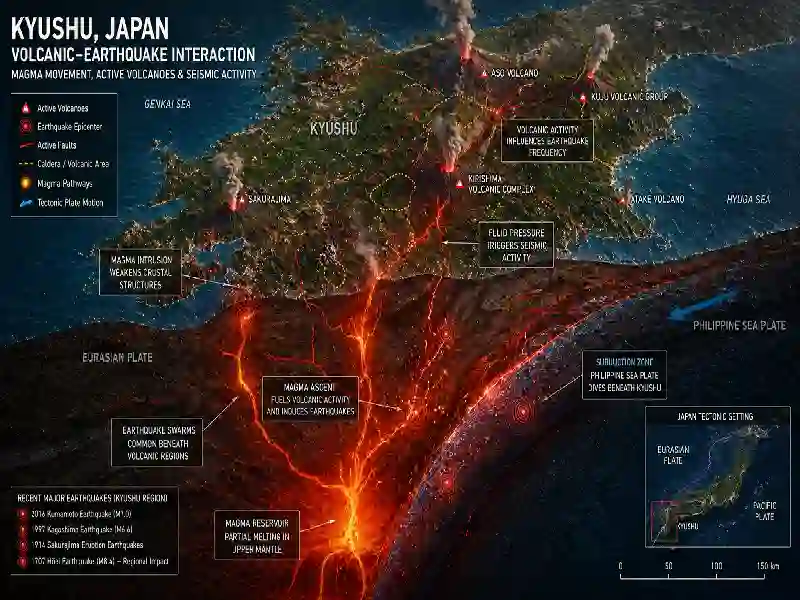
Southern Japan experiences both tectonic and volcanic earthquakes.
- Active volcanoes
- Magma movement underground
- Frequent earthquake swarms
This makes Kyushu different from purely tectonic regions.
Hokkaido Region (Northern Seismic Activity)
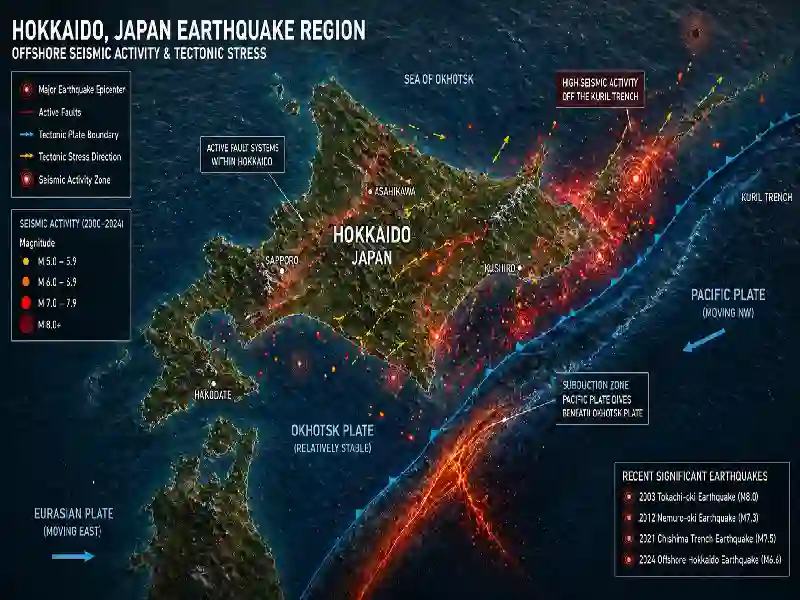
Hokkaido experiences strong seismic activity due to Pacific Plate movement.
- Offshore earthquakes common
- Cold-region tectonic activity
- Tsunami potential exists
Recent Earthquake Activity Across Japan
Japan experiences thousands of earthquakes every year.
Recent patterns show:
- Frequent offshore earthquakes
- Inland fault earthquakes
- Volcanic seismic swarms
- Aftershock sequences after major events
Most earthquakes are small, but strong earthquakes remain possible across multiple regions.
Major Earthquakes That Shaped Japan
Japan’s history includes some of the world’s most studied earthquakes.
- 2011 Tōhoku Earthquake (M9.0)
Triggered a devastating tsunami. - 1995 Kobe Earthquake (M6.9)
A destructive inland fault earthquake. - 1923 Great Kantō Earthquake (M7.9)
One of the deadliest earthquakes in Japanese history.
Understand magnitude vs impact
Japan vs Other Earthquake Regions
Japan’s seismic complexity is unusual.
- Japan → multiple subduction + fault systems
- Iceland → volcano + plate spreading
- Chile → dominant subduction zone
- California → transform faults like the San Andreas Fault
Few countries combine as many earthquake systems as Japan
Can Earthquakes in Japan Be Predicted?
No — earthquakes cannot be predicted precisely.
However, Japan has some of the world’s most advanced earthquake monitoring systems.
Scientists can:
- track seismic activity
- issue early warnings
- monitor plate movement
But exact timing remains impossible to know.
Learn more → Can earthquakes be predicted
Because several tectonic plates interact beneath the country.
Northeastern Japan and the Nankai Trough are considered extremely high-risk.
Yes — especially in central Japan.
Some are, especially in southern regions like Kyushu.
Final Thoughts
Japan’s earthquakes are not controlled by a single fault or trench. Instead, the country sits on a complex network of subduction zones, inland faults, and volcanic systems — all interacting beneath the surface. That’s why earthquake behavior changes from one region to another.
Understanding these regional differences helps explain why Japan remains one of the most important countries for earthquake research.